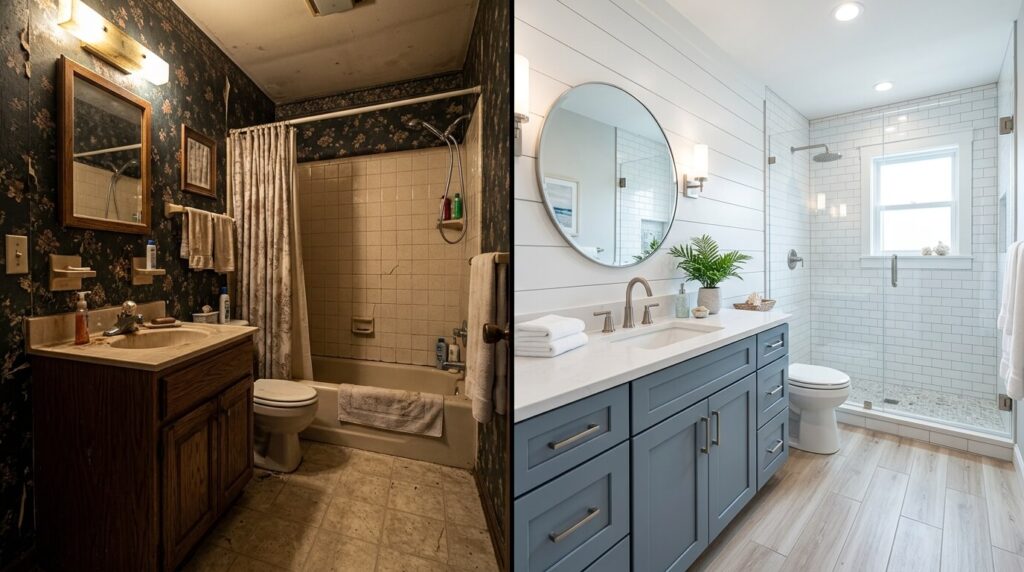
Discover expert coastal bathroom design ideas — from color palettes and tile choices to fixtures, storage, and décor. Transform your bathroom into a serene beachside sanctuary with this complete guide. There’s something undeniably magnetic about a bathroom that feels like the ocean found its way indoors. Maybe it’s the way soft blue-gray walls seem to breathe. Maybe it’s the warmth of a driftwood-toned vanity catching morning light. Whatever it is, the coastal bathroom has earned its place as one of the most enduringly beloved design styles — not just for beach houses, but for any home whose owner craves a daily retreat that actually feels like one.
But here’s the thing most guides won’t tell you: getting a coastal bathroom right is harder than it looks. Done poorly, it tips into kitschy souvenir-shop territory — plastic starfish, rope towel rings, anchors everywhere. Done beautifully, it’s the kind of space where you genuinely don’t mind getting up at 6 a.m.
This guide covers everything: the design principles, color strategies, material choices, tile decisions, lighting, storage, and finishing touches that separate a truly stunning coastal bathroom from one that just looks like someone went overboard at a nautical gift shop. Whether you’re planning a full remodel or just want to refresh what you have, you’ll find practical, actionable guidance here.
What Makes a Bathroom Truly “Coastal”?
The coastal design style draws from one simple idea: nature along the shoreline is inherently calming. Sand, sea, weathered wood, smooth stone, soft light — these are the building blocks. A well-designed coastal bathroom doesn’t replicate the beach; it distills the feeling of it.
Modern coastal design has evolved significantly. The old-school version was nautical — anchors, rope, blue-and-white stripes, ceramic lighthouses. The contemporary coastal aesthetic is far more refined. It leans into:
- Organic texture over literal ocean motifs
- Soft, layered neutrals rather than primary navy-and-white
- Natural materials — stone, wood, linen, woven accents
- Airiness and light as non-negotiable priorities
- Subtle references to the sea rather than direct representations of it
This is why coastal style continues to hold up decade after decade. At its core, it’s simply good design — calm, tactile, light-filled, and deeply livable.
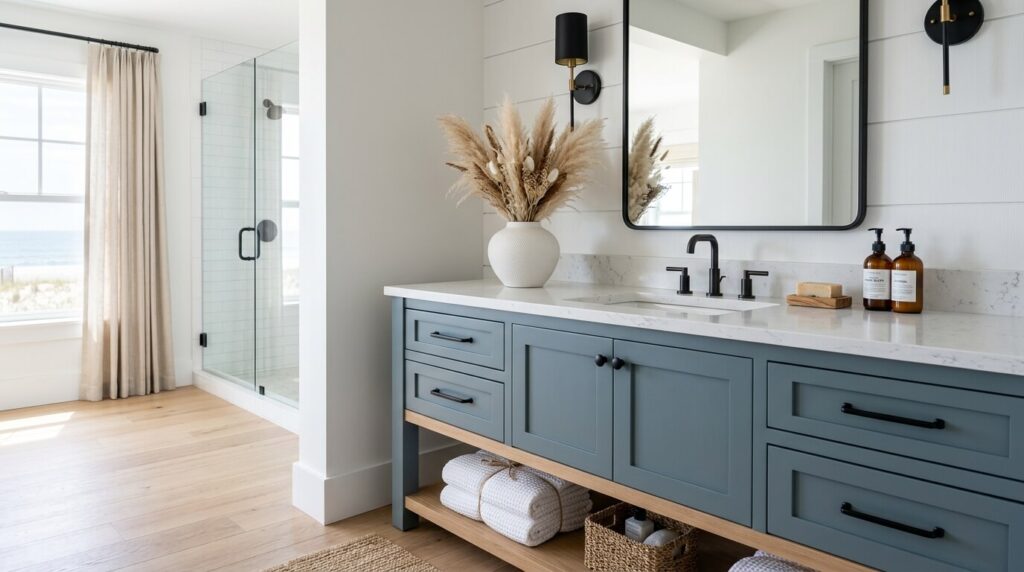
Coastal Bathroom Color Palettes: Going Beyond Basic Blue
Color is where most coastal bathrooms succeed or fail. Get this right, and everything else becomes easier.
The Foundation: Sand and Stone Neutrals
The smartest coastal bathrooms start with a warm neutral base, not white. Crisp white can work beautifully, but it reads colder and more clinical. Soft sand, warm greige, linen, and weathered cream better evoke the actual shore — and they give you far more flexibility with your accent colors.
Good foundation shades to consider:
- Warm white with yellow or pink undertones (not stark white)
- Sand beige
- Greige (gray-beige hybrid)
- Soft taupe
- Natural linen tones
The Accent Layer: Ocean-Inspired Color
This is where your coastal identity comes through. The instinct is often to go navy, but navy can feel heavy and dated in smaller bathrooms. The most successful coastal color palettes use mid-toned ocean hues — colors that read as the sea in different lights:
- Soft seafoam green — light, airy, and works equally well in bright or dim spaces
- Dusty sage — coastal with a slight botanical feel
- Pale aqua or turquoise — classic but elegant when muted
- Smoky blue-gray — sophisticated, especially on cabinetry
- Washed denim blue — warmer than navy, more casual and livable
One of the most versatile coastal cabinet colors you’ll encounter is something in the Sherwin-Williams Smoky Blue (SW 7604) family — a muted, soft blue that reads differently throughout the day. It avoids the darkness of navy while still delivering a rich, intentional color statement.
The Third Layer: Warm Accents
Coastal palettes can feel cold if you don’t introduce warmth. Warm wood tones, natural fiber textures, gold or brass hardware, and terracotta accents provide the counterbalance that keeps a coastal bathroom from feeling sterile.
Tile Choices That Define a Coastal Bathroom
Tile is arguably the single most impactful design decision in a bathroom. In a coastal space, the right tile does enormous heavy lifting.
Shower Wall Tiles
For shower walls, large-format matte tiles in marble-look porcelain are a workhorse choice. A 12×24 Carrara-look porcelain in a soft gray or warm white provides the clean, sophisticated base that lets your accent tiles shine. The matte finish matters — glossy tiles can read too slick and commercial; matte tiles feel more organic and natural, which aligns with the coastal aesthetic.
Accent and Floor Tiles
This is where you can get expressive. Some of the most stunning coastal bathrooms use a statement tile in a specific zone — the shower floor, a niche, or a feature wall. Options that work beautifully:
Scallop/Fan Tiles — Perhaps the most quintessentially coastal tile option. The organic, shell-like shape is a direct but elegant nod to the sea. These work especially well in shower pans or niches where they create visual drama without overwhelming the space. Look for options that mix matte and glossy tiles in the same sheet for added texture and depth.
Zellige-style tiles — Handmade-look tiles with subtle variation in color and surface. Their organic imperfection gives a coastal space the kind of authenticity that mass-produced tiles lack.
Pebble mosaics — Natural stone pebble tiles on shower floors mimic the feel of a riverbed or shoreline and provide excellent slip resistance. Their textural quality is unmatched.
Subway tile in herringbone — Classic, never boring when laid at an angle. White or soft gray herringbone in a shower creates movement and visual interest.
Wood-look porcelain planks — For bathroom floors, a wood-look tile in a warm greige (like an 8×48 plank format) gives the warmth of hardwood without the moisture risk. The elongated format also makes the room feel larger.
Practical Tile Notes
A few things worth knowing before you commit to any tile:
- Always check manufacturer ratings for intended use (floor vs. wall vs. wet areas)
- Tiles with more grout lines generally offer better slip resistance in shower floors
- Smaller tiles in shower pans are often safer than large format because of the extra grout lines
- Use stain-resistant grout (like Tec or similar brands) in coastal bathrooms — moisture and humidity make grout maintenance a real consideration
- For niche edges, a Schluter trim system gives a professional, clean finish
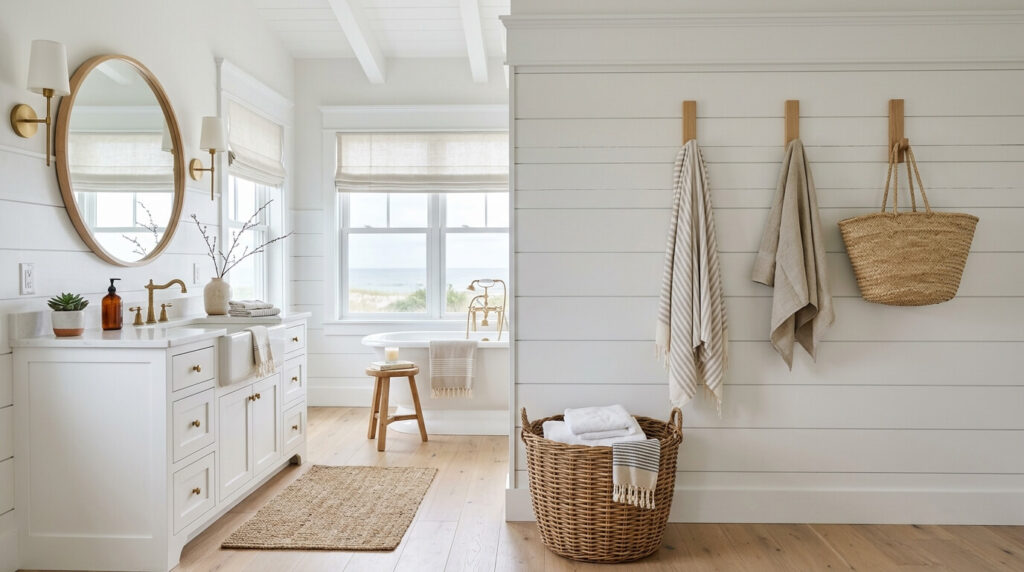
Vanity and Cabinetry: Where Coastal Character Lives
The vanity is the bathroom’s focal point. It’s often the first thing eyes land on, and it sets the tone for everything else.
Color
In a coastal bathroom, painted cabinetry is almost always more interesting than wood stain. The blue-gray spectrum is the sweet spot — from pale sky tones to richer dusty blues. The key is muted, slightly desaturated color rather than bright or primary hues. This is what separates a sophisticated coastal palette from a child’s nautical-theme bedroom.
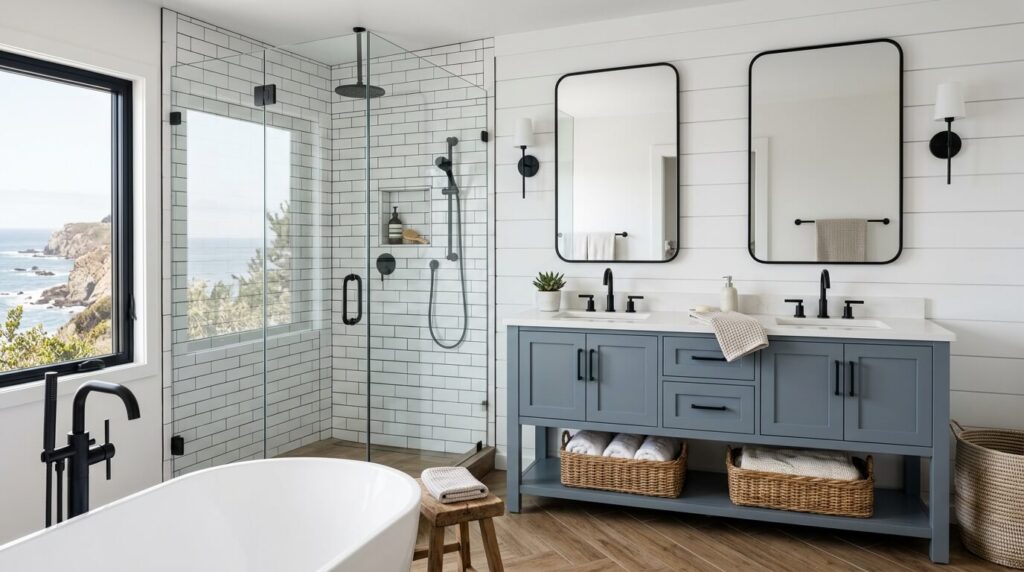
For a farmhouse-coastal hybrid, this painted cabinetry pairs especially well with shiplap, white quartz countertops, and matte black hardware.
Storage
One of the most underappreciated aspects of a great bathroom design is vertical storage. If you’re remodeling, floor-to-ceiling cabinetry next to the vanity is a game-changer — it gives you linen storage, toiletry organization, and a visual sense of height that makes the room feel larger. A tall linen cabinet around 18 inches wide won’t crowd the space but dramatically increases functionality.
Countertops
White quartz with subtle veining is the go-to for coastal bathrooms. It has the marble look without the porosity and maintenance demands of real marble. The veining should be subtle — heavy dramatic veining can compete with your tile choices rather than complementing them. For a slightly warmer feel, leathered quartzite or honed limestone offer beautiful organic texture.
Fixtures and Hardware: The Details That Tie It Together
Mixing Metals (Yes, It’s Allowed)
One design rule that has evolved significantly: you no longer need to match every metal finish in a room. In fact, mixing metals thoughtfully can add richness and depth. A common and successful combination in coastal bathrooms pairs matte black hardware on cabinetry with brushed stainless or brushed nickel in the shower. The contrast works because the finishes are different enough to read as intentional.
The key to making mixed metals work: limit yourself to two finishes, and be consistent within each zone (all cabinetry hardware in one finish, all shower fixtures in another).
Showerheads
A rain showerhead is a natural fit for the coastal aesthetic — it evokes the feeling of a warm summer shower in the best possible way. If budget allows, a ceiling-mounted rain head with a separate handheld wand gives you the spa experience while remaining extremely practical for everyday use and cleaning.
Faucets
Simple, clean-lined single-handle faucets work best in coastal spaces. Elaborate traditional designs with multiple curves and flourishes can feel out of place. Look for something with gentle curves rather than sharp angles, in brushed nickel, matte black, or satin brass depending on your overall palette.
Drains
Don’t overlook the drain. A square infinity drain (also called a linear drain) gives a shower floor an incredibly clean, updated look — and it pairs especially well with scallop or mosaic tiles because the geometric contrast is visually interesting.
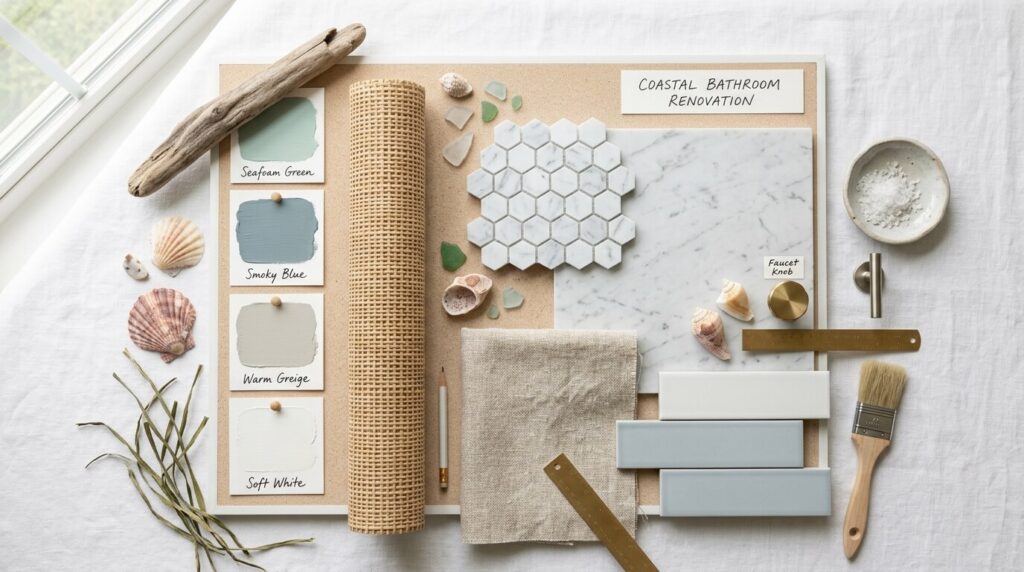
Shiplap in the Coastal Bathroom: How to Do It Right
Shiplap is a defining element of coastal farmhouse style. When used thoughtfully, it adds texture, warmth, and architectural interest that tile alone can’t provide. But there are practical concerns in a bathroom environment that need to be addressed.
Material Matters
Standard MDF is not appropriate for bathrooms — it absorbs moisture and will swell and deteriorate. The right choice is MDX board, which is an exterior-rated MDF designed to handle humidity. Pair it with a moisture-resistant paint (specifically formulated for bathrooms) and you’ll have a durable, beautiful surface.
If you want extra durability, PVC shiplap is another excellent option — it’s completely impervious to moisture and ideal for high-humidity areas.
Placement Strategy
Shiplap works beautifully as a focal wall — typically the wall facing the doorway, behind the vanity, or as an accent in an adjacent area that connects visually to the bathroom. Using shiplap in both the bathroom and an adjoining hallway or entryway (as one accent element) creates cohesion and makes smaller spaces feel more intentional and connected.
Keep shiplap away from direct water contact — it should not be inside the shower enclosure. Outside the wet zone, it’s both practical and beautiful.
Lighting Design: The Underrated Coastal Bathroom Element
Lighting is what most homeowners underinvest in, and it’s a mistake that makes even beautifully designed bathrooms feel flat.
Natural Light First
The coastal style depends on light — the whole aesthetic is built around the idea of a space that feels open, airy, and sun-kissed. If your bathroom has limited natural light, this becomes the first problem to solve. Strategies include:
- Larger or higher windows (where privacy allows)
- Frosted glass to allow light while maintaining privacy
- Skylights, which can be a transformative addition in bathrooms
Layered Artificial Lighting
Three layers of light work together in a well-designed bathroom:
Task lighting — Flanking the mirror with vertical sconces (rather than a single overhead bar) gives the most flattering, even light for grooming tasks. Position sconces at face height, roughly 60–65 inches from the floor to the center of the fixture.
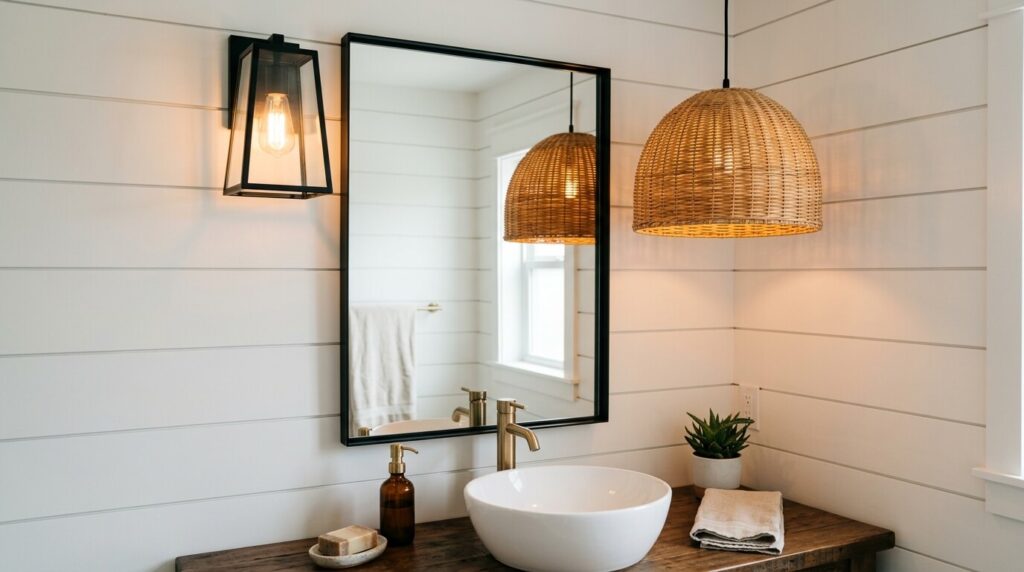
Ambient lighting — Recessed downlights or a flush ceiling fixture provide overall illumination. In a coastal bathroom, pendant lights can add character — something with rattan, woven material, or a simple geometric form fits the aesthetic.
Accent lighting — LED strip lighting under floating vanities, inside niches, or along mirror edges creates a spa-like glow and adds depth.
Bulb Temperature
Use bulbs in the 2700K–3000K range (warm white) for bathrooms. Cool daylight bulbs (4000K+) tend to feel clinical and wash out warm coastal tones.
Mirrors: Framed vs. Frameless and How to Choose
The mirror choice is often agonized over — and understandably so. It’s both functional and decorative, and it has to work in harmony with the vanity below it.
Framed mirrors give more personality. A thin black frame complements matte black hardware and adds visual definition. A driftwood-look frame reinforces the coastal material palette. For casual or farmhouse-coastal styles, a framed mirror almost always feels more appropriate than frameless.
Frameless mirrors read as sleeker and more modern. They work well in contemporary coastal styles where the design is more minimal and clean-lined.
Sizing rule: The mirror should be narrower than the vanity — leave at least 2–4 inches on each side. Vertically, a mirror that extends from just above the backsplash to a few inches below the ceiling creates a dramatic, custom-built feel.
Practical tip: If you’re choosing between a mirror and sconces vs. a medicine cabinet, consider a recessed medicine cabinet with a mirror face. It gives you hidden storage without sacrificing style.
Coastal Bathroom Flooring: What Works and What Doesn’t
Flooring sets the entire tone for a bathroom. In a coastal space, the goal is warmth, texture, and durability.
Best Options
Wood-look porcelain plank tile — The best of all worlds. It provides the organic warmth of wood with none of the moisture risk. An 8×48 or similar elongated format in a warm greige makes the room feel larger and works beautifully with blue or green cabinetry.
Natural stone tile — Travertine, limestone, and slate all have gorgeous texture and organic variation that suits the coastal aesthetic. Important caveat: natural stone requires sealing and more maintenance than porcelain. Not ideal for everyone.
Large-format porcelain in a stone or concrete look — A 24×24 or 18×36 tile in a warm stone look minimizes grout lines, making small bathrooms feel more expansive.
Pebble tile mosaics — Best used as an accent, particularly in shower pans, but can be used as a full floor in some applications. The texture is wonderful and genuinely evokes the shoreline.
What to Avoid
Real wood or laminate — Wood and bathrooms are a risky combination even with high-quality materials. Porcelain alternatives are simply smarter.
Very cold gray tiles — These can make a coastal bathroom feel industrial rather than serene. Warm your grays or choose a slightly warmer tile tone.
Coastal Bathroom Decor: The Finishing Layer
This is where many coastal bathrooms overcorrect. Less is significantly more.
What Works
Organic textures — A woven basket, a linen hand towel, a teak or bamboo bath mat, a terracotta pot with a small plant. These materials feel authentically coastal without being literal.
Live plants — Humidity-loving plants like ferns, pothos, snake plants, or air plants are perfect for bathrooms. They add life, color, and reinforce the nature-connected ethos of coastal design.
Single statement piece — A piece of abstract art in ocean tones, an interesting ceramic vessel, or a sculptural coral-inspired object reads as sophisticated and intentional. Multiple small items read as clutter.
Wood accents — A teak shelf, driftwood-look hooks, or a bamboo ladder for towels. Keep wood accents limited but impactful.
Candles — Simple, coastal-scented candles in neutral vessels add both ambiance and scent dimension without adding visual clutter.
What to Avoid
- Decorative anchors, ship wheels, or cartoon sea creatures
- Plastic or resin “coastal” accessories from mass retailers
- Overcrowding surfaces — in a coastal bathroom, negative space is part of the design
- Mixing too many patterns (one patterned element is enough)
Small Coastal Bathroom Design: Making It Work in Limited Space
Not everyone has a spacious master bathroom to work with. The good news is that the coastal aesthetic actually lends itself well to smaller spaces — the emphasis on light, openness, and simplicity helps a smaller room breathe.
Space-Expanding Strategies
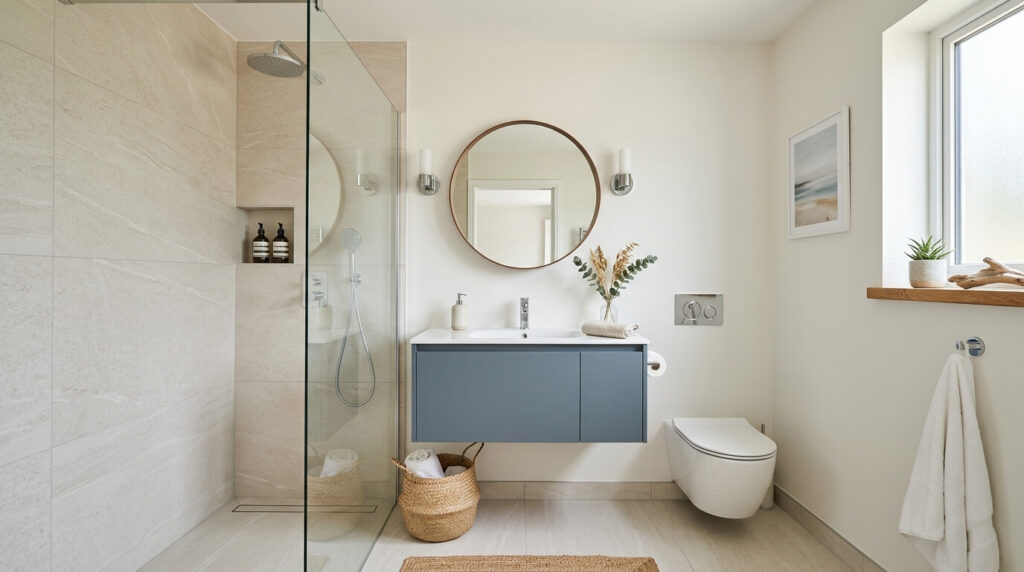
Frameless glass shower enclosure — Nothing opens up a small bathroom like a frameless glass shower door or panel. It allows sight lines to travel through the space uninterrupted.
Large-format floor tile — Counterintuitively, a bigger tile (24×24 or larger) in a small bathroom feels more expansive than small tiles because it has fewer grout lines breaking up the visual field.
Wall-mounted vanity — Floating vanities expose the floor beneath them, which makes the room feel larger. They’re also easier to clean.
Vertical storage rather than wide footprints — A tall, narrow linen tower takes up minimal floor space while adding substantial storage capacity.
Mirror strategy — In a small bathroom, a larger mirror does disproportionate work. A full-width mirror spanning the entire vanity wall creates the illusion of doubled space.
Consistent color palette — In a small space, fewer colors with more tonal variation feel calming and cohesive rather than choppy.
Common Coastal Bathroom Design Mistakes
Even with the best intentions, certain mistakes keep showing up in coastal bathroom renovations.
Mistake 1: Going too dark with the cabinetry color. Rich navy can look stunning in photos but absorb light in real bathrooms, making the space feel smaller and heavier. Opt for mid-toned blues and blue-grays instead.
Mistake 2: Matching every metal finish. This makes a bathroom feel flat and overly coordinated. Thoughtful mixing of two finishes adds the kind of lived-in depth that professional designers use intentionally.
Mistake 3: Using standard MDF shiplap in a humid bathroom. This is a durability issue that will cost you later. Specify MDX or PVC from the start.
Mistake 4: Choosing tile based on showroom lighting. Bathroom tile looks very different under natural light versus the bright display lighting in a tile showroom. Always bring a sample home and observe it at different times of day before committing.
Mistake 5: Neglecting grout color. White grout will stain. In a coastal bathroom, a soft warm gray grout is both more forgiving and more sophisticated. Tec grout and similar stain-resistant formulas are worth the investment.
Mistake 6: Overdoing the nautical theme. If your bathroom looks like a coastal gift shop, step back. The most beautiful coastal bathrooms use restraint — the ocean is evoked, not illustrated.
Mistake 7: Underinvesting in lighting. A single overhead fixture is never enough. Plan for at least two layers of light: task and ambient. The right lighting transforms how color and texture read in the finished space.
Coastal Farmhouse Bathroom: The Hybrid Style Explained
The coastal farmhouse aesthetic has become one of the most popular bathroom design directions, and for good reason — it blends the warmth and coziness of farmhouse style with the light, breezy quality of coastal design.
The defining characteristics of a successful coastal farmhouse bathroom:
- Shiplap as a wall treatment (the farmhouse element)
- Muted blue or blue-gray cabinetry (the coastal element)
- Matte black hardware (bridges both styles)
- Scallop or organic mosaic tile in the shower (coastal detail)
- White quartz countertops with subtle veining (clean and versatile)
- Wood-look floor tile in a warm greige (warmth from the farmhouse side)
The color story leans coastal (soft blues, whites, warm grays) while the architectural details lean farmhouse (shiplap, simple cabinetry profiles, organic textures). When these elements are balanced, the result is a bathroom that feels both relaxed and intentional.
Step-by-Step: Planning Your Coastal Bathroom Remodel
If you’re planning a full remodel, the sequence matters enormously.
Step 1: Define your style direction. Are you going classic coastal, coastal farmhouse, modern coastal, or something in between? Pull inspiration images and identify the 3–5 elements that appear consistently in the images you love.
Step 2: Set your budget and prioritize. Tile and cabinetry are the highest-impact investments. Lighting and hardware are relatively low cost for high visual impact. Décor is the last layer and doesn’t need to be resolved at the remodel stage.
Step 3: Choose your tile first. Many designers recommend starting at a tile showroom because the right tile can drive the entire design. Give yourself patience — the tile that drives the design often isn’t found on the first visit.
Step 4: Build your color palette around the tile. Once you have your hero tile, everything else — cabinet color, wall paint, countertop — can be selected to complement it.
Step 5: Select fixtures and hardware. Decide on your metal finish (or two finishes if you’re mixing) and apply it consistently.
Step 6: Plan your lighting. Work with an electrician early — adding sconces or repositioning fixtures is much easier before walls are closed.
Step 7: Add décor last. After everything is installed, live in the space for a few weeks before adding decorative accessories. You’ll have a clearer sense of what the room needs and what it doesn’t.
Coastal Bathroom Comparison Table: Design Element Choices
| Element | Classic Coastal | Coastal Farmhouse | Modern Coastal |
|---|---|---|---|
| Wall treatment | Painted or tile | Shiplap + paint | Tile or large format stone |
| Cabinet color | Soft aqua or seafoam | Smoky blue or dusty blue | White, warm gray |
| Hardware finish | Brushed nickel | Matte black | Brushed brass or chrome |
| Shower tile | Subway or Carrara | Scallop + Carrara | Large format marble-look |
| Floor tile | Pebble mosaic or travertine | Wood-look plank | Large format concrete or marble |
| Mirror | Driftwood frame | Black thin frame | Frameless or brass frame |
| Lighting | Rattan or woven pendants | Industrial-coastal pendants | Minimalist sconces |
Conclusion
A coastal bathroom done well is one of the most genuinely pleasurable spaces you can create in a home. It’s not about replicating the beach — it’s about distilling the feeling of being near it. The calm, the light, the organic textures, the sense that the world has slowed down a little.
The principles are consistent whether you’re working with a modest half bath or a sprawling master suite: start with a light, warm neutral base; bring in ocean-inspired color through cabinetry or accent tile; choose materials that feel natural and tactile; keep the palette focused; and resist the urge to over-decorate. Let the architecture and materials do the work.
Whether you’re drawn to a clean modern coastal look, the warmth of a coastal farmhouse blend, or a classic beachy palette, the core intent is the same — a bathroom that feels like your own private retreat, every single day.
Frequently Asked Questions
What is a coastal bathroom style?
A coastal bathroom is a design style inspired by the natural beauty of the shore — sand, sea, weathered wood, and stone. It typically features light and airy color palettes (whites, soft blues, seafoam greens, warm neutrals), natural materials, organic textures, and a calm, uncluttered atmosphere. Modern coastal design avoids overt nautical clichés like anchors or rope in favor of more refined, nature-inspired elements.
Is coastal style still popular in 2026?
Yes — the coastal aesthetic has evolved rather than faded. Contemporary coastal design is more refined and sophisticated than earlier versions, leaning into organic textures, muted palettes, and natural materials rather than nautical novelty items. Its emphasis on light, calm, and natural beauty keeps it relevant and widely appealing.
What colors work best in a coastal bathroom?
The most effective coastal palettes start with a warm neutral base (sand, linen, warm white, greige) and layer in muted ocean hues like soft seafoam green, dusty sage, pale aqua, or smoky blue-gray. Mid-toned blues work better than dark navy in most bathrooms, especially smaller ones. Warm wood tones and natural fiber textures add depth and prevent the palette from feeling cold.
What tiles are best for a coastal bathroom?
Versatile choices include: large-format Carrara-look matte porcelain for shower walls, scallop or fan tiles for shower floors or niches, wood-look porcelain planks for bathroom floors, and pebble mosaic tiles as accents. Always verify manufacturer ratings for the specific area of use (wall vs. floor vs. wet areas), and choose stain-resistant grout in a warm gray rather than white.
Can I use shiplap in a bathroom?
Yes, but material choice matters. Standard MDF will deteriorate in high-humidity environments. Use MDX board (exterior-rated MDF) or PVC shiplap for bathroom applications, paired with a moisture-resistant paint. Keep shiplap outside of wet zones (not inside the shower enclosure) and apply it as a focal wall or accent treatment.
How do I achieve a coastal farmhouse bathroom style?
Coastal farmhouse blends shiplap (the farmhouse element) with muted blue or blue-gray cabinetry, scallop or organic tiles, white quartz countertops, wood-look flooring, and matte black hardware. The color palette leans coastal (soft blues, whites, warm grays) while architectural details like shiplap and simple cabinet profiles add farmhouse warmth. The result is relaxed, cohesive, and livable.
What hardware finish is best for a coastal bathroom?
The most popular options are brushed nickel (classic coastal), matte black (coastal farmhouse, modern), and brushed brass (warm modern coastal). Mixing two finishes — such as matte black cabinet hardware with brushed stainless shower fixtures — is both acceptable and encouraged in modern design. Limit yourself to two finishes and apply each consistently within its zone.
How do I make a small bathroom look coastal?
Focus on light, openness, and visual continuity. Use a frameless glass shower enclosure to open sight lines, choose large-format floor tiles to reduce visual grout lines, consider a wall-mounted floating vanity, add a generously sized mirror, and keep the color palette tight (2–3 colors maximum). In a small space, restraint in décor is especially important — let the materials and fixtures create the character.
What is the difference between coastal and nautical style?
Nautical style is theme-based — it uses literal ocean symbols like anchors, ship wheels, ropes, and stripes. Coastal style is atmosphere-based — it evokes the feeling of the shore through color, texture, light, and natural materials without relying on representational objects. Modern coastal design is firmly in the atmosphere camp.
What lighting works best in a coastal bathroom?
Use layered lighting: task lighting (sconces flanking the mirror at face height), ambient lighting (recessed downlights or a ceiling fixture), and accent lighting where possible (under floating vanities or inside niches). Bulb temperature should be 2700K–3000K (warm white). Rattan, woven, or simple geometric pendant fixtures complement the coastal aesthetic beautifully.