
There’s a moment in every bathroom renovation when the excitement of picking finishes and fixtures gives way to the sobering reality of numbers. How wide can your vanity actually be? Is a 34-inch height really better than 32? And what happens if your cabinet is just two inches too deep?
Getting bathroom cabinet dimensions wrong doesn’t just look bad — it creates lasting friction every single day. A vanity that’s too tall leaves you craning your neck at the mirror. A cabinet that’s too deep blocks the toilet door. And one that’s too wide? You’re looking at a costly removal and reinstall.
This guide covers every dimension that matters for bathroom cabinets — standard vanity sizes, wall cabinet specs, medicine cabinet measurements, ADA accessibility requirements, clearance rules, and step-by-step measuring instructions. Whether you’re renovating a tiny powder room or outfitting a spacious master suite, you’ll find exactly what you need here.
What “Standard” Really Means for Bathroom Cabinet Dimensions
The phrase “standard size” gets thrown around a lot in the cabinet industry, but it’s worth unpacking. Standard dimensions aren’t laws — they’re benchmarks developed over decades of residential building practice, plumbing rough-in conventions, and ergonomic research.
Manufacturers build to these benchmarks because they fit the majority of bathrooms and make plumbing connections predictable. When you choose a standard-sized vanity cabinet, you can expect the drain rough-in, water supply lines, and wall clearances to line up with minimal adjustment. The moment you go custom, all of that convenience disappears — and the cost goes up accordingly.
That said, standard doesn’t always mean right for your specific space. Understanding the full range of what’s available, and why those ranges exist, is what separates a successful renovation from an expensive redo.
Standard Bathroom Vanity Cabinet Dimensions at a Glance
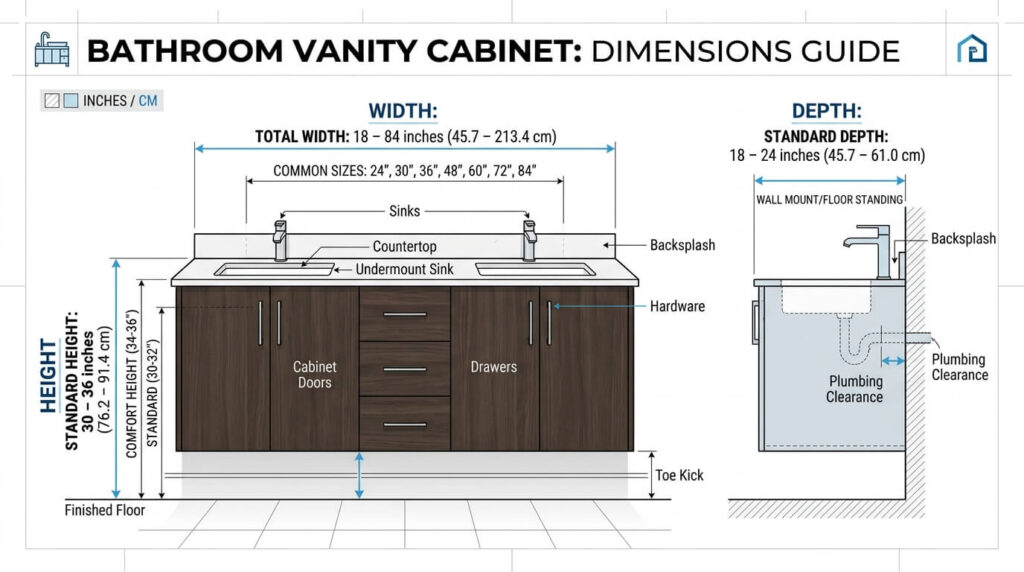
Before diving into the details, here’s a quick reference table for the three core dimensions of bathroom vanity cabinets.
| Dimension | Standard Range | Most Common Size | Notes |
|---|---|---|---|
| Width | 18″ – 84″ | 36″ (single sink) | Single-sink: 18″–48″; Double-sink: 60″–84″ |
| Height (base cabinet) | 30″ – 36″ | 32″–34″ | Countertop adds 1″–1.5″; vessel sinks need lower base |
| Depth | 18″ – 24″ | 21″ | Includes door/drawer face; countertop typically overhangs 1″ |
Bathroom Vanity Cabinet Width: Choosing the Right Fit
Width is usually the first dimension people focus on, and for good reason — it determines how much counter space, storage, and sink configuration you can accommodate.
Single-Sink Vanity Widths
Single-sink vanities are the workhorses of guest bathrooms, powder rooms, and smaller master baths. Here’s how each standard width plays out in real life:
- 18 inches: The absolute minimum for a functional vanity. Almost exclusively used in powder rooms, where counter space is secondary to fitting the space. Expect a compact circular basin and limited storage below.
- 24 inches: The smallest size considered practical for a bathroom someone uses daily. You’ll get a small rectangular sink and one or two cabinet doors below. Good for narrow spaces alongside a toilet.
- 30 inches: A step up that adds meaningful counter space without dominating a room. Works well in half-baths and smaller full bathrooms where a single user needs functional but not spacious storage.
- 36 inches: The sweet spot for most single-sink bathrooms. Enough room for a properly sized sink, reasonable counter space on one side, and drawer or cabinet storage. This is the size designers most often default to for full-bathroom renovations.
- 48 inches: Moves toward the generous end for a single-sink cabinet. You’re getting significant counter and storage space — great for a bathroom one person uses heavily. Some people split the sink toward one end and use the remaining counter as a dedicated grooming station.
Double-Sink Vanity Widths
Double-sink vanities shift the minimum width considerably because two basins need adequate spacing. Crowding two sinks into a too-narrow cabinet is one of the most common bathroom design mistakes — users end up bumping elbows and fighting for mirror space.
- 60 inches: The entry point for double-sink vanities. Two people can use this comfortably, but the spacing between sink centers (ideally 30 inches or more) will feel snug. Works in master bathrooms where the overall space is moderate.
- 72 inches: The most popular double-sink width. Sinks are spaced comfortably, each user has elbow room, and there’s storage between and around both basins. This is the standard recommendation for a shared master bath.
- 84 inches and beyond: Moves into luxury territory. Common in large master suites and high-end renovations. At this width, designers sometimes add a center section of drawers or a decorative element between the two sink areas.
Key rule for double sinks: The center of one sink to the center of the other should never be less than 30 inches. Ideally, 36 inches feels most comfortable.
Bathroom Vanity Cabinet Height: The Measurement Most People Get Wrong
Height is the dimension where people most often make mistakes — and the one they regret longest, because it affects posture and comfort every single time they use the sink.
Traditional vs. Comfort Height
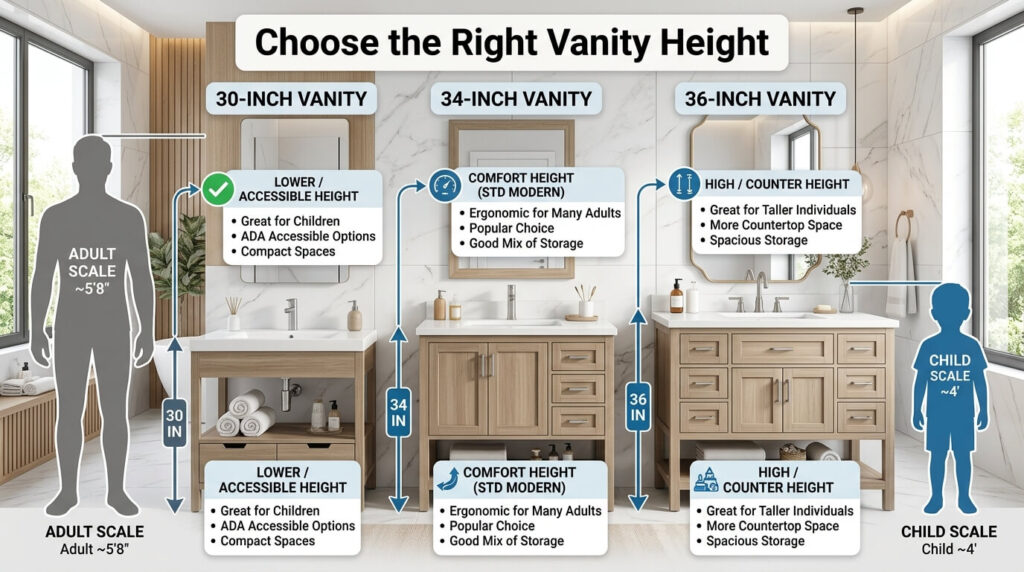
For most of the twentieth century, bathroom vanity cabinets were built to 30–32 inches, which made sense when average human height was lower and ergonomic research was limited. Today, that height feels uncomfortably low for many adults. Bending over a 30-inch vanity to wash your face is hard on your lower back over time.
The shift toward what’s now called “comfort height” — 34 to 36 inches — mirrors what happened in the kitchen: countertop heights moved up to 36 inches decades ago and nobody looked back. Bathroom vanities are following the same trend.
Here’s how to think about vanity cabinet height for your situation:
| Cabinet Height | Total Height with Top | Best For |
|---|---|---|
| 30″ | ~31.5″ | Children’s bathrooms; vessel sinks (adds height) |
| 32″ | ~33.5″ | Traditional style bathrooms; shorter adults |
| 34″ | ~35.5″ | Most adults; growing trend in new construction |
| 36″ | ~37.5″ | Taller adults; comfort-focused renovations |
Note: These heights represent the cabinet base itself. Adding a standard 1–1.5 inch countertop brings the total usable surface height up accordingly.
Vessel Sinks Change the Calculation Completely
If you’re planning to use a vessel sink — those above-counter bowls that have become popular in contemporary design — your base cabinet needs to be shorter, not taller. A vessel sink typically adds 5 to 7 inches of height on top of the counter surface. Pair one with a 36-inch vanity cabinet and a 1.5-inch countertop, and you’re looking at a total height of 42–45 inches. That’s too high for comfortable use.
The general rule: subtract 4 to 6 inches from your desired total height to find the right cabinet height for a vessel sink setup. Most vessel sink vanities are built to 28–30 inches.
ADA-Compliant Vanity Heights
The Americans with Disabilities Act specifies that accessible sink surfaces should be no higher than 34 inches from the floor, with knee clearance underneath for wheelchair users. If you’re building an accessible bathroom — or simply future-proofing your space — a wall-mounted vanity at 32–34 inches is the standard approach, with at least 27 inches of knee clearance below.
Bathroom Vanity Cabinet Depth: The Dimension Nobody Talks About Enough
Depth is the least glamorous of the three dimensions, but it’s arguably the one that causes the most problems when it’s wrong. A too-deep cabinet blocks toilet access, interferes with door swings, and makes a small bathroom feel claustrophobic. Too shallow, and users can’t comfortably reach faucets or get adequate counter space.
Standard Depth Ranges
- 18 inches: The minimum practical depth for a functional vanity. Used in very narrow bathrooms and hallway-style layouts. Shallow enough that countertop space is limited; often paired with wall-mounted faucets.
- 21 inches: The sweet spot that most manufacturers target. Provides enough depth for a standard undermount or drop-in sink, comfortable faucet reach, and usable counter space without projecting aggressively into the room.
- 24 inches: Slightly deeper than standard, sometimes used in larger bathrooms where extra counter space is a priority. Common in custom installations.
The countertop typically overhangs the cabinet face by about 1 inch at the front, so a 21-inch cabinet with a countertop projects roughly 22 inches from the wall.
Why Depth Affects Everything Downstream
Here’s what many renovation guides miss: depth is the dimension most likely to conflict with other elements in the bathroom. Before settling on your cabinet depth, measure each of these:
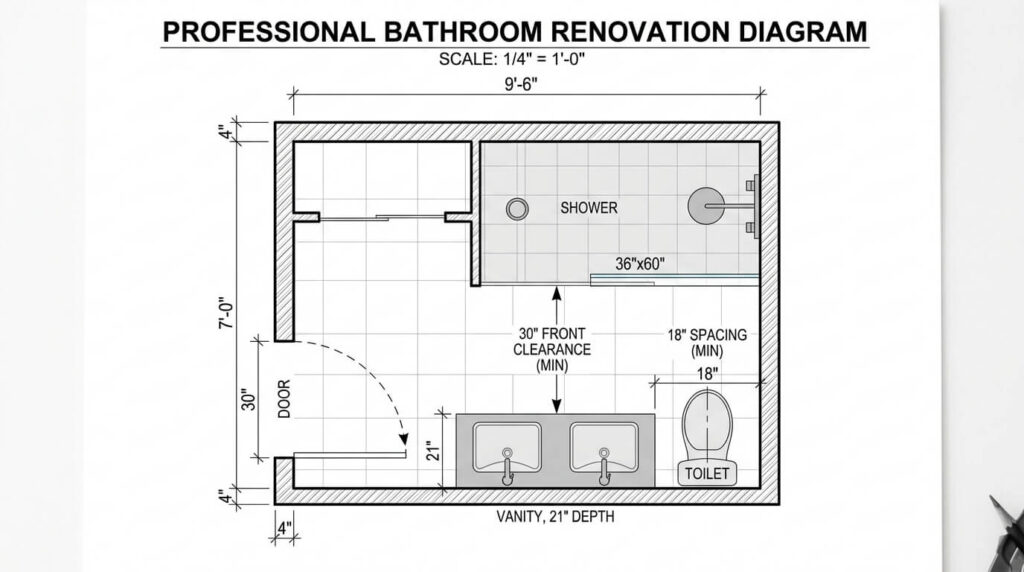
- Distance from the vanity wall to the toilet: If your toilet is positioned on the same wall run as the vanity, the cabinet depth plus required clearance (typically 18 inches from the cabinet side to the toilet center) will determine your maximum width.
- Door swing radius: A bathroom door swinging inward can easily collide with a too-deep vanity. Measure from the hinge point and trace the full arc — the cabinet shouldn’t fall within it.
- Shower or tub clearance: The space between the front of your vanity and the nearest fixture edge should be at least 30 inches for comfortable movement, 36 inches if you want it to feel spacious.
Wall Cabinet Dimensions: Upper Storage Over the Toilet and Sink
Many bathroom renovation guides focus entirely on vanity base cabinets and ignore the equally important wall-mounted storage above the toilet, above the vanity, or flanking the mirror. These upper cabinets follow different dimensional conventions.
Standard Bathroom Wall Cabinet Sizes
Width: Upper bathroom wall cabinets typically come in widths of 12, 18, 24, and 30 inches. Over-toilet cabinet units are often 24–30 inches wide to clear the tank while maximizing storage.
Height: Standard bathroom wall cabinet heights are 24, 30, and 36 inches. Taller units provide more storage but can feel overwhelming in a small bathroom.
Depth: This is where bathroom wall cabinets differ significantly from kitchen wall cabinets. Kitchen uppers are typically 12 inches deep; bathroom wall cabinets are shallower — usually 4 to 7 inches — to avoid head collisions and maintain visual proportion. Some open-shelf bathroom wall units go as shallow as 3.5 inches.
Installation Height for Bathroom Wall Cabinets
The bottom of a bathroom wall cabinet should sit at least 18 inches above the countertop when mounted above a vanity. This provides enough mirror and counter access without the cabinet feeling like it’s looming overhead. Over the toilet, the bottom of the cabinet should be no lower than 12 inches above the tank lid.
Medicine Cabinet Dimensions: Recessed vs. Surface Mount
Medicine cabinets occupy a unique dimensional niche because they serve double duty as mirror and storage, and their installation type — recessed into the wall versus mounted on it — dramatically affects the usable space around them.
Standard Medicine Cabinet Sizes
| Type | Typical Width | Typical Height | Typical Depth |
|---|---|---|---|
| Single-door | 14″–18″ | 24″–30″ | 3.5″–6″ |
| Two-door | 24″–30″ | 24″–36″ | 3.5″–6″ |
| Three-door | 36″–48″ | 28″–36″ | 3.5″–6″ |
Recessed Medicine Cabinets
A recessed medicine cabinet fits inside the wall cavity, with its face flush to the wall surface. This eliminates any projection into the room — a major advantage in tight bathrooms. The standard wall cavity depth between studs is 3.5 inches (2×4 framing) or 5.5 inches (2×6 framing). Most recessed medicine cabinets are designed for one of these depths.
The tricky part: recessed installation requires cutting between studs, which means your cabinet width is constrained to the stud spacing (typically 16 inches on center, giving you roughly 14.5 inches of usable opening). Wider recessed units require either relocating or removing studs, which becomes a structural and cost consideration.
Surface-Mount Medicine Cabinets
Surface-mount units attach to the wall face and project outward, typically 4 to 6 inches. This projection can feel intrusive in a small bathroom but is far simpler to install. You’re not limited by stud placement, so wider units are easier to accommodate.
Linen Cabinet Dimensions: Tall Storage That Transforms a Bathroom
Freestanding or built-in linen cabinets — tall, narrow storage towers positioned in bathroom corners or flanking vanities — are an underused solution in bathrooms that lack under-vanity storage. They follow different dimensional conventions than base vanities.
Standard Linen Cabinet Sizes
- Width: 12, 18, and 24 inches are most common. 12-inch units fit in narrow corners; 24-inch units provide meaningful storage.
- Height: 60, 72, and 84 inches. An 84-inch linen cabinet nearly reaches a standard 96-inch ceiling, maximizing vertical space.
- Depth: 12 to 18 inches, shallower than a vanity base. This keeps the cabinet from projecting too far into the room.
Linen cabinets are the most space-efficient addition to a bathroom if your vanity is too narrow for adequate storage. A 12 x 84-inch tower in a corner can hold as much as a much wider base cabinet without occupying floor space in the main traffic path.
Bathroom Cabinet Clearances: The Numbers Builders Know but Most Homeowners Don’t
Here’s a dimension-adjacent reality that most guides gloss over: the clearances around your cabinets matter as much as the cabinet dimensions themselves. Even a perfectly-sized vanity will feel cramped if the surrounding clearances aren’t respected.
Required and Recommended Clearances
| Location | Minimum Clearance | Recommended |
|---|---|---|
| In front of vanity | 21″ | 30″+ |
| Vanity side to toilet centerline | 15″ | 18″–21″ |
| Vanity side to wall or obstruction | 4″–6″ | 6″+ |
| Door swing (bathroom entry) | Full arc + 2″ | Clear of all fixtures |
| Shower or tub edge to vanity | 24″ | 30″+ |
| Cabinet top to light fixture | 6″ | 8″+ |
The 21-inch minimum in front of the vanity is the baseline from most building codes. In practice, anything under 30 inches will feel restrictive during daily use. If your vanity depth or width choice forces a clearance under 30 inches, that’s a signal to reconsider.
How to Measure Your Bathroom for Cabinet Dimensions
Knowing standard sizes is only half the battle. Translating those numbers into your actual bathroom requires precise, systematic measuring. Here’s how to do it without making the mistakes that lead to cabinets that don’t fit.
What You’ll Need
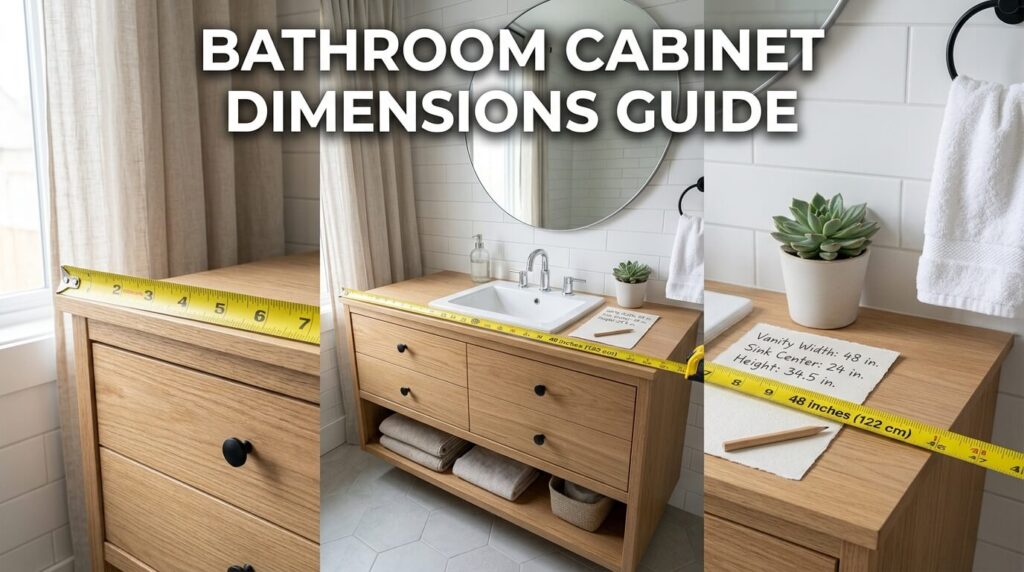
- A tape measure (25-foot minimum)
- A notepad and pencil (phone notes work fine but paper doesn’t run out of battery mid-measure)
- A level (useful for checking walls)
- A flashlight (plumbing and electrical locations can be in dark areas)
Step 1: Map the Full Room
Start by sketching a rough top-down floor plan of the bathroom. It doesn’t need to be to scale, but it should note every wall, every door (with swing direction), every window, and the locations of the toilet, tub, and shower. This bird’s-eye view prevents the common mistake of measuring one wall in isolation and missing conflicts on adjacent walls.
Step 2: Measure Available Width
Measure the width of the wall where the vanity will be installed, wall-to-wall. Then account for any interruptions: doors, heating vents, outlets, windows, and the clearance needed from adjacent fixtures. The number that remains is your maximum vanity width. Subtract 1–2 inches for installation wiggle room.
Step 3: Locate Plumbing Rough-Ins
For a new installation or replacement, you need to know where the drain stub-out comes through the floor or wall, and where the hot and cold supply lines are. These locations constrain your sink position, which constrains your vanity layout. Mark them on your sketch. For standard vanities, the drain is typically centered on the vanity width; for off-center or double-sink configurations, this changes.
Step 4: Measure Depth Constraints
Measure from the vanity wall to the nearest obstruction directly in front of where the cabinet will sit. Common obstructions: the toilet front, a door in swing range, or the shower threshold. Your cabinet depth cannot bring your total depth (cabinet + countertop overhang + any clearance allowance) beyond that point.
Step 5: Measure Height Constraints
Measure from the floor to the lowest ceiling obstruction (light fixture, ventilation fan, sloped ceiling). For most bathrooms this isn’t a constraint on base vanities, but for tall linen cabinets or wall-hung units, it matters. Also note the height of any existing electrical outlets on the vanity wall — outlet placement affects mirror and medicine cabinet positioning.
Step 6: Check the Floor for Level
Bathrooms with tile floors are often not perfectly level. A 1/4-inch variation across a 60-inch vanity width is enough to create visible gaps or cause cabinet doors to swing open on their own. Check your floor with a level and note where the high point is. Your cabinet installer needs to know this for shimming.
Choosing Dimensions for Different Bathroom Types
Not all bathrooms are alike, and the right cabinet dimensions depend heavily on the room’s purpose and the people using it.
Powder Room (Half Bath)
Space is the primary constraint. A powder room typically has only a toilet and a small vanity — no tub or shower. Width options: 18–30 inches. Depth: 16–21 inches. Height: can be shorter at 30–32 inches since it’s typically used by guests who are just washing hands. A wall-mounted vanity in a powder room dramatically opens up the floor, which makes small spaces feel significantly larger.
Guest Bathroom
Gets occasional use, so storage needs are lower than a daily-use bathroom. A 30–36-inch single-sink vanity at 32–34 inches high with 21 inches of depth handles almost every guest bathroom layout comfortably.
Children’s Bathroom
Height becomes important. A standard 32-inch vanity with a 1.5-inch top gives you a working surface at 33.5 inches — which is manageable for kids but may require a step stool for younger children. Some families choose 30-inch-height vanities for kids’ bathrooms and adjust up in later renovations. Durability of materials matters here too; solid wood and plywood construction hold up better than particleboard to the abuse children’s bathrooms take.
Master Bathroom
This is where you have room to invest in comfort. A comfort-height cabinet at 34–36 inches, a width of 48–72 inches (single or double sink), and a 21-inch depth is the sweet spot. If you have two users, go double-sink at 60 inches minimum — 72 inches if the space allows. Consider storage deeply: how many people use this bathroom, do they share or have separate zones, and what items need to be accessible versus stored?
Accessible or Universal Design Bathroom
ADA guidelines inform, but shouldn’t limit, accessible bathroom design. A wall-mounted vanity at 32–34 inches with 27 inches of knee clearance below is the foundation. The vanity width should be sufficient for a roll-under sink configuration. Avoid cabinets with toe kicks that prevent wheelchair footrests from sliding under. Choose lever-style hardware over knobs for easy operation.
Cabinet Types and How They Affect Dimensional Planning
Freestanding Vanity Cabinets
These sit on their own legs or base and aren’t attached to the wall (beyond securing for stability). They’re the easiest to install and remove, but they use floor space below and create cleaning challenges. Dimensional range is the widest of all cabinet types: 18 to 84+ inches.
Wall-Mounted (Floating) Vanity Cabinets
Attached directly to wall studs with no floor contact. The major dimensional advantage: installation height is fully adjustable, making them ideal for custom comfort-height setups and accessible designs. They create a visual lightness in the room. The catch: they require solid wall blocking or direct stud attachment, which can be tricky in retrofit situations. Maximum weight capacity varies by manufacturer and installation method; heavy stone countertops require additional wall support.
Freestanding vs. Floating: Key Dimensional Differences
| Feature | Freestanding | Wall-Mounted |
|---|---|---|
| Height flexibility | Fixed by manufacturer | Fully adjustable |
| Floor clearance | None (sits on floor) | Typically 6–18″ above floor |
| Max width | 84″+ | Limited by wall support |
| Countertop weight support | Excellent (floor-supported) | Must be engineered for stone |
| Installation complexity | Low | Moderate to high |
Corner Vanity Cabinets
These eliminate the traditional width × depth measurement and replace it with two side lengths — typically equal on both sides. Common corner vanity dimensions are 24×24 inches or 30×30 inches, measured along each wall. The sink and countertop are usually triangular or curved to fit the corner geometry. Useful in very small bathrooms where every corner counts, though the usable counter space is limited.
Common Mistakes When Planning Bathroom Cabinet Dimensions
Even experienced renovators make these errors. Knowing them in advance is the cheapest way to avoid them.
Measuring the rough opening, not the finished opening. Walls with tile, drywall, or other finishes are thicker than the studs. Always measure the finished opening — the space you actually have after all wall surfaces are in place.
Ignoring the door swing. The bathroom door swings somewhere. If you haven’t mapped its arc and confirmed it clears your planned vanity, you may find yourself with a beautiful new cabinet that can only open halfway.
Forgetting countertop overhang. A 21-inch-deep base cabinet with a countertop that overhangs 1 inch in front and hangs 0.5 inches over the sides projects about 22 inches from the wall. That 1-inch difference matters in a tight space.
Choosing height based only on aesthetics. A 36-inch vanity photographed in a magazine looks stunning. But if you’re 5’4″, you may find yourself barely able to see into the mirror without a raised surface. Test comfort heights by placing a piece of plywood at the height you’re considering and using it at the sink for a minute.
Underestimating the impact of plumbing location. Moving a drain even 6 inches can cost hundreds to thousands of dollars in rough plumbing work. Always know your plumbing rough-in locations before committing to a vanity configuration.
Not accounting for ventilation fans and light fixtures. Ceiling-mounted fans and lights in older bathrooms are sometimes positioned directly above where a new, taller cabinet would sit. Check overhead clearances, not just horizontal ones.
Buying cabinets before confirming delivery access. A 72-inch double vanity won’t fit through most standard bathroom doorways assembled. Verify that the unit ships flat-packed or can be disassembled, or that your doorway is wide enough for the assembled cabinet.
Expert Tips for Getting Dimensions Right the First Time
Tip 1: Add the countertop to your height calculation before you order. This sounds obvious but is frequently skipped. A 34-inch cabinet base plus a 1.5-inch quartz countertop gives a 35.5-inch surface height. Add a vessel sink and you could be at 40+ inches. Map the full stack before committing.
Tip 2: Use painter’s tape on the floor to mock up the vanity footprint. Before purchasing, tape out the exact width and depth of the planned cabinet on your bathroom floor. Walk around it, open the toilet lid, swing the door — you’ll immediately feel if anything conflicts.
Tip 3: For double vanities, pay more attention to sink spacing than total width. The width matters, but the experience of a double vanity is determined by how much space each person actually has at their sink. Measure 30 inches from the center of one sink position and put your hand there — that’s where the other sink center will be. Does it feel comfortable?
Tip 4: When in doubt on height, go slightly higher. It’s much easier to adapt to a counter that’s slightly high (you can add a step stool or small platform for shorter users) than to one that’s too low. And as users age, the comfort-height advantage of a taller vanity becomes more pronounced, not less.
Tip 5: Treat the depth as a maximum, not a target. In tight bathrooms, a 17 or 18-inch-depth vanity with a good sink configuration often works better than a standard 21-inch unit. Don’t default to 21 just because it’s standard — check your clearance math first.
Materials, Construction Quality, and Why They Affect Dimensional Stability
Cabinet dimensions aren’t static. In a high-humidity environment like a bathroom, the materials your cabinet is made from will expand, contract, and potentially warp over time — especially if they’re exposed to water.
Solid wood is dimensionally stable when properly sealed but responds to humidity changes. A solid wood door can expand visibly in summer humidity and contract in dry winters, affecting how cabinets open and close.
Plywood is more dimensionally stable than solid wood because its cross-grain layers resist warping. It’s the preferred substrate for high-quality bathroom vanity cabinets. Look for exterior-grade plywood or marine-grade plywood in bathroom applications.
MDF (medium-density fiberboard) is very stable when dry but absorbs moisture readily. In bathroom environments with consistent humidity exposure — under-sink cabinets near plumbing, for example — MDF can swell and lose structural integrity over time. Better quality cabinets avoid MDF in moisture-prone areas.
Thermofoil and laminate surfaces are moisture-resistant but can peel at edges if the substrate beneath them gets wet. The dimensional stability of the unit depends primarily on the substrate (usually MDF or plywood) rather than the surface treatment.
For bathrooms, prioritize plywood construction over MDF, particularly for the cabinet box (carcass). Doors and drawer faces in MDF with a quality finish are more acceptable since they’re not typically in contact with standing water.
Conclusion: The Right Bathroom Cabinet Dimensions Start With the Right Questions
Bathroom cabinet dimensions aren’t just about fitting a box into a space. They’re about creating a room that works for real people, every single day, for years.
The right width depends on your sink needs, your storage requirements, and the clearances your bathroom layout allows. The height depends on who’s using the space, how often, and what they’re doing there. The depth depends on how much room you have in front of the cabinet, how your door swings, and what your plumbing rough-in allows.
Standard dimensions — those 36-inch-wide, 34-inch-tall, 21-inch-deep benchmarks — exist because they work for the majority of situations. But understanding why they work, and where they can flex, is what gives you the confidence to make the right call for your specific space.
Measure carefully, account for clearances, mock it up with tape on the floor, and verify your plumbing locations before you buy. Do those things, and your bathroom cabinet dimensions will be exactly right.
Frequently Asked Questions
What is the standard size of a bathroom vanity cabinet?
Standard bathroom vanity cabinets are 21 inches deep, between 30 and 36 inches tall (before countertop), and available in widths from 18 to 84 inches. The most common single-sink vanity is 36 inches wide; the most common double-sink vanity is 60 or 72 inches wide.
What height should a bathroom vanity cabinet be?
For most adults, a cabinet height of 32 to 34 inches — which brings the countertop to roughly 33.5 to 35.5 inches — is the most comfortable. Comfort-height vanities at 36 inches (countertop at ~37.5 inches) are gaining popularity. Traditional height is 30 to 32 inches. If using a vessel sink, subtract 4 to 6 inches from your target total height to find the right cabinet height.
How deep should bathroom cabinet dimensions be?
Standard vanity cabinet depth is 21 inches, measured from the back wall to the front face of the cabinet (excluding countertop overhang). In tight spaces, 18-inch-deep vanities are a practical alternative. Always verify you’ll have at least 21 inches of clear floor space in front of the vanity after installation, with 30 inches preferred.
What is the minimum width for a bathroom vanity?
The absolute minimum functional width is 18 inches, typically reserved for powder rooms with severe space constraints. For a bathroom where someone gets ready daily, 24 inches is the practical minimum for a single-sink setup.
How far should a bathroom vanity be from the toilet?
The edge of the vanity cabinet should be at least 15 inches from the centerline of the toilet (per most building codes), but 18 inches is more comfortable and 21 inches or more is ideal. If the toilet is beside the vanity on the same wall, measure the toilet’s rough-in and add 15–21 inches before placing the outer edge of your vanity.
What size bathroom cabinet fits over the toilet?
Over-toilet wall cabinets are typically 24 to 30 inches wide, 24 to 36 inches tall, and 5 to 7 inches deep. The bottom of the cabinet should be at least 12 inches above the toilet tank lid.
Can I use kitchen base cabinets as bathroom vanity cabinets?
Technically yes, but with important caveats. Kitchen base cabinets are typically 34.5 inches tall (before countertop) and 24 inches deep — taller and deeper than most bathroom vanity standards. The depth is the bigger issue: a 24-inch-deep “vanity” will project significantly further into the room and may conflict with toilet clearances. You’d also need to cut a hole for plumbing, which kitchen cabinets aren’t pre-configured for. It’s done, but it’s rarely the right choice for small or medium bathrooms.
What are ADA-compliant bathroom cabinet dimensions?
ADA guidelines require the sink rim or counter to be no higher than 34 inches from the floor. Knee clearance below the vanity must be at least 27 inches high, 30 inches wide, and 19 inches deep. Vanity hardware must be operable with one hand without tight grasping (lever handles over knobs). Wall-mounted vanities are generally the easiest type to configure for ADA compliance.
How wide does a double-sink vanity need to be?
Double-sink vanities should be at least 60 inches wide for two functional basins. For comfortable daily use by two people, 72 inches is recommended. The centers of the two sinks should be at least 30 inches apart, with 36 inches preferred.
Does vanity depth include the countertop?
No. Standard vanity depths are measured to the face of the cabinet, not including countertop overhang. A 21-inch-deep cabinet with a countertop that overhangs the front face by 1 inch projects 22 inches from the wall. Always add countertop overhang to your clearance calculations.