Confused about bathroom cabinet sizes? This complete guide covers standard vanity widths, heights, depths, medicine cabinet dimensions. You’ve measured your bathroom three times. You’ve bookmarked a dozen vanities. And you’re still not sure whether a 36-inch or 48-inch cabinet will actually fit — or feel right — once it’s installed.
Choosing the wrong bathroom cabinet size is one of the most common (and costly) renovation mistakes homeowners make. Too wide, and the door won’t open properly. tall, and the countertop feels awkward. shallow, and there’s nowhere to store anything useful.
This guide cuts through the confusion. Whether you’re remodeling a compact powder room, upgrading a master bath, or outfitting a double-sink vanity, you’ll find every standard bathroom cabinet size explained here — along with real guidance on which dimensions work best for different bathroom layouts, user needs, and storage goals.
What Are Standard Bathroom Cabinet Sizes?
“Standard” doesn’t mean one-size-fits-all. Bathroom cabinets come in several categories — vanity cabinets, medicine cabinets, wall cabinets, and linen towers — and each has its own set of typical dimensions.
In North America, bathroom cabinet manufacturers generally follow established sizing conventions that align with plumbing rough-in locations, countertop slabs, and door clearances. These standards exist to simplify installation and keep costs manageable, but they’re not rigid rules.
Here’s a quick overview before we go deeper:
| Cabinet Type | Typical Width | Standard Height | Standard Depth |
|---|---|---|---|
| Vanity Cabinet | 18″ – 72″ | 31″ – 35″ | 17″ – 24″ |
| Medicine Cabinet | 14″ – 48″ | 18″ – 36″ | 3.5″ – 6″ |
| Wall Cabinet | 9″ – 36″ | 12″ – 42″ | 4″ – 8″ |
| Linen Tower | 12″ – 24″ | 60″ – 84″ | 12″ – 18″ |
Bathroom Vanity Cabinet Sizes: Width, Height, and Depth Explained
The vanity cabinet is the centerpiece of most bathrooms. Getting its dimensions right affects everything: counter space, sink placement, storage capacity, and how the room feels to move around in.
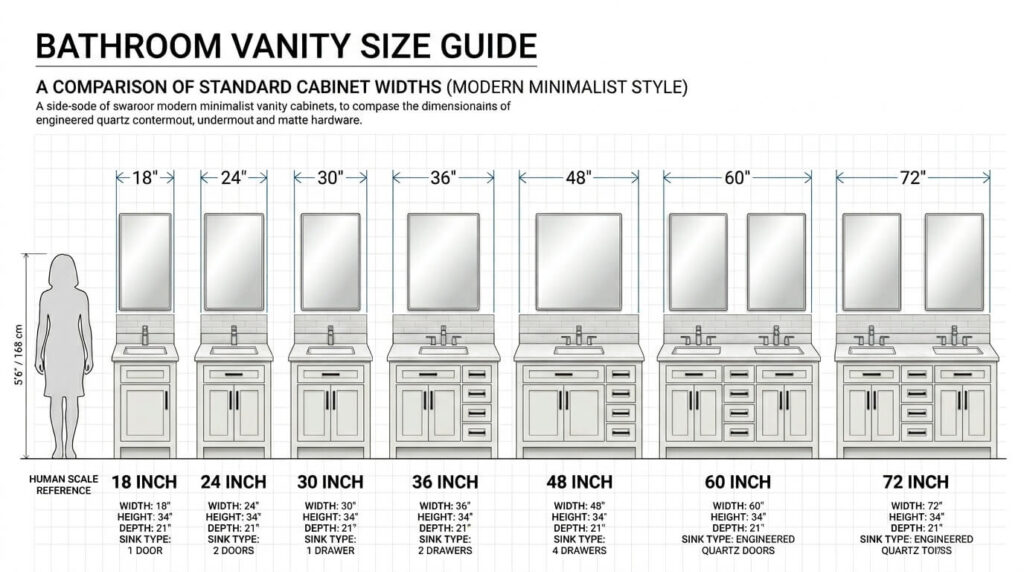
Standard Vanity Widths
Width is the first number people think about — and for good reason. It determines how much counter space you get, whether a single or double sink fits, and how much floor space the unit consumes.
- 18 inches – Designed for very small bathrooms, powder rooms, or tight alcoves. Fits a single undermount or vessel sink with minimal counter space. Common in half baths.
- 24 inches – A reliable choice for compact bathrooms. Provides enough room for a single sink and a small storage cabinet below. Often used in guest baths.
- 30 inches – The most widely used single-sink vanity width. Gives comfortable counter space on one side of the sink. Works well in bathrooms 5×7 feet or larger.
- 36 inches – Adds meaningful counter space while still fitting in moderately sized bathrooms. Popular in master baths and family bathrooms.
- 48 inches – Often called the “sweet spot” for single-sink vanities. Provides generous counter space and deep storage, sometimes with drawers on one or both sides.
- 60 inches – The entry point for double-sink vanities. Fits two sinks comfortably with some counter space between them. Works in bathrooms at least 8–9 feet wide.
- 72 inches – A full 6-foot double-sink vanity. Ideal for master bathrooms with two users. Requires ample floor space and good lighting on both sides.
Pro Tip: Always measure the door swing before ordering. A 72-inch vanity in a narrow bathroom can make the room feel like a hallway if there’s no breathing room beside it.
Standard Vanity Height
This is where many guides go wrong by treating height as a fixed number. It isn’t.
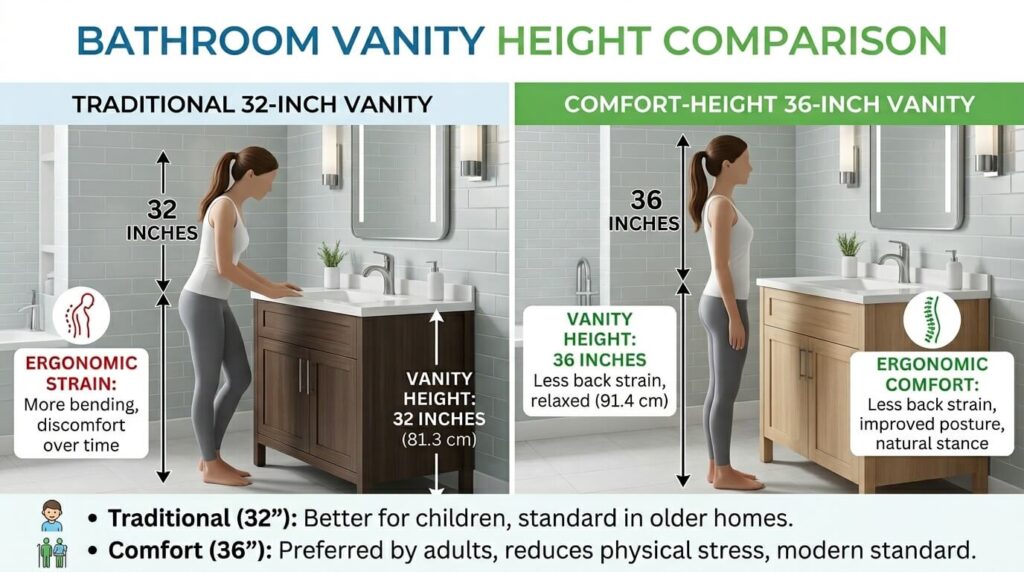
The traditional standard vanity height is 32 inches, which was set decades ago based on average user heights. But the industry has largely shifted toward what’s called “comfort height” or “ADA-compliant height” — 34 to 36 inches. This taller dimension aligns the countertop with the standing user’s waist, reducing back strain from bending over the sink.
- 31–32 inches – Traditional/older standard. Still found in pre-2000 homes and budget cabinets. Can feel low for adults over 5’6″.
- 33–35 inches – The current standard for most new construction. Feels natural for average-height adults.
- 36 inches – Comfort height. Preferred by many homeowners today. Standard for accessible and ADA-compliant bathrooms.
Keep in mind: vanity height is measured without the countertop and sink. Add 1.5–2 inches for a typical countertop, bringing the finished surface height to around 34–38 inches.
Bathroom Cabinet Sizes: The Complete Guide
Standard Vanity Depth
Depth determines how far the cabinet extends from the wall. Most standard bathroom vanities run 18 to 21 inches deep. Some compact models go as shallow as 16 inches for tight spaces, while deeper units reach 22–24 inches.
Why does depth matter beyond storage? Because it affects clearance. In bathrooms with toilets or shower doors directly across from the vanity, inadequate clearance creates a cramped, uncomfortable space. Building codes in most regions require a minimum of 21 inches of clear space in front of any toilet or fixture — so plan accordingly.
Medicine Cabinet Sizes: More Than Just a Mirror
Medicine cabinets are one of the most underutilized storage opportunities in the bathroom. They add recessed storage without eating into floor space — but only if you choose the right size.
Standard Medicine Cabinet Dimensions
Most medicine cabinets are designed to fit between standard wall studs, which are spaced 16 inches apart. That’s why you’ll commonly see widths of 14 inches (single stud bay) and 30 inches (double stud bay).
| Configuration | Common Widths | Common Heights |
|---|---|---|
| Single-door recessed | 14″, 16″, 20″ | 18″ – 26″ |
| Double-door recessed | 24″, 30″, 36″ | 24″ – 36″ |
| Surface-mount | 14″ – 48″ | 18″ – 30″ |
| Tri-view (3-door) | 36″, 40″, 48″ | 26″ – 36″ |
Depth for recessed medicine cabinets typically runs 3.5 to 4 inches — just enough to fit within a standard wall cavity. Surface-mount models can go deeper, offering 5–6 inches of usable shelf space.
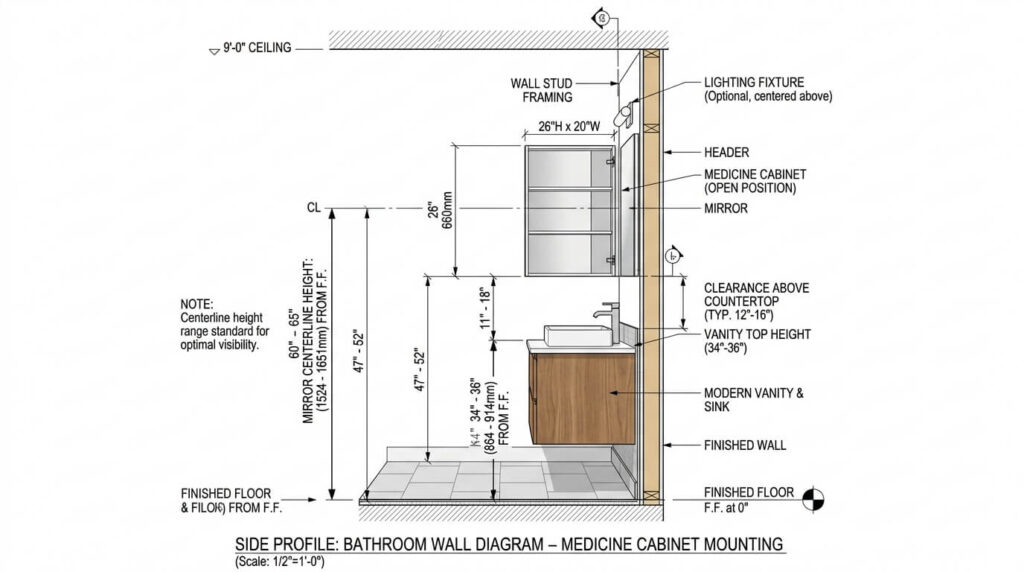
One thing most guides skip: mirror placement relative to eye level. For a medicine cabinet to function well, the mirror’s center should sit at approximately 60 to 65 inches above the floor — roughly eye level for adults between 5’4″ and 6′. If you’re mixing medicine cabinet heights for a couple of different heights, a tri-view cabinet that spans wider and taller gives both users a comfortable reflection.
Bathroom Wall Cabinet Sizes
Wall-mounted cabinets above the toilet or beside the vanity are excellent for storing toiletries, towels, and extra supplies without taking up floor space. They’re particularly valuable in smaller bathrooms where every square foot counts.
Standard wall cabinet widths run from 9 to 36 inches, with heights between 12 and 42 inches and depths of 4 to 8 inches (shallow enough to avoid head clearance issues).
When positioning wall cabinets:
- Mount the bottom at least 18 inches above the vanity countertop to allow comfortable use of the sink.
- For over-toilet placement, leave at least 12 inches above the tank lid.
- Deeper cabinets (6–8 inches) work better for folded towels and bulkier items; shallower ones (4–5 inches) suit toiletries and small bottles.
Linen Tower Cabinet Sizes
Linen towers are tall, narrow freestanding or built-in cabinets that maximize vertical storage. They’re a smart solution when floor space is limited but wall height isn’t.
Typical linen tower dimensions:
- Width: 12 to 24 inches
- Height: 60 to 84 inches
- Depth: 12 to 18 inches
A 12-inch-wide, 72-inch-tall linen tower beside a vanity can store as much as 3–4 small wall cabinets combined — while taking up a fraction of the visual weight.
How to Choose the Right Bathroom Cabinet Size
Knowing the numbers is only half the job. Applying them to your specific bathroom is where most people get stuck. Here’s a practical decision framework.
Step 1: Measure Your Bathroom Accurately
Before looking at any cabinet, measure:
- Floor-to-ceiling height
- Wall width between any obstructions (doors, windows, plumbing walls)
- Distance from the toilet centerline to the nearest wall (should be 15–18 inches on each side per code)
- Rough-in plumbing locations — especially the drain and supply lines, which will dictate sink placement
Measure twice. Then measure again with a second person to confirm.
Step 2: Account for Clearance Zones
Cabinet size isn’t just about what fits in the space — it’s about what works in the space. Key clearance rules:
- At least 21 inches of clear floor space in front of the vanity for comfortable use
- At least 15 inches from the toilet centerline to any cabinet edge
- At least 30 inches between parallel vanities or fixtures (more if two people use the space simultaneously)
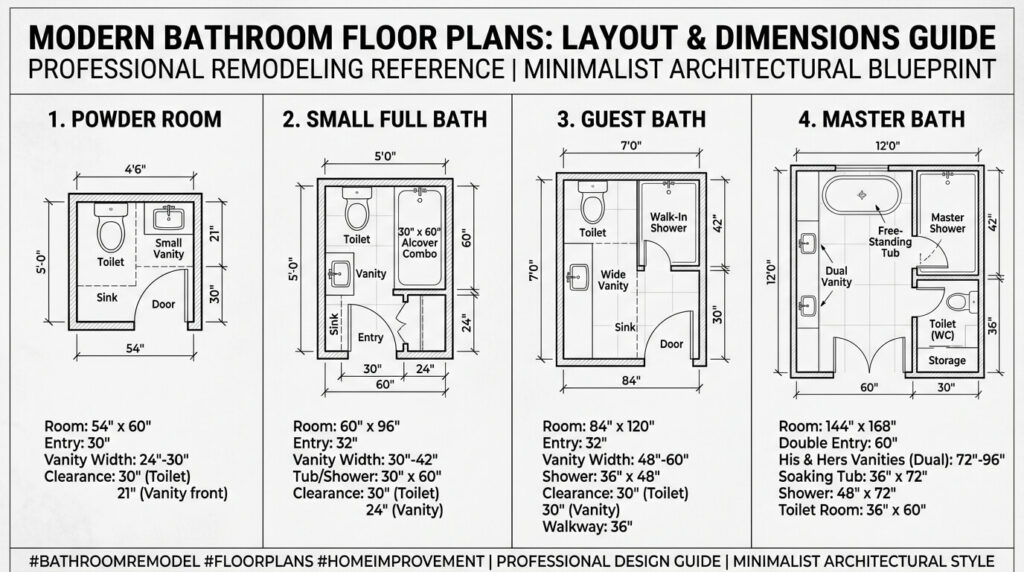
Step 3: Match Cabinet Size to Bathroom Type
| Bathroom Type | Recommended Vanity Width |
|---|---|
| Powder room / half bath | 18″ – 24″ |
| Small full bath (5×7 ft) | 24″ – 36″ |
| Guest bathroom | 30″ – 48″ |
| Master bathroom | 48″ – 72″ |
| Jack-and-Jill bathroom | 60″ – 72″ double sink |
Step 4: Think About Who Uses the Space
A bathroom for young children needs lower counters and accessible storage. A master bath for a tall couple benefits from 36-inch comfort-height vanities. An accessible bathroom for an elderly user or someone with mobility limitations should meet ADA standards: 34-inch max counter height, 30 inches of knee clearance below, and adequate maneuvering space on all sides.
Common Mistakes to Avoid When Selecting Bathroom Cabinet Sizes
These are the errors that renovation professionals see repeatedly — and they’re almost always avoidable.
1. Choosing width without measuring door swing clearance. A 60-inch vanity looks great on paper but becomes frustrating if the bathroom door bangs into it every time someone enters.
2. Ignoring plumbing rough-in locations. If your supply lines are on the left and you order a vanity with a centered cabinet frame, you may have a conflict that requires a plumber to reroute pipes — adding cost and time.
3. Confusing cabinet height with finished counter height. Always add countertop thickness (typically 1.5 inches for quartz or granite) to your cabinet height when calculating the final working surface.
4. Underestimating the value of depth. Shallow vanities save floor space but sacrifice storage. If storage is a priority, go as deep as your clearance allows — even 2–3 extra inches of depth dramatically increases interior volume.
5. Forgetting about the mirror or medicine cabinet above. The vanity and the medicine cabinet/mirror above it are a visual unit. Plan their widths together for a cohesive, intentional look — ideally matching or complementing widths.
Single-Sink vs. Double-Sink Vanity: Sizing Considerations
The decision between a single and double sink isn’t just about preference — it’s about available space and daily use patterns.
A double-sink vanity typically starts at 60 inches wide. In a bathroom narrower than 8 feet, two sinks can create a rushed, crowded morning routine with too little personal counter space.
For a double vanity to feel genuinely comfortable, each user should have at least 24 inches of counter space to either side of their sink. That puts a functional double vanity at 72 inches or more when counting the sinks themselves.
If your bathroom is under 8 feet wide, a single sink with extra-wide counter space (a 48-inch vanity, for example) will often serve two people better than forcing in a double.
Freestanding vs. Built-In Cabinet Sizes: What’s Different?
Freestanding vanities are furniture-style pieces that sit on legs or a solid base. They typically run slightly shorter (30–33 inches) and shallower (18–20 inches) than built-in models. They’re easier to install and replace, but offer less storage integration.
Built-in or semi-custom vanity cabinets come in the full range of standard widths and can be ordered in non-standard increments (every 3 inches in many product lines). They’re anchored to the wall and offer the cleanest, most custom appearance.
If you’re working with a non-standard wall width — say, 43 inches — a semi-custom or custom cabinet will fill the space properly. Trying to fit two standard cabinets into that gap will leave awkward filler strips or gaps near the wall.
Conclusion Bathroom Cabinet Sizes
Getting bathroom cabinet sizes right isn’t about memorizing numbers — it’s about understanding how those numbers interact with your specific space, your plumbing, your clearance needs, and the people who use the room every day.
Start with your measurements. Work outward from the plumbing rough-in. Factor in clearance zones and door swings. Then match the standard size ranges that fit your bathroom type and your household’s habits.
The right bathroom cabinet size doesn’t just fit in the room. It makes the room work better — giving everyone more comfort, more storage, and a space that feels thoughtfully designed from the very first morning.
FAQ Bathroom Cabinet Sizes
What is the standard size for a bathroom vanity cabinet?
The most common bathroom vanity cabinet width is 30 to 36 inches for a single sink. Standard height (without countertop) ranges from 32 to 35 inches, with 34–36 inches considered “comfort height.” Standard depth is 18 to 21 inches.
What is the minimum size for a bathroom vanity?
The smallest standard bathroom vanity is 18 inches wide, typically used in powder rooms or very compact spaces. Some custom models go as narrow as 16 inches, but these offer very limited counter and storage space.
How deep should a bathroom cabinet be?
Most bathroom vanity cabinets are 18 to 21 inches deep. Wall-mounted cabinets are much shallower at 4 to 8 inches. The right depth depends on available clearance — you need at least 21 inches of open floor space in front of any cabinet.
What height should a bathroom medicine cabinet be mounted?
The mirror center of a medicine cabinet should sit approximately 60 to 65 inches above the finished floor — roughly eye level for average-height adults. This aligns the usable shelving with a comfortable reach range.
What is the standard height of a bathroom cabinet with countertop?
The finished countertop surface (cabinet plus countertop) typically sits between 34 and 38 inches above the floor. The cabinet itself is 32–35 inches; the countertop adds 1.5 to 2 inches.
Can I use a 60-inch vanity in a small bathroom?
A 60-inch vanity can work in a bathroom that’s at least 7–8 feet wide, but only if you have 21 or more inches of clearance in front of it and the door doesn’t conflict with the cabinet when opened. In bathrooms smaller than 5×8 feet, a 60-inch vanity is usually too large to be functional.
What’s the difference between standard and comfort height for bathroom cabinets?
Standard height is 32 to 34 inches (cabinet only), based on older sizing conventions. Comfort height is 34 to 36 inches, which aligns the countertop closer to waist height for most adults, reducing back strain. Most new bathrooms use comfort height today.
How wide should a double-sink vanity be?
A functional double-sink vanity should be at least 60 inches wide, with 72 inches being ideal for two users to have comfortable counter space beside their respective sinks.