
If you’ve ever stepped out of the shower into a bathroom that looks like a sauna, you already know the problem isn’t just fogged-up mirrors. Moisture in your shower that’s left to sit can quietly damage paint, grout, and drywall — and create the exact conditions mold needs to grow. The good news: most of the fixes are simple, and the ones that aren’t simple are at least predictable.
This guide covers what actually causes shower condensation, how to tell if it’s become a real problem, and nine fixes ranked from “do this today” to “consider this during your next renovation” — plus a quick way to check whether your exhaust fan is even strong enough for your bathroom.
Why Your Shower Builds Up So Much Moisture
What Causes Condensation in the First Place
Hot water releases water vapor into the air, and warm air holds more moisture than cool air. The moment that warm, humid air touches a cooler surface — a mirror, a window, a tiled wall — it cools rapidly and the vapor turns back into liquid droplets. That’s condensation, and it’s the reason your bathroom can feel wetter after a shower than during it.
A single hot shower can release more than a liter of water into the air of a small bathroom. In a room with poor airflow, that moisture has nowhere to go, so it lingers on every cold surface in the room.
Why It Matters: Health and Structural Risks
Left unaddressed, that lingering moisture does two kinds of damage:
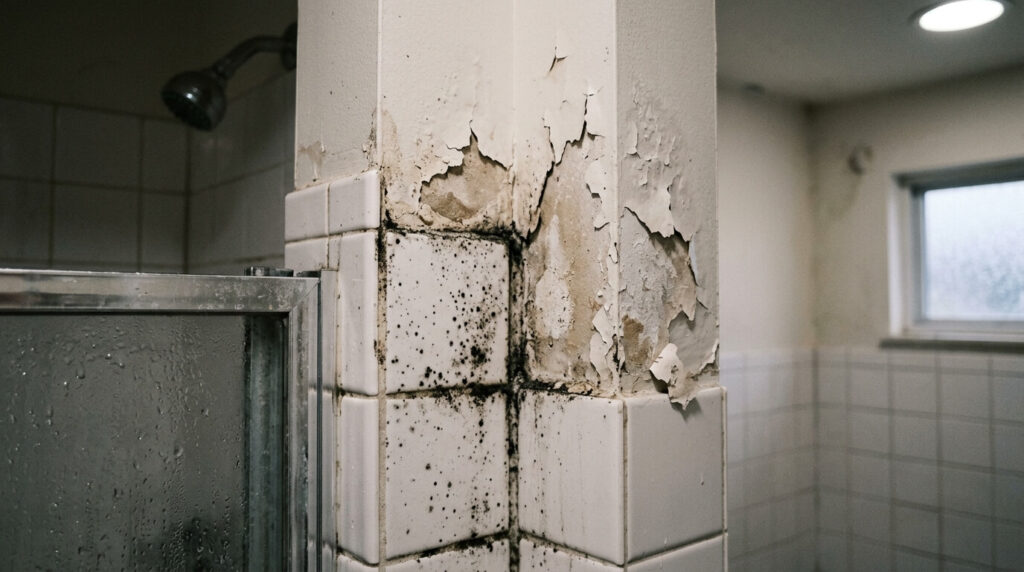
- Structural damage: Paint peels, wallpaper lifts, grout breaks down, wood trim rots, and drywall behind tile can deteriorate — all repairs that get more expensive the longer they’re ignored.
- Health effects: Damp environments are exactly what mold and mildew need to grow, and prolonged exposure to mold spores has been linked to respiratory irritation, especially for people with asthma or allergies.

Signs Your Bathroom Has a Moisture Problem
Not sure if your bathroom has crossed the line from “normal steam” to “actual problem”? Watch for:
- Condensation that doesn’t clear within 20–30 minutes of finishing your shower
- Peeling paint or bubbling wallpaper, especially near the ceiling or shower
- A musty smell that returns even after cleaning
- Dark spots in grout lines that come back days after scrubbing
- Soft or discolored drywall around the tub or shower surround
- Wood trim that feels soft or looks swollen
If you’re only seeing mirror fog that clears within a few minutes, that’s normal. If you’re seeing two or more of the signs above, it’s worth working through the fixes below — and possibly calling a contractor if you suspect damage behind the walls.
Is Your Bathroom Fan Even Powerful Enough? (A Simple CFM Guide)
This is the step almost every other guide skips, and it’s often the actual root cause of a chronically steamy bathroom: the fan is too small for the room.
Bathroom exhaust fans are rated in CFM (cubic feet per minute) — how much air they move. As a general rule of thumb based on commonly used ventilation guidance:
| Bathroom Size | Recommended Fan Capacity |
|---|---|
| Up to 50 sq ft | 50 CFM minimum |
| 50–100 sq ft | 1 CFM per square foot |
| Bathroom with a separate tub, shower, and toilet | Add 50 CFM per fixture |
| High-use or steam shower | Size up, or add a humidity-sensing model |
A fan that’s undersized — or one that’s the right size but vents through a long, twisty duct run — will run forever without actually clearing the steam. If your bathroom is consistently steamy despite a fan running the whole time, check its rating against this table before assuming the problem is your habits.
9 Proven Ways to Reduce Moisture in Your Shower
1. Run — and Properly Size — Your Exhaust Fan
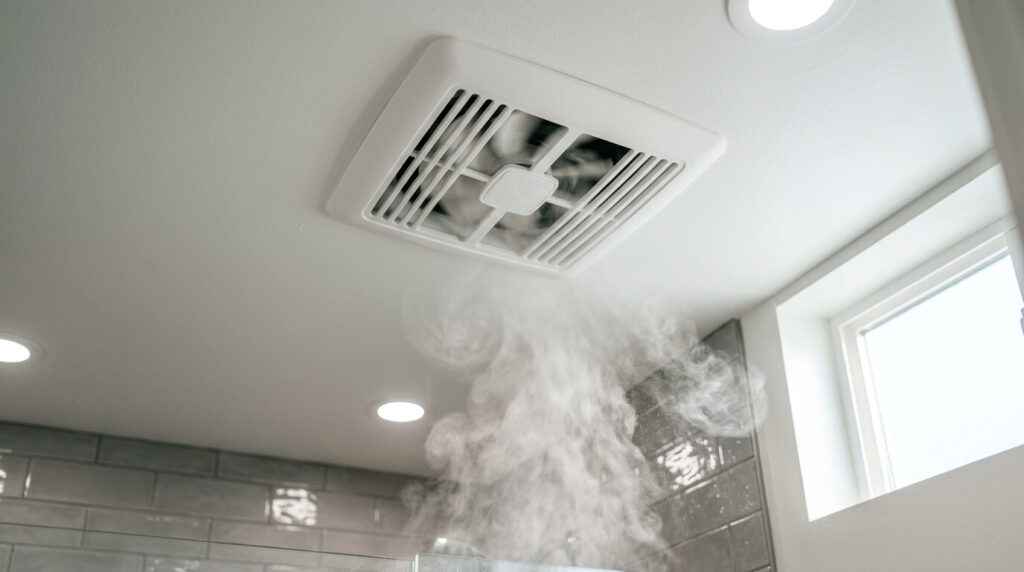
Turn the fan on before you start showering, not after, and let it run for at least 20–30 minutes once you’re done. If your bathroom doesn’t clear up in that window even with a fan rated correctly for the room (see the table above), check for a blocked vent, a dirty fan filter, or a duct run that’s too long — all common reasons a “working” fan still underperforms.
One detail almost everyone misses: fans need makeup air. If your bathroom door seals tightly with no gap underneath, the fan has nothing to pull from and works far less efficiently. A simple fix is a louvered door or at least a 1/2-inch gap at the bottom.
2. Crack a Window or the Door
If you have a bathroom window, open it during and after your shower — it gives moist air a direct path out instead of just circulating. In cold climates this isn’t always practical, so weigh comfort against ventilation, and only leave windows open when you’re home for security.
3. Squeegee and Towel-Dry After Every Shower
This is the single highest-effort-to-payoff habit on this list. A 30-second squeegee pass on shower walls and glass removes most of the standing water that would otherwise evaporate slowly back into the air — which is exactly what keeps humidity elevated long after you’ve left the room. Wipe the floor and any puddles near the drain too.
4. Take Shorter, Cooler Showers
Lowering the water temperature by even a few degrees noticeably reduces how much vapor gets released. This is a free, immediate fix — and it has the side benefit of lowering your water heating costs.
5. Add a Dehumidifier
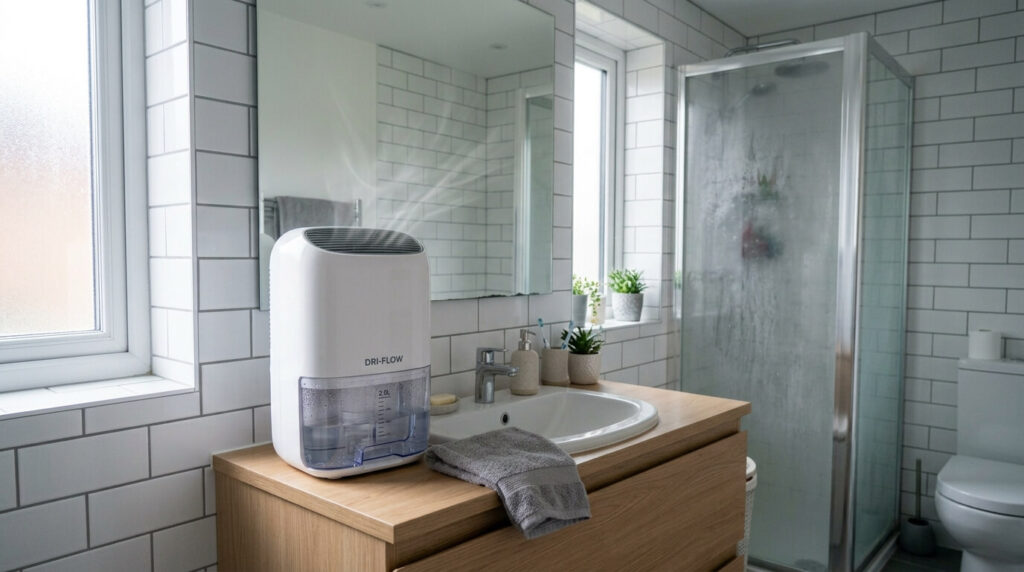
For bathrooms that stay damp no matter what, a dehumidifier is the most direct fix. As a rough guide: a small bathroom typically needs a unit that pulls under 30–40 pints per day, while a larger or shared bath/shower space may need 40–60 pints per day. Match capacity to your square footage and run it during and after showers.
6. Upgrade to Moisture-Resistant Materials
This is a renovation-level fix, not a today fix — but it’s the most permanent one. Traditional tile and grout are porous and give moisture (and mold) places to hide. Non-porous surfaces like acrylic or solid-surface shower panels, and mold-resistant or moisture-rated paint elsewhere in the bathroom, remove most of the surfaces mold actually needs to take hold.
7. Add Humidity-Absorbing Plants (and Avoid These)
Certain plants genuinely help pull moisture from the air and tolerate low-light, humid bathroom conditions: peace lily, Boston fern, snake plant, English ivy, and spider plant are commonly recommended options. Note that peace lilies are mildly toxic if ingested by pets or small children, so place them out of reach.
Not every “bathroom plant” helps, though — some release more moisture into the air than they absorb. If you’re choosing plants specifically to manage humidity rather than just for decoration, stick to varieties known for moisture absorption rather than assuming any tropical-looking plant will do the job.
8. Install a Demisting Mirror or Heated Towel Rail
A heated demister pad behind your bathroom mirror keeps the glass just warm enough that condensation can’t form on it at all — a permanent fix for the “can’t see to shave/do makeup” problem. A heated towel rail does double duty: it dries your towels faster (so they’re not adding moisture back into the air) and adds a small amount of ambient heat, which reduces how much condensation forms on nearby cold surfaces.
9. Get Wet Towels and Clothes Out of the Room
A damp towel left hanging in the bathroom keeps releasing moisture into the air for hours after your shower is over. Hang towels somewhere with airflow outside the bathroom, or use a heated towel rail (see above) so they dry quickly in place.
Quick Comparison: Which Method Actually Works Best?
| Method | Cost | Effort | Best For |
|---|---|---|---|
| Exhaust fan (correctly sized) | Low–Medium | Low (set and forget) | Every bathroom — this is the baseline fix |
| Squeegee/towel-dry habit | None | Low, daily | Slowing mold growth between deeper fixes |
| Cooler/shorter showers | None | Low | Quick, immediate reduction |
| Dehumidifier | Medium | Low | Bathrooms without windows or weak ventilation |
| Plants | Low | Low | Supplementing other methods, not a standalone fix |
| Demisting mirror / heated rail | Medium | Medium (installation) | Daily comfort, not structural moisture control |
| Non-porous materials/renovation | High | High | Long-term, permanent prevention of mold and damage |
Still Steamy? Troubleshooting a Fan That Isn’t Working
If you’ve got a fan running and it’s still not clearing the room, check these in order:
- Is it sized correctly? Compare it to the CFM table above.
- Is the duct clear and reasonably short? Long or kinked duct runs choke airflow even from a strong fan.
- Is the vent terminating outside, not into an attic? Fans that dump moist air into an attic space just move the mold problem, they don’t solve it.
- Is the filter or fan housing clogged with dust? Clean it at least twice a year.
- Is there a gap for makeup air under the door? Without it, the fan is fighting against a sealed room.
If all of the above check out and the bathroom is still chronically damp, that points toward a ventilation redesign or a dehumidifier rather than a habit problem.
Quick Fixes Today vs. Long-Term Solutions
Do today, free: Run the fan longer, squeegee after every shower, lower the shower temperature, move wet towels out of the room.
Do this month, low cost: Add a dehumidifier, add moisture-absorbing plants, install a demisting mirror pad.
Plan for your next renovation: Resize or replace the exhaust fan, switch to non-porous wall materials, address makeup air/door clearance, upgrade single-pane windows.
FAQ: Moisture in the Shower
What humidity level is too high for a bathroom?
Indoor relative humidity above roughly 50–60% for extended periods creates favorable conditions for mold growth. Brief spikes during a shower are normal; the concern is humidity that stays elevated long after you’re done.
How long should a bathroom exhaust fan run after a shower?
Most guidance recommends running the fan for 20–30 minutes after you finish showering, or until visible condensation has cleared from mirrors and tile.
Does a bathroom fan have to vent outside?
Yes. A fan that vents into an attic or wall cavity instead of outside just relocates the moisture problem and can cause hidden mold growth in those spaces.
What plants absorb moisture from a bathroom?
Peace lily, Boston fern, snake plant, English ivy, and spider plant are commonly cited for tolerating humid, low-light bathroom conditions while helping draw moisture from the air.
How do I stop my bathroom mirror from fogging up?
A heated demister pad behind the mirror is the most permanent fix. Lower-cost temporary options include wiping the mirror with a thin layer of shaving cream or running the fan before you start showering.
Can too much moisture in a shower cause mold?
Yes — mold needs moisture, a food source (soap scum, dust, grout, drywall), and time. Reducing how long moisture sits on surfaces is the most effective way to interrupt that cycle.
Is it bad to shower without running the fan?
Occasionally, no — but consistently skipping it allows moisture to settle into porous surfaces like grout and drywall, which is what eventually leads to mold and structural damage.
Conclusion
Shower moisture isn’t something you can eliminate entirely, but you can control how long it sticks around — and that’s really what determines whether you end up with a fogged mirror or a mold problem. Start with the free habits (fan, squeegee, shorter showers), add equipment if your bathroom still won’t dry out, and treat materials and ventilation upgrades as part of your next renovation rather than an emergency fix.