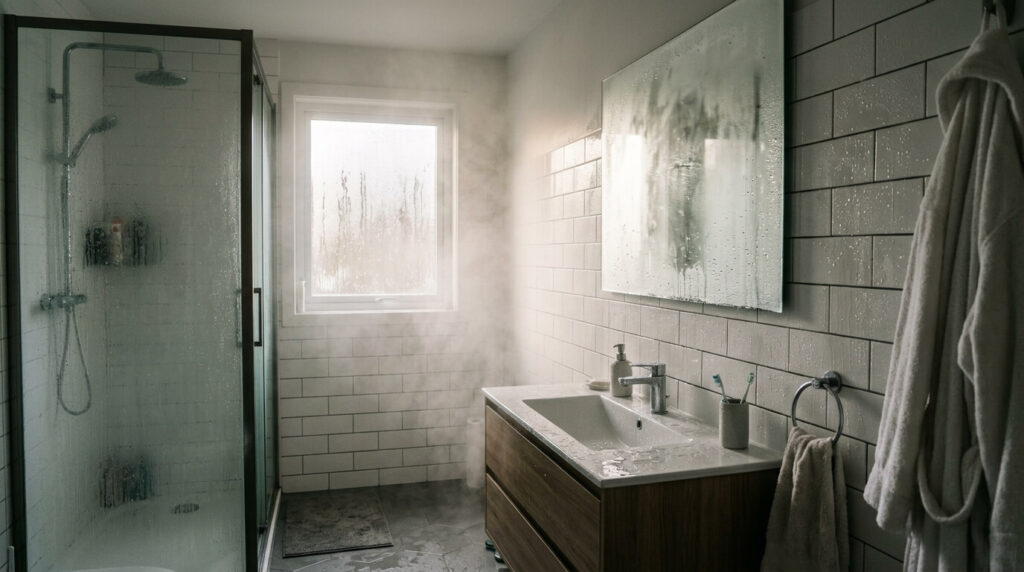
If you walk into your bathroom and the mirror’s already fogged before you’ve even turned the shower on, that’s not just an inconvenience — it’s a sign your bathroom is holding onto more moisture than it should. Learning how to reduce humidity in a bathroom isn’t about one trick; it’s about combining the right ventilation, habits, and materials so moisture never gets the chance to settle into walls, grout, and paint. Below are nine fixes that actually move the needle, plus how to tell when a quick habit change isn’t enough and you need a bigger upgrade.
Editor’s note: For specifics on fan sizing or structural moisture issues, it’s worth getting a second opinion from a licensed HVAC technician or contractor — the guidance below covers the general principles, but every bathroom’s layout is different.
Why Bathrooms Get So Humid in the First Place
A hot shower can release enough water vapor to push a small bathroom’s relative humidity well above 80% in minutes. Warm, moist air rises and spreads across the room until it touches a cooler surface — a mirror, a window, a tile wall — where it cools rapidly and condenses back into liquid water. That’s the fog on your mirror and the beads on your window. The smaller and more enclosed the bathroom, the faster humidity climbs, because there’s less air volume to dilute the steam and often less airflow to clear it out.
Three things make this worse: long, hot showers that produce more steam; a bathroom with no window or an undersized exhaust fan; and a lack of insulation, which keeps interior surfaces cold enough that condensation forms easily even in a well-ventilated room.
What Humidity Level Is Actually Too High?
Most building scientists consider 50–60% relative humidity a reasonable target for a bathroom outside of active showering. Anything that sits above 60% for extended periods creates ideal conditions for mould spores to germinate, since most mould species need both moisture and a relative humidity above roughly 60% to establish themselves on a surface.
A cheap digital hygrometer (often under $15) tells you in real time, rather than guesswork, whether your ventilation is actually doing its job. Place it away from the direct path of shower steam — on a shelf or windowsill — and check it an hour after your last shower, once the air has had a chance to settle. If it’s consistently reading above 60%, you have a ventilation gap worth addressing with one of the fixes below.
1. Size and Run Your Extractor Fan Correctly
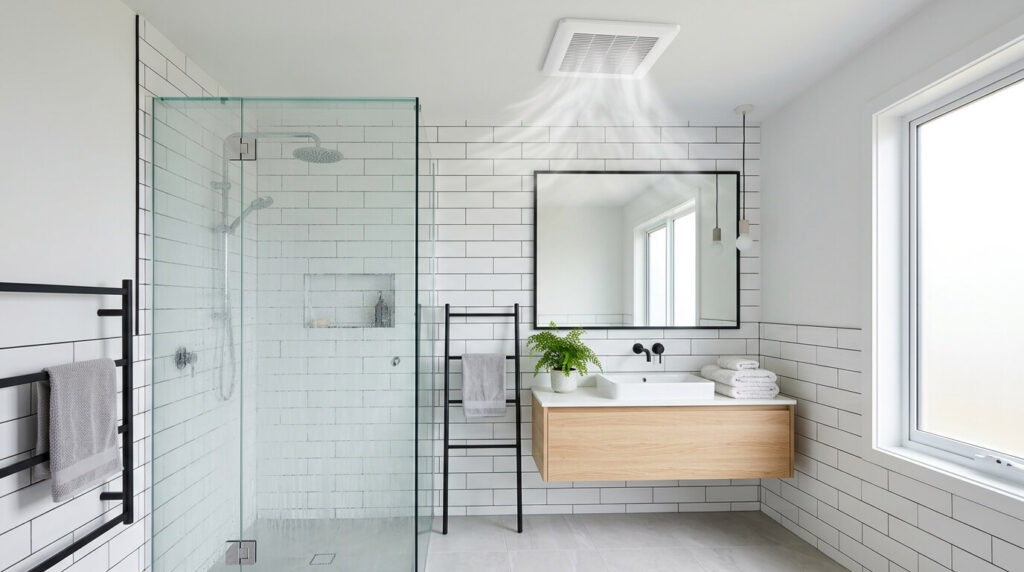
An extractor fan is the single most effective tool for controlling bathroom humidity, but only if it’s powerful enough for the room and run long enough to clear the air. As a rough rule of thumb, a fan needs roughly 1 CFM (cubic foot per minute) of extraction capacity per square foot of bathroom floor area, with a minimum of around 50 CFM even for small bathrooms. If your fan struggles to clear steam within 10–15 minutes of a shower ending, it’s likely undersized for the space.
Run the fan during your entire shower and for at least 15–20 minutes afterward — longer in larger or poorly insulated bathrooms. A humidity-sensing fan automates this by switching on once it detects rising moisture and switching off once levels drop, which removes the guesswork (and the temptation to forget to turn it back off). Whatever fan you have, clean the grille and filter every few months; a dust-clogged fan can lose a significant share of its extraction capacity without you noticing.
2. Use a Dehumidifier Where Ventilation Falls Short
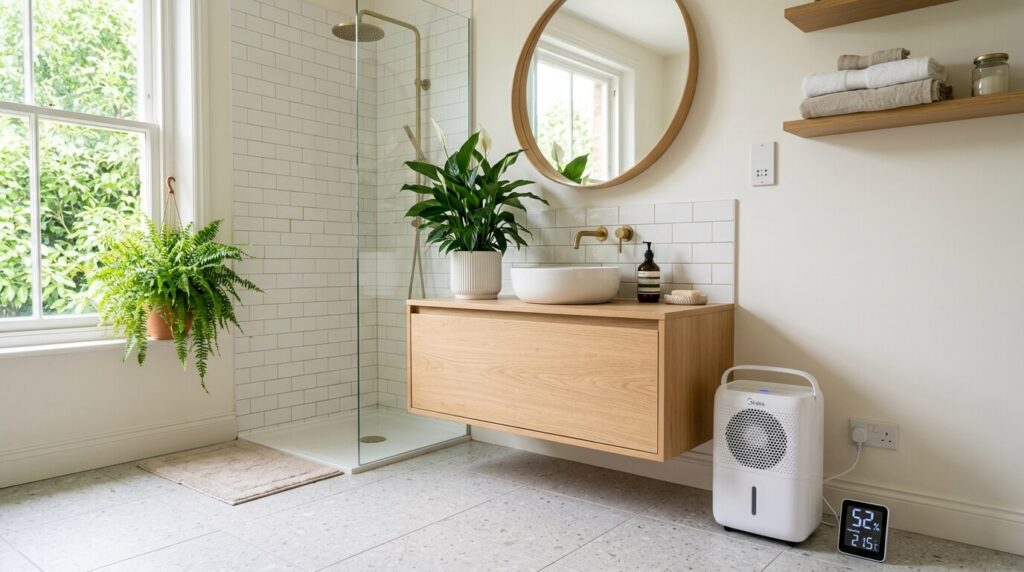
In bathrooms with poor airflow, an electric dehumidifier acts as a backup moisture-removal system rather than a replacement for a fan. Compact, bathroom-rated units are designed to handle the higher humidity and splash exposure of a shower room and can be left running on a timer. When sizing one, match its rated daily moisture-extraction capacity (measured in pints per day) to your bathroom’s square footage — a small bathroom typically needs a unit rated for under 40 pints per day, while a larger or particularly damp space may need 40–60 pints.
If a plug-in unit isn’t practical, moisture-absorbing materials such as silica gel packs or calcium chloride crystal tubs offer a low-cost, no-electricity alternative. They won’t match an active dehumidifier’s output, but placed in a cabinet or corner, they meaningfully reduce ambient dampness in a small enclosed space.
3. Ventilate Even Without a Window
A windowless bathroom isn’t doomed to permanent dampness — it just needs to rely more heavily on mechanical and passive ventilation. An inline extractor fan, which is more powerful than a standard wall- or ceiling-mounted unit, is often the better choice here because it can move air through longer ductwork to an exterior vent. A vented bathroom door — one with built-in louvres — also lets humid air exchange with the hallway even when the door is closed, which matters when there’s no window to crack open.
If you can’t install a window, consider a passive vent connected through the wall or roof, which uses pressure differences and rising warm air to draw moisture out without using electricity. Pair this with the extractor fan rather than relying on it alone; passive ventilation is a helpful supplement, not a substitute for active extraction in a high-steam environment.
4. Wipe Down Surfaces After Every Shower
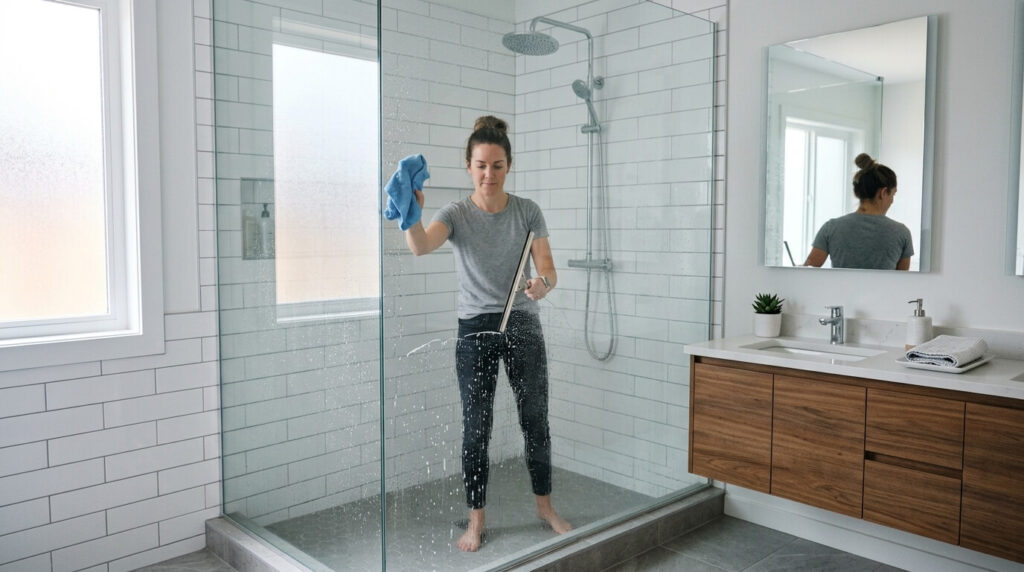
This is the cheapest and most overlooked fix on this list. Any water left sitting on tile, glass, or countertops continues evaporating into the room’s air for hours, slowly pushing humidity back up even after the fan has done its job. A squeegee run across glass shower doors and tiled walls takes under a minute and removes the bulk of standing water before it can evaporate.
Pay particular attention to tile grout, which is porous and holds moisture far longer than the tile itself — this is exactly where mould tends to take root first. A microfibre cloth on countertops and the floor finishes the job and prevents the slip hazard that comes with standing water.
5. Take Shorter, Cooler Showers
Lowering your shower temperature by even a few degrees noticeably reduces how much steam is generated, since cooler water produces less water vapor at the same flow rate. Cutting shower length by a couple of minutes compounds the effect — less total steam means less for your fan or dehumidifier to clear. This is a low-effort change, but it’s also the one people resist most, so treat it as a complementary habit rather than your primary strategy.

6. Choose Moisture-Resistant Materials and Paint
Standard interior paint absorbs ambient moisture over time, which is why bathroom ceilings and walls are often the first place you’ll see peeling or bubbling. A paint formulated specifically for high-humidity environments — typically labelled mould-resistant or bathroom-specific — creates a tighter moisture barrier and resists mildew growth far longer than a standard finish.
The same logic applies below the surface. If you’re renovating, moisture-resistant drywall (often called green board) or cement board behind tiled walls performs significantly better than standard drywall in a high-humidity room, and a vapor barrier installed during the build prevents moisture from migrating into wall cavities and insulation. For flooring and furniture, non-porous options — porcelain or ceramic tile, PVC or treated-wood vanities — resist swelling and water damage that untreated wood and standard MDF can’t withstand.
7. Add Humidity-Absorbing Plants (With Realistic Expectations)
Certain plants do pull moisture from the air through their leaves, and a few — peace lilies, Boston ferns, and Chinese evergreens among them — tolerate the low light and high humidity of a typical bathroom well. They’re a genuinely nice addition to the room and a small, ongoing contributor to moisture control.
It’s worth being honest about scale, though: plants are not a substitute for an extractor fan or dehumidifier. Their absorption rate is modest compared to mechanical ventilation, and a few species actually release more water vapor than they take in, so it’s worth checking before you fill a shelf with greenery. Treat plants as a finishing touch on top of your ventilation strategy, not the strategy itself.
8. Dry Towels and Clothing Outside the Bathroom
A damp towel left hanging in an unventilated bathroom keeps releasing moisture into the room for hours after your shower has ended — sometimes longer than the shower itself contributed. Hang towels somewhere with airflow, ideally outside the bathroom or on a heated towel rail that actively dries them rather than just holding them. The same goes for any wet bath mats or clothing; moving them out of the room removes an ongoing moisture source you might not have considered.
9. Know the Warning Signs Before They Become Repairs
Catching excess humidity early is far cheaper than fixing what it eventually causes. Watch for a persistent musty smell, visible mould or mildew at grout lines and ceiling corners, paint that’s peeling or bubbling, and wood trim that feels soft or shows discoloration. Condensation that reappears on windows or mirrors within minutes of wiping them down — even with the fan running — usually points to a ventilation system that’s undersized for the room, not a habit you’re missing.
If you spot any of these signs, address them quickly: clean small mould patches with diluted white vinegar or a dedicated anti-mould spray rather than bleach, which can disperse spores instead of fully killing them. Persistent or spreading mould, especially behind walls or under flooring, is worth having assessed by a professional before it affects the structure.
Comparing Your Options
| Method | Upfront cost | Effort | Effectiveness | Best for |
|---|---|---|---|---|
| Extractor/exhaust fan | Low–moderate | Low (set and forget) | High, if correctly sized | Almost every bathroom |
| Portable dehumidifier | Moderate | Moderate (emptying/maintenance) | Moderate–high | Bathrooms with weak or no ventilation |
| Passive vent | Low | Very low | Low–moderate | Supplementing an existing fan |
| Moisture-absorbing crystals/gel | Very low | Low (replace periodically) | Low | Small spaces, cabinets, backup support |
| Plants | Low | Low | Very low | Aesthetic boost alongside other methods |
For most bathrooms, the right combination is a correctly sized extractor fan run long enough after each shower, paired with the wipe-down habit and, where ventilation is genuinely weak, a dehumidifier as backup.
If you’re weighing whether to upgrade your fan or add a dehumidifier, our [bathroom ventilation guide] walks through sizing in more detail, and our bathroom remodel checklist covers what to look for if humidity has already caused damage you need to repair.
FAQ
What humidity level is too high for a bathroom?
Relative humidity consistently above 60% creates conditions favorable to mould growth. Aim to bring the room back down to 50–60% within 15–20 minutes of finishing a shower.
How can I reduce bathroom humidity without a window?
Rely on a properly sized inline or standard extractor fan run during and after showers, consider a vented bathroom door, and add a portable dehumidifier if the fan alone can’t keep up.
Do plants actually reduce bathroom humidity?
They contribute a small amount of moisture absorption, but the effect is modest compared to mechanical ventilation. Use them to complement a fan or dehumidifier, not replace one.
How long should I run my bathroom fan after a shower?
A minimum of 15–20 minutes is a reasonable starting point; larger or poorly insulated bathrooms may need it running longer to fully clear residual steam.
Can high bathroom humidity damage my house?
Yes. Sustained high humidity contributes to mold and mildew, peeling paint, deteriorating grout, and — left unaddressed for long enough — structural damage to wood framing and drywall.
What’s the difference between a dehumidifier and an extractor fan?
An extractor fan pulls humid air out of the room and vents it outside; a dehumidifier pulls moisture out of the air within the room and collects it as water. They solve the same problem differently, and many high-humidity bathrooms benefit from both.
How do I know if my bathroom has a humidity problem?
Look for a musty smell, condensation that lingers well after a shower, visible mould at grout lines or ceiling corners, and peeling paint — and consider checking with a hygrometer if you want a precise reading rather than a guess.
The Bottom Line
There’s no single fix for bathroom humidity — it’s a combination of moving enough air, removing standing water quickly, and choosing materials that don’t hold onto moisture in the first place. Start with the fan you already have: confirm it’s running long enough and isn’t clogged with dust, then layer in the habits and upgrades above based on what your bathroom’s actually missing. If you’ve tried the habit-level changes and you’re still seeing condensation, peeling paint, or recurring mould, that’s usually a sign the underlying ventilation or materials need an upgrade rather than another quick fix — and that’s worth a conversation with a contractor before the damage spreads further.