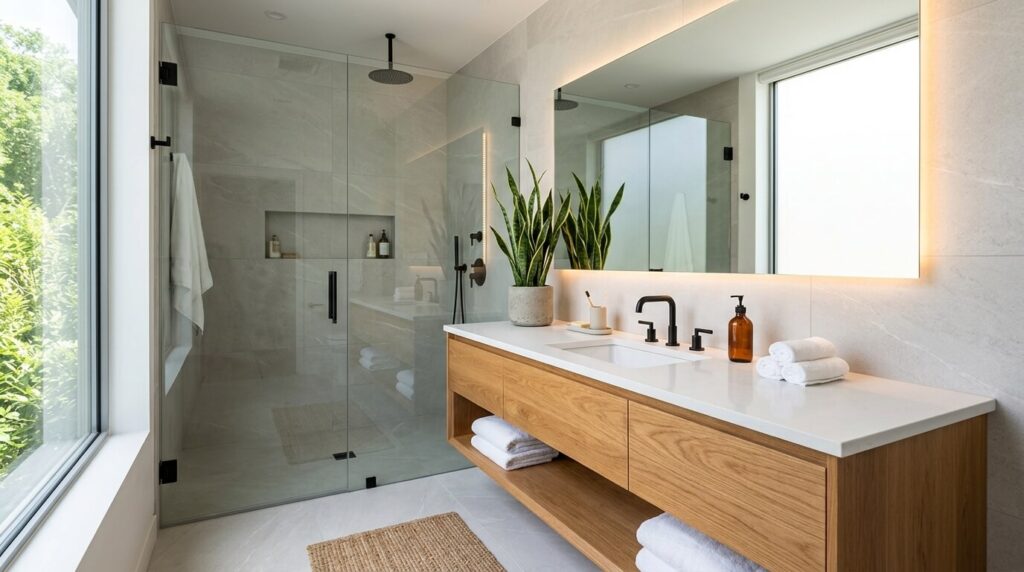
If you’ve been scrolling renovation photos and keep gravitating toward the same clean, uncluttered bathrooms, there’s a good chance you’re drawn to contemporary bathroom decor. Unlike styles frozen in a specific era, contemporary design constantly evolves — which makes it flexible, but also a little harder to pin down when you’re trying to shop for it or brief a contractor.
This guide breaks contemporary bathroom decor into its actual building blocks — color, materials, lighting, fixtures, and styling — so you can apply it room by room, whether you’re doing a full renovation or a weekend refresh.
What Makes a Bathroom “Contemporary”? (Contemporary vs. Modern)
The terms “modern” and “contemporary” get used interchangeably, but they’re not the same thing. Modern design refers to a specific historical movement rooted in the early-to-mid 20th century — think chrome, glass, and the minimalism of Bauhaus and mid-century design. Contemporary design isn’t tied to a fixed era. It reflects current trends, which means it shifts over time while holding onto a few consistent principles:
- Clean, unfussy lines on cabinetry, fixtures, and trim
- A restrained material and color palette — fewer choices, used well
- A mix of geometric structure and soft, rounded elements (a rectangular vanity paired with a curved mirror or oval tub, for example)
- Function-first layouts that prioritize storage and flow over ornamentation
Because it isn’t locked to strict rules, contemporary style adapts well to almost any bathroom size or budget — a small powder room and a sprawling primary suite can both read as contemporary if the fundamentals are right.
The Contemporary Bathroom Color Palette
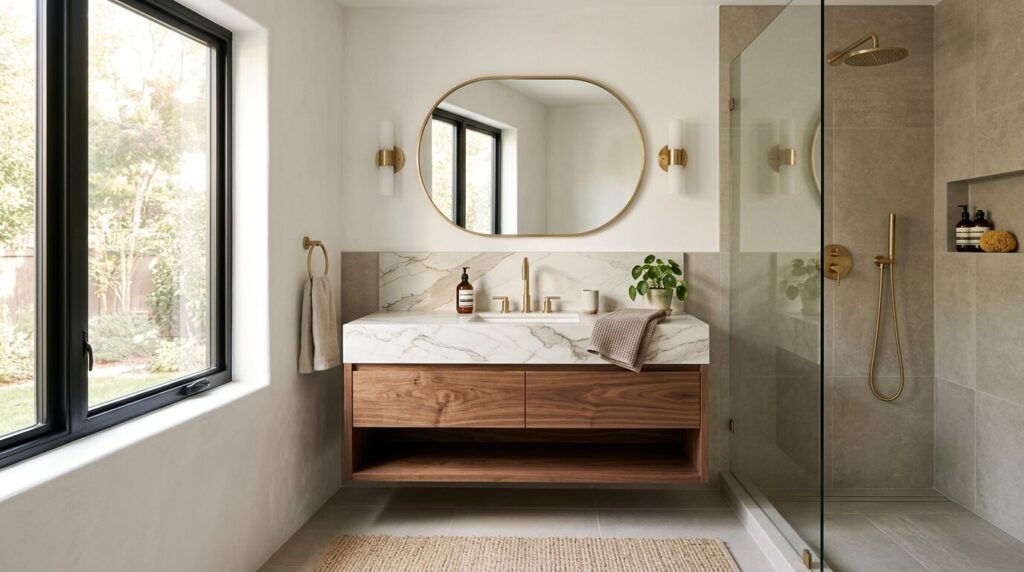
Color is where contemporary decor sets its tone. The base is almost always neutral — soft whites, warm greiges, taupe, and light grays — because a quiet backdrop lets materials and lighting do the visual work. From there, designers layer in contrast through one of two routes:
- Deep, moody accents — matte black, charcoal, or navy on a vanity, frame, or accent wall for drama.
- Warm metallics — brushed gold or brass hardware and fixtures against a cool neutral base for a softer, more elevated feel.
A practical way to plan your palette: choose one neutral for 60% of the room (walls, floor), one secondary tone for 30% (vanity, tile), and one accent for the remaining 10% (hardware, art, textiles). This ratio keeps the space from feeling either flat or overdone.
Try this: Paint or tile a single accent wall behind the vanity instead of committing color to the entire room — it’s the lowest-risk way to test a bolder shade.
Materials & Surfaces That Define the Look
Material choice does more to signal “contemporary” than almost anything else in the room. Prioritize:
- Large-format tile (12×24″ or bigger) with minimal grout lines for a seamless, expansive look
- Natural stone or stone-look surfaces — marble, travertine, or engineered quartz — often with bold, visible veining as a feature rather than something to hide
- Matte and honed finishes over high-gloss, which read as more current and hide water spots better
- Floating (wall-mounted) vanities, which visually lighten the room, make floors easier to clean, and free up space in smaller bathrooms
- Frameless glass shower enclosures, which remove visual clutter and let tile work or a statement wall carry the design uninterrupted
If you’re renovating on a budget, a large-format porcelain tile that mimics marble delivers most of the visual impact of natural stone at a fraction of the material and maintenance cost.
Lighting That Elevates Contemporary Bathroom Decor
Lighting in a contemporary bathroom does double duty: it needs to be functional enough for grooming tasks and stylish enough to act as a design feature. Aim for three layers:
- Task lighting at the mirror — vertical sconces on either side of the mirror reduce shadows on the face better than a single overhead fixture
- Ambient lighting — recessed ceiling lights or a flush-mount fixture for even, general illumination
- Statement lighting — a sculptural pendant, a backlit LED mirror, or a small chandelier over a freestanding tub as the room’s focal point
Warm-toned LED bulbs (2700K–3000K) tend to suit contemporary palettes better than stark cool-white light, especially against warm neutrals or metallic hardware.
Fixtures & Hardware Finishes to Choose
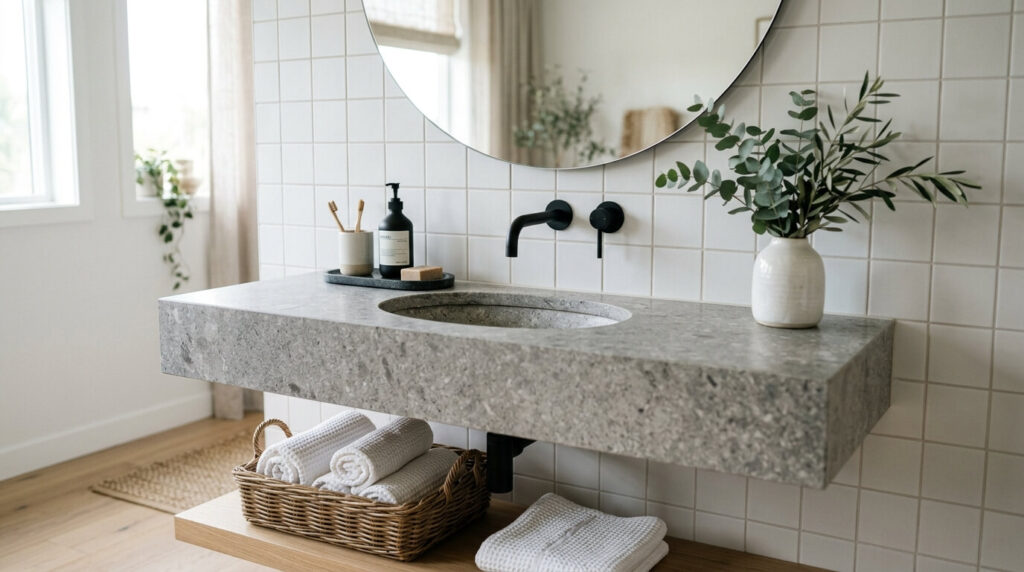
Hardware finish is a fast, relatively inexpensive way to shift a bathroom’s whole personality. Popular contemporary options include:
| Finish | Best Paired With |
|---|---|
| Matte black | Bright white walls, brass accents, black-and-white tile |
| Brushed gold / brass | Warm neutrals, marble, soft pastels |
| Brushed nickel | Cool grays, blues, transitional spaces |
| Polished chrome | Crisp, minimalist all-white schemes |
Whichever finish you choose, consistency matters more than the specific color — mixing three or four different metal tones across faucets, hardware, and lighting tends to undercut the intentional, curated feel contemporary decor relies on. One dominant finish with a single secondary accent (for example, black fixtures with brass mirror trim) reads as deliberate rather than mismatched.
Styling with Decor & Accessories
This is the layer most guides skip — but it’s what actually makes a bathroom feel finished rather than just renovated.
Textiles
Choose a small number of higher-quality pieces over a full matching set. A textured bath mat, a couple of Turkish or waffle-weave towels, and a simple woven storage basket add warmth without visual noise.
Art & Mirrors
An oversized, minimally framed mirror — round, arched, or a clean rectangle — does more for a contemporary bathroom than several small decor pieces combined. If wall space allows, one piece of abstract or black-and-white photographic art works better than a gallery wall, which can crowd the room’s intentionally quiet feel.
Greenery & Accents
A single sculptural plant (snake plant, ZZ plant, or eucalyptus if you don’t want to fuss with real greenery) softens hard surfaces like stone and glass. Keep countertop styling to two or three objects max — a soap dispenser, a small tray, and one decorative object is usually the ceiling before it starts to look cluttered.
Contemporary Decor Ideas for Small Bathrooms
Contemporary principles are especially useful in tight spaces because the style already leans toward efficiency. For a small bathroom:
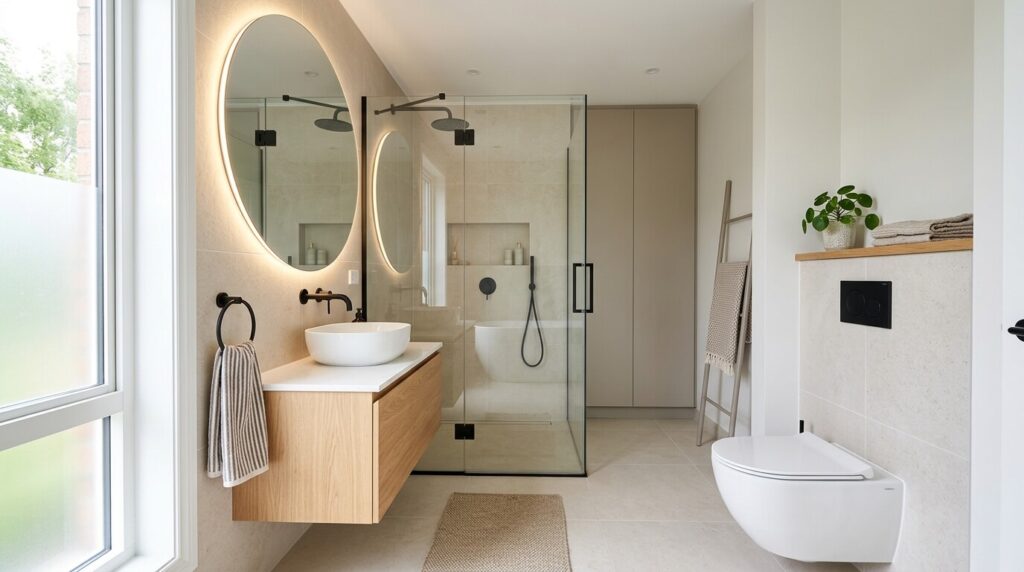
- Use a floating vanity to expose more floor and make the room feel larger
- Choose large-format tile rather than small mosaic patterns, which visually shrink a space
- Swap a tub for a walk-in shower with a frameless glass panel to open up sightlines
- Install a backlit or oversized mirror to bounce light and add perceived square footage
- Stick to a tighter color palette (two tones max) so the eye isn’t broken up by transitions
Budget-Friendly vs. Splurge-Worthy Updates
You don’t need a full renovation to shift a bathroom toward contemporary decor. Here’s where to spend and where to save:
Save on:
- Paint (a single accent wall in a current neutral)
- Hardware swaps (cabinet pulls, towel bars)
- Textiles and accessories
- Peel-and-stick or paintable wallpaper for an accent wall
Splurge on:
- A statement mirror or lighting fixture
- A frameless glass shower enclosure
- Large-format tile or a stone-look countertop
- A floating vanity, if your plumbing setup allows
A licensed contractor or interior designer can confirm which of these updates require plumbing or electrical work in your specific bathroom before you budget for them.
FAQ
What’s the difference between modern and contemporary bathroom style?
Modern design refers to a specific historical design movement from the early-to-mid 20th century. Contemporary design isn’t tied to a particular era — it reflects whatever is currently trending, built around a consistent foundation of clean lines and a restrained palette.
What colors are used in contemporary bathroom decor?
Most contemporary bathrooms start with a neutral base — white, greige, or gray — and add contrast through either a deep matte accent (black, charcoal) or a warm metallic (gold, brass).
Is contemporary bathroom style expensive?
Not necessarily. Large-format porcelain tile, paint, and hardware swaps can achieve much of the look without full stone surfaces or a gut renovation.
What accessories work best in a contemporary bathroom?
Fewer, higher-quality pieces: an oversized mirror, one or two textured towels, a single sculptural plant, and minimal countertop styling.
How do I make a small bathroom look contemporary?
Lean on a floating vanity, large-format tile, a frameless glass shower, and an oversized mirror to open up the space, and keep the color palette to two tones.
Do contemporary bathrooms need matching hardware?
Not matching exactly, but consistent — one dominant metal finish throughout, with at most one secondary accent finish, keeps the look intentional.