How to reduce humidity in bathroom? Struggling with a steamy, moldy bathroom? Discover 19 proven ways to reduce humidity, from fan sizing and dehumidifiers to fixes for windowless bathrooms. Steam up your mirror every morning? Notice a musty smell creeping into the towels, or dark speckles forming in the grout no matter how often you scrub? You’re not imagining it — bathrooms are, by design, the most humid room in the average home, and unmanaged moisture is the single biggest cause of mold, peeling paint, swollen cabinetry, and costly structural repairs.
The good news is that bathroom humidity is almost always fixable without a full renovation. This guide walks through exactly how to reduce humidity in a bathroom — from free habit changes you can start today to the ventilation upgrades and materials that solve the problem for good, including the trickiest case of all: a bathroom with no window. Along the way you’ll find the science behind why condensation forms, the humidity level you should actually be aiming for, and how to tell when a damp bathroom has turned into a bigger building problem.
Why Bathroom Humidity Happens — and Why It Matters
Every time you run a hot shower or bath, water evaporates into the air as vapor. Warm air can hold far more moisture than cool air, so a five-minute hot shower can push bathroom humidity from a normal 40–50% up to 90–100% almost instantly. That moisture-laden air then drifts across the room until it touches a colder surface — a mirror, a window, a tile wall, the ceiling — where it cools rapidly and condenses back into liquid water.
This isn’t just a cosmetic nuisance. Persistent moisture is what allows mold and mildew to colonize a bathroom, and once a colony establishes itself in porous material like grout, drywall, or wood, it’s extremely difficult to eliminate completely without removing the affected material. Left unmanaged, excess humidity can lead to:
- Mold and mildew on walls, ceilings, grout, and shower curtains
- Health effects, including aggravated allergies, asthma flare-ups, and respiratory irritation from prolonged mold exposure
- Peeling or bubbling paint and lifting wallpaper
- Warped or swollen wood, including door frames, cabinets, and skirting boards
- Loosened tiles and crumbling grout, since water seeps behind cement-based grout over time
- Dry rot and structural decay in untreated timber framing
- Musty odors that linger in towels, bath mats, and soft furnishings
- Higher heating bills, because damp air actually feels colder and prompts people to turn the heat up
Signs of Excess Moisture to Watch For
Most bathrooms look clean at a glance, but the early warning signs of a humidity problem are usually hiding in plain sight:
- Condensation beading on mirrors, windows, or tiled walls within minutes of a shower
- Water droplets collecting on the ceiling above the shower
- A persistent musty smell that returns shortly after cleaning
- Dark specks or fuzzy patches in grout lines, sealant, or ceiling corners
- Peeling paint, bubbling wallpaper, or damp patches on walls
- Tiles that feel loose or grout that crumbles when scraped
- Wood trim, doors, or cabinetry that stick or feel swollen
If you’re seeing two or more of these, it’s worth treating humidity control as a priority rather than a someday project.
How To Reduce Humidity In Bathroom
What Humidity Level Should a Bathroom Actually Be?
Indoor air quality guidelines generally recommend keeping relative humidity in a home between 30% and 50%, with most building-science sources citing 50% as the upper comfort ceiling before mold risk rises sharply. A bathroom is the exception during active use — a brief spike to 80–100% relative humidity (RH) while the shower is running is normal and not a problem in itself.
What matters is the recovery time: a well-ventilated bathroom should drop back down toward that 50% baseline within 20–30 minutes of the shower or bath ending. If your bathroom is still visibly steamy or the mirror is still fogged an hour later, that’s a clear signal your ventilation isn’t keeping pace with moisture production.
How to Measure Bathroom Humidity
You don’t have to guess. A simple plug-in or battery-powered hygrometer (sometimes bundled into smart thermostats or humidity-sensing fans) costs very little and gives you a real number to work from. Place it away from the direct shower spray, at roughly chest height on an interior wall, and check it both during a shower and 30 minutes after. This single habit turns “my bathroom feels damp” into a measurable, fixable problem.
19 Effective Ways to Reduce Humidity in a Bathroom
1. Run the Extractor Fan — and Leave It Running Longer Than You Think
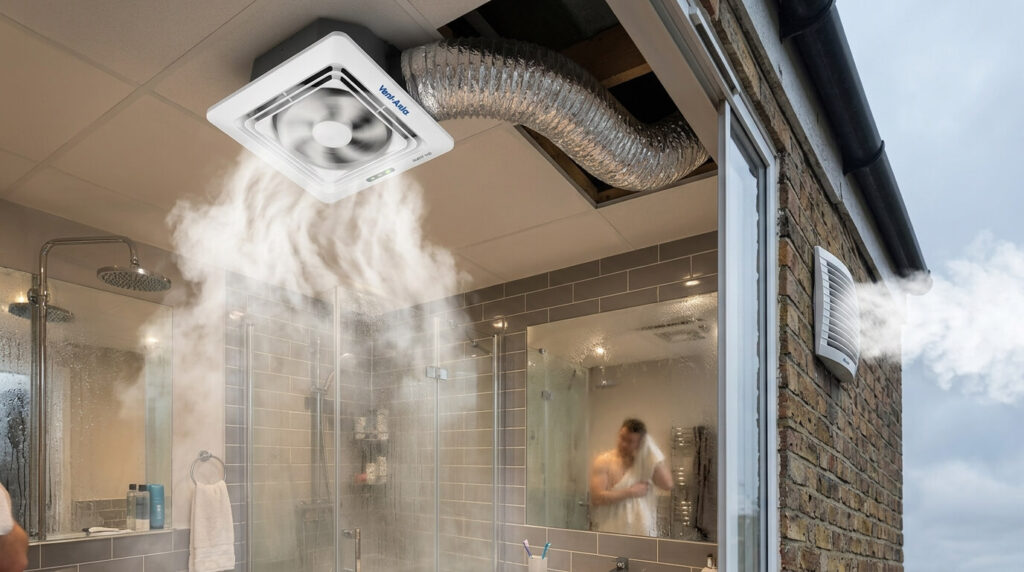
An extractor (exhaust) fan is the single most effective fix for bathroom humidity because it physically removes moist air rather than just moving it around. Run the fan during the entire shower or bath, then keep it running for 15–30 minutes afterward — most humidity actually escapes the room in the minutes after you step out, not during.
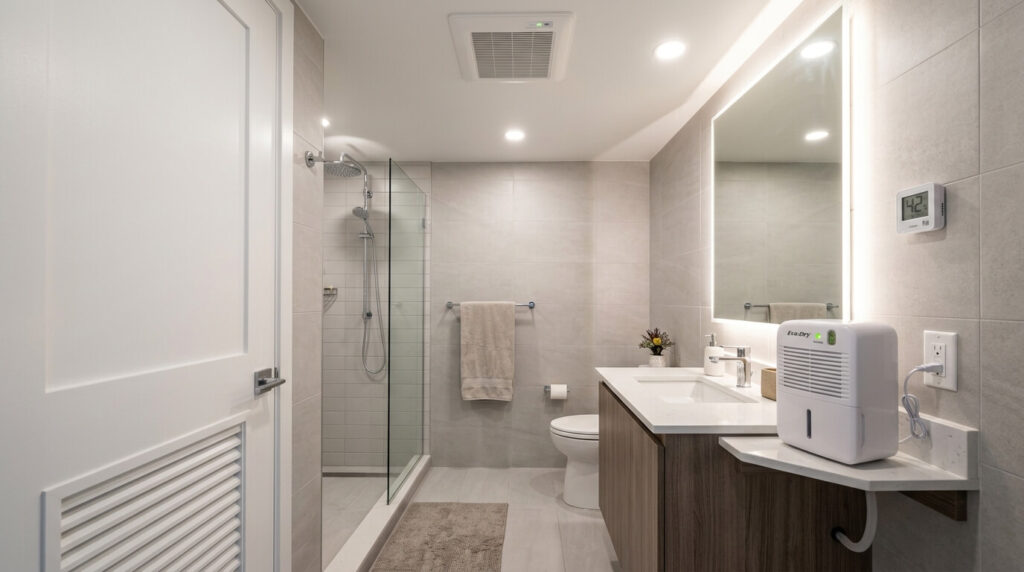
Fan capacity matters too. As a rule of thumb, a bathroom fan should be rated for at least 1 cubic foot per minute (CFM) per square foot of floor area, with a practical minimum of 50 CFM for an average-sized bathroom and more for larger rooms or rooms with a separate tub and shower. Many ventilation codes and standards (such as those referenced by ASHRAE and the Home Ventilating Institute) use this benchmark when sizing residential exhaust fans. If your existing fan struggles to clear steam within 20 minutes, it’s likely undersized or due for cleaning.
Maintenance tip: dust and grime inside the fan housing and grille reduce airflow significantly over time. Vacuum the grille and wipe down the fan blades every two to three months.
2. Switch to a Humidity-Sensing or Timer-Controlled Fan
A standard light-switch fan only runs while someone remembers to flip it — and it’s usually switched off the moment the room feels merely “okay,” long before humidity has actually cleared. Humidistat-controlled fans solve this by automatically activating when relative humidity crosses a set threshold and shutting off once the air dries out, even if no one is in the room. Timer-delay fans, which keep running for a set period after the light or fan switch is turned off, achieve a similar result more cheaply. Either upgrade removes the human error from the equation.
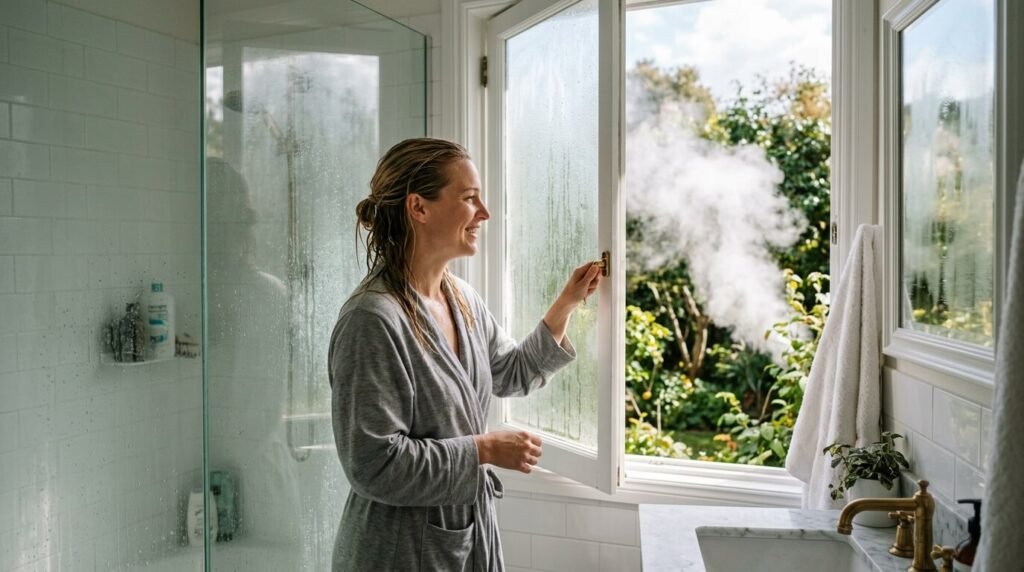
3. Open the Window (When You Have One)
If your bathroom has an operable window, opening it during and after a shower lets moist air escape directly outside rather than migrating into the rest of the house. This costs nothing and works well in mild weather, though it has real trade-offs: in winter it lets heat escape and the room turn cold fast, and in any season an open ground-floor window left unattended is a security consideration. Single-pane windows also tend to run colder than double-glazed ones, which means they collect more condensation in the first place — something to budget for if window replacement is on the table.
4. Add Passive (Trickle) Ventilation
Passive vents — small, non-powered openings built into the wall or window frame — use the natural tendency of warm, moist air to rise and escape through pressure differences, drawing in fresh air to replace it. They require no electricity and very little maintenance beyond keeping the vent unobstructed and occasionally wiped clean, but they move far less air than a powered extractor fan and work best as a supplement, not a replacement.
5. Take Shorter, Cooler Showers
The hotter and longer the shower, the more water vapor enters the air. Trimming a shower by even two to three minutes, or lowering the water temperature slightly, measurably reduces the moisture load your ventilation has to clear. It’s a free fix and also saves water and energy — the only downside is it asks you to give up a little bit of luxury.
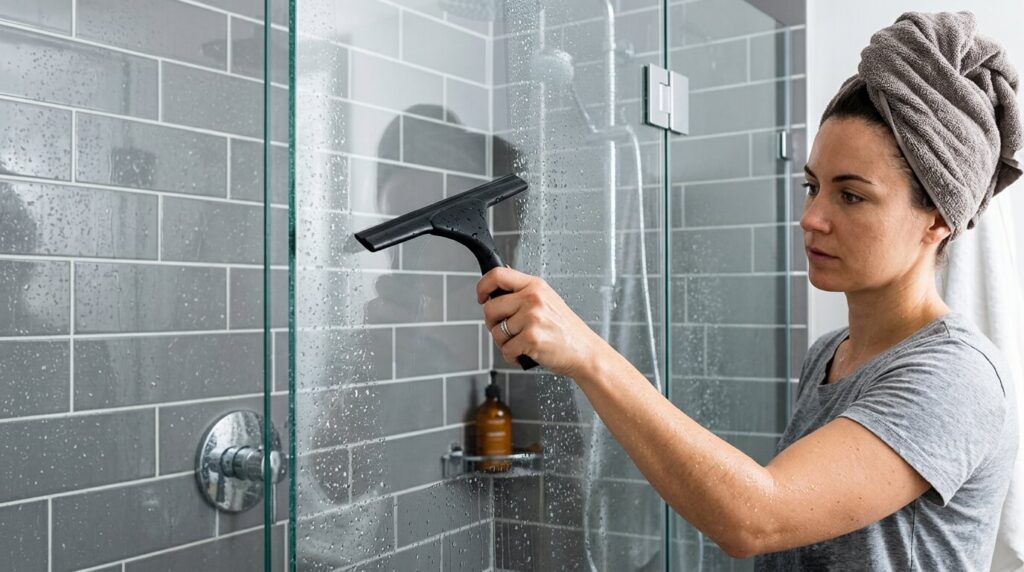
6. Squeegee and Wipe Down Wet Surfaces Immediately
Standing water left on tiles, glass, and the tub edge doesn’t just sit there — it slowly evaporates back into the room over the next hour, undoing the work your fan just did. A cheap squeegee for glass and tile, followed by a quick towel pass on the floor and windowsill, removes that moisture before it can re-enter the air. This single 60-second habit, done after every shower, is one of the most underrated humidity fixes there is.
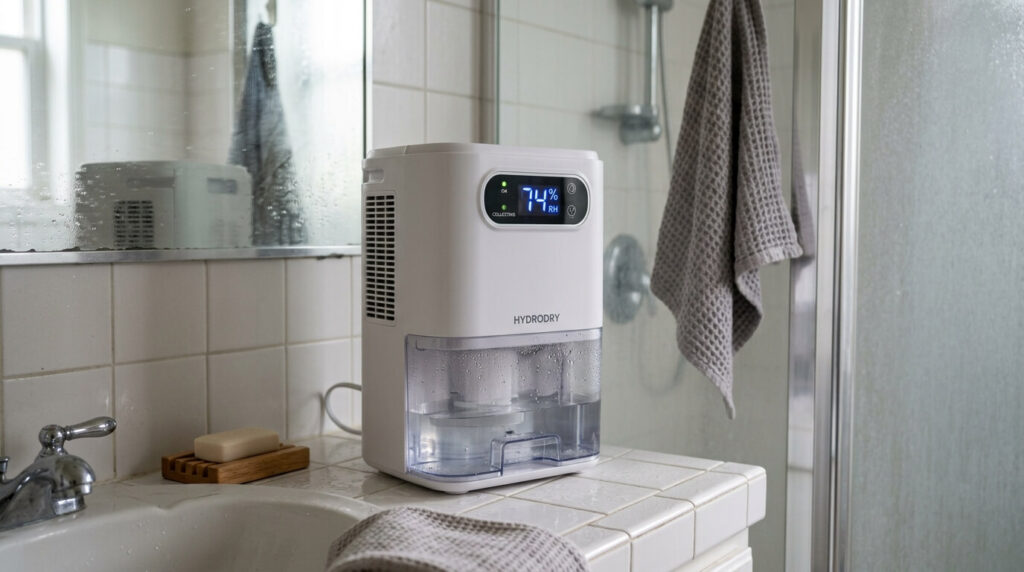
7. Use a Dehumidifier
A compressor or desiccant dehumidifier actively pulls moisture from the air and collects it as liquid water in a removable tank. Compact, bathroom-specific models are designed to handle higher ambient humidity and tighter spaces, and many sit comfortably on a counter or shelf. Before buying, weigh:
- Room size – larger or open-plan bathrooms need higher extraction capacity
- Extraction capacity – measured in litres or pints of water removed per day
- Noise level – relevant in small spaces used early morning or late at night
- Power source – electric dehumidifiers need a nearby, ideally GFCI-protected, outlet
If a full electric unit isn’t practical, passive moisture absorbers (see #8) are a lower-cost alternative.
8. Try Moisture-Absorbing Materials
For small or windowless bathrooms, silica gel packs, bamboo charcoal bags, calcium chloride crystals, or even an open box of baking soda placed discreetly on a shelf or inside a cabinet will passively pull moisture from the air. They won’t match the output of a fan or dehumidifier, but they help in the gaps between active ventilation cycles and need no power. Baking soda is best refreshed every few weeks; charcoal and silica products generally last several months before needing replacement or recharging.
9. Add Humidity-Loving Houseplants
Certain plants absorb moisture through their leaves and tolerate the warm, low-light conditions typical of a bathroom, making them a genuinely useful (and decorative) part of a humidity-control routine:
- Peace lily – thrives in steamy, low-light conditions and purifies the air, but is mildly toxic if ingested by children or pets
- Boston fern – loves warm, moist air and indirect light; direct sun will scorch its fronds
- Orchids – many species absorb ambient moisture and prefer indirect light and non-freezing warmth
- Chinese evergreen (Aglaonema) – tolerant of low light, thrives in humidity, and doubles as an air purifier
- Spider plant – hardy, low-maintenance, and effective at moderating humidity even in dim bathrooms
Note that not every houseplant helps — some tropical varieties actually release moisture vapor and can add to the problem, so stick to known moisture-absorbing species.
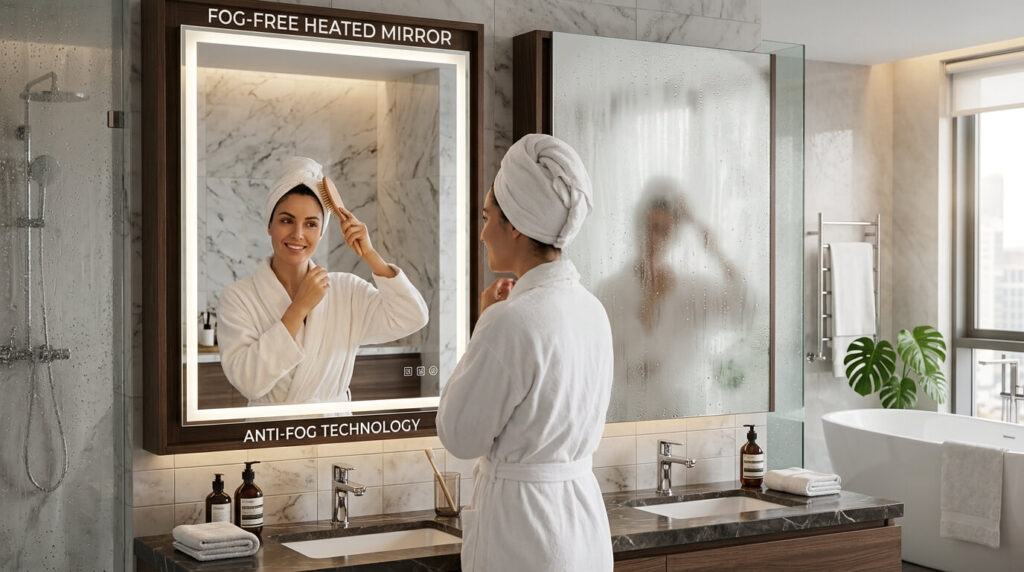
10. Demist Mirrors and Use Anti-Fog Spray
A cold mirror surface is exactly what condensation needs to form, and a fogged mirror keeps that moisture suspended in the room rather than draining away. Heated, demistable mirrors use a built-in low-wattage heating pad to keep the glass slightly warmer than the surrounding air, so condensation simply can’t form on it. You can retrofit an existing mirror with an adhesive demister pad, or apply an anti-fog spray, which leaves a thin water-repelling film that resists droplet formation — a cheaper, lower-maintenance option, though it needs reapplying periodically.
11. Get Wet Towels and Clothing Out of the Room
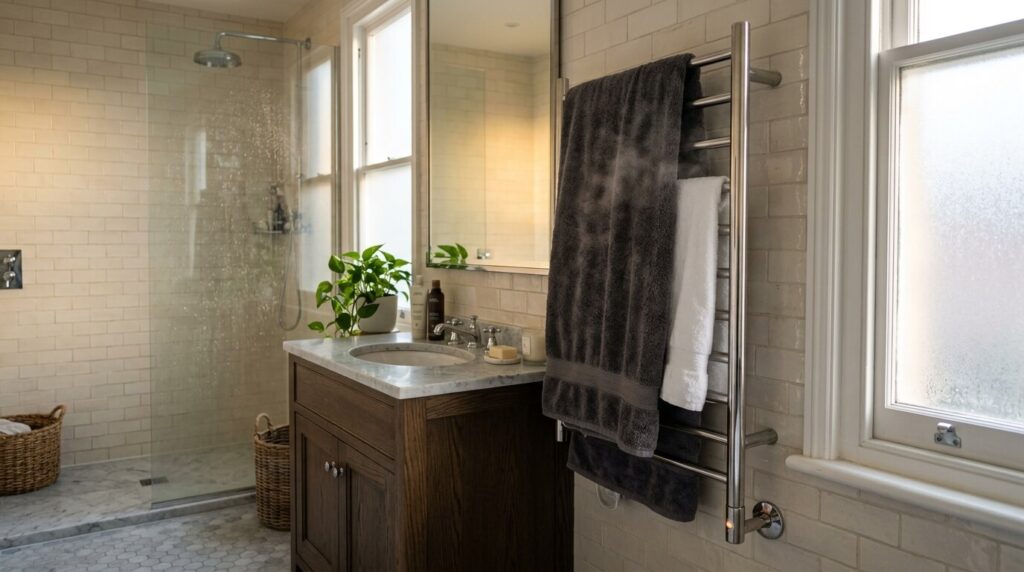
A damp towel left hanging in the bathroom keeps releasing moisture into the air for hours after your shower has ended. Hang towels and any wet clothing outside the bathroom — ideally somewhere with airflow — rather than on the back of the bathroom door. A heated towel rail or radiator solves this two ways at once: it dries the towel quickly while also gently warming and drying the surrounding air.
12. Improve Airflow With the Door
Keeping the bathroom door open after showering lets humid air disperse into the wider house rather than staying trapped in one small room. The trade-off is privacy and the fact that you’re technically relocating moisture rather than eliminating it, so this works best alongside an extractor fan, not instead of one. If privacy is non-negotiable, a vented (louvred) bathroom door allows continuous air exchange even while closed, and a small fan placed just outside the door can help push fresh air through the gap.
13. Insulate Bathroom Walls and Exhaust Ductwork
This is a step almost every consumer guide skips, and it matters most in cold climates: an extractor fan duct that runs through an unheated loft or attic before reaching the outside wall can itself become a condensation point. Warm, moist air traveling through a cold, uninsulated duct cools and drips back down into the fan housing or ceiling cavity — sometimes causing a damp ceiling stain that has nothing to do with the bathroom’s ventilation habits and everything to do with an under-insulated vent run. Insulating both the exterior walls and any ducting between the fan and the outside helps the whole bathroom stay closer to a stable, even temperature, which reduces the temperature gap that drives condensation in the first place.
14. Upgrade to Double-Glazed Windows
Single-pane glass runs noticeably colder than the surrounding wall, which makes it a magnet for condensation the moment humid air touches it. Double- or triple-glazed windows trap an insulating layer of air (or gas) between panes, keeping the inner surface closer to room temperature and dramatically cutting the condensation that beads on cold glass. It’s a bigger investment than most items on this list, but it also pays back in lower heating bills.
15. Choose Moisture-Resistant Materials
What your bathroom is built from has a direct effect on how much humidity it can tolerate without damage:
- Mould-resistant, water-repellent paint formulated for bathrooms resists peeling, bubbling, and surface mildew far better than standard interior paint
- Acrylic or laminate wall panels are a non-porous, grout-free alternative to tile, removing the joints where mold most often takes hold
- Cement board or moisture-resistant drywall (“greenboard”) behind tile is far more tolerant of splashing than standard drywall
- PVC, waterproof MDF, or treated-wood vanities resist the swelling and warping that untreated wood suffers in a humid room
- Porcelain or ceramic floor tile is non-porous and far more water-resistant than vinyl, laminate, or untreated wood flooring
16. Add Heat to the Room
Relative humidity is, by definition, a relationship between moisture content and air temperature — warmer air can hold more water vapor without condensing, and it also dries surfaces faster. A heated towel radiator, a small space heater, or in-floor (radiant) heating all raise the ambient temperature enough to speed up evaporation of leftover surface moisture and reduce the temperature gap between the air and cold surfaces like tile and glass. This is especially useful in winter, when the contrast between a hot shower and a cold bathroom is at its most extreme.
17. Maintain Caulk, Sealant, and Grout
Even the best ventilation can’t compensate for water actively seeping through a failed seal. Inspect the caulk around the tub, shower tray, and sink edges twice a year; once it cracks, peels, or discolors, water can travel behind tiles and panels where it has no chance to evaporate and every chance to feed mold out of sight. Re-caulking is a low-cost, hour-long job that prevents much more expensive hidden damage.
18. Clean Regularly — and Treat Mold the Moment You See It
Routine cleaning with a mold-inhibiting bathroom cleaner keeps spores from establishing a foothold, particularly in grout lines, ceiling corners, behind fixtures, and under sinks — all spots where airflow is naturally weaker. If mold does appear, treat it promptly with a dedicated anti-mold spray, diluted white vinegar, or a baking-soda paste. Avoid relying on bleach as a long-term fix on porous surfaces like grout, since it can bleach the surface mold visually while leaving the root structure intact under the surface, allowing it to return.
19. Combine Strategies for a Windowless Bathroom
A bathroom with no window can’t rely on the simplest fix — opening a window — so it has to work harder on every other front simultaneously. See the dedicated section below for the specific combination that works best when natural ventilation isn’t an option.
Reducing Humidity in a Bathroom Without a Window
Windowless bathrooms (common in mid-house layouts, basements, and converted spaces) are at the highest risk of chronic dampness because there’s no direct path for moist air to escape outside. The fix is rarely a single product — it’s stacking several of the strategies above:
- Install the strongest extractor fan the space allows. A humidity-sensing or inline fan (which sits in the ducting rather than the ceiling itself) provides stronger, automatic airflow than a basic ceiling unit, which matters most when there’s no window to help.
- Keep the door open whenever privacy allows, or fit a vented door so air can exchange with the rest of the house even when closed.
- Run a compact dehumidifier or moisture absorbers as a constant backup between fan cycles, since there’s no passive air exchange filling that gap.
- Choose moisture-tolerant materials throughout — water-repellent paint, non-porous wall panels, and sealed cabinetry matter more here because the room has fewer ways to dry out on its own.
- Inspect for mold more frequently. Windowless bathrooms should be checked monthly rather than seasonally, since hidden corners dry out more slowly without any natural air movement.
Comparison Table: Bathroom Humidity Solutions at a Glance
| Solution | Approx. Cost | Effectiveness | Effort to Maintain | Best For |
|---|---|---|---|---|
| Extractor fan (run + maintain) | Low–Medium | High | Low | Every bathroom |
| Humidity-sensing/timer fan upgrade | Medium | High | Very Low | Bathrooms used by multiple people |
| Opening a window | Free | Medium | None | Bathrooms with operable windows |
| Passive/trickle vents | Low | Low–Medium | Very Low | Supplementing an extractor fan |
| Shorter, cooler showers | Free | Low–Medium | None | Everyone, as a daily habit |
| Squeegee/wipe down after showering | Low (one-time) | Medium | Low (daily habit) | Every bathroom |
| Electric dehumidifier | Medium–High | High | Medium (emptying tank) | Persistently humid or windowless rooms |
| Moisture absorbers (silica, charcoal) | Low | Low–Medium | Medium (replacing regularly) | Small or windowless bathrooms |
| Humidity-loving houseplants | Low | Low | Low | Decorative, supplementary control |
| Demistable mirror / anti-fog spray | Low–Medium | Medium (mirror only) | Low | Anyone tired of wiping mirrors |
| Heated towel rail/radiator | Medium–High | Medium | Low | Cold climates, drying towels fast |
| Vented bathroom door | Medium | Medium | None | Windowless or enclosed bathrooms |
| Duct/wall insulation | Medium–High | High (long-term) | None after install | Cold-climate homes with attic ducting |
| Double-glazed window upgrade | High | High | Very Low | Single-pane window replacement |
| Moisture-resistant materials (paint, panels, tile) | Medium–High | High (long-term) | Low | Renovations and new builds |
| Caulk and grout maintenance | Low | Medium (prevents hidden damage) | Low (twice yearly) | Every bathroom |
Common Mistakes That Make Bathroom Humidity Worse
- Turning the fan off the second the shower ends. Most moisture leaves the room in the following 20–30 minutes — switching off early traps it inside.
- Leaving wet towels and bath mats in the room. They keep releasing moisture long after you’ve finished showering.
- Relying on bleach alone for mold. It can lighten surface staining without killing the mold colonizing porous grout or drywall underneath.
- Closing vents to save on heating. Blocked or closed passive vents and trickle vents stop the airflow they’re designed to provide.
- Ignoring a fan that’s lost suction. A clogged or undersized fan can run constantly and still fail to clear humidity — it’s worth testing airflow with a tissue held near the grille.
- Painting over mold instead of treating it. Standard paint doesn’t kill mold spores, and they will usually resurface through new paint within months.
- Skipping the dryer/heater after winter showers. Cold bathrooms hold less heat to evaporate leftover surface water, extending the time moisture lingers.
When Humidity Signals a Bigger Problem
Most bathroom dampness responds well to the fixes above within a few weeks. It’s time to call in a professional — a ventilation specialist, damp surveyor, or contractor — if you notice:
- Mold that returns within days of cleaning despite consistent ventilation
- Crumbling plaster, visibly damp patches, or a spreading stain on walls or ceiling
- Soft, spongy, or visibly rotting wood around the tub, window frame, or subfloor
- A persistent musty smell that doesn’t clear even with the fan running and door open
- Tiles that are loose across a wide area, suggesting moisture has been trapped behind them for some time
These are signs that moisture has gotten behind a wall, into a subfloor, or into structural framing — areas no amount of fan-running or squeegeeing can fix on their own, and where delaying repair tends to make the eventual fix more expensive.
Key Takeaways How To Reduce Humidityathroom
- Bathroom humidity spikes during a shower are normal; the problem is when it doesn’t drop back to roughly 50% RH within 20–30 minutes.
- Running the extractor fan for 15–30 minutes after showering, not just during it, is the single highest-impact habit you can adopt for free.
- Wiping or squeegeeing surfaces immediately after a shower prevents standing water from re-evaporating into the room.
- Dehumidifiers, moisture absorbers, and houseplants are useful supplements, not replacements, for proper mechanical or natural ventilation.
- Windowless bathrooms need a layered approach: stronger fan, vented door, dehumidifier, and moisture-tolerant materials working together.
- Persistent, fast-returning mold, crumbling plaster, or soft wood are signs the issue has moved beyond simple humidity control and needs professional attention.
Frequently Asked Questions
What humidity level is too high for a bathroom?
A brief spike to 80–100% relative humidity during a shower is normal. The problem is when humidity stays above roughly 60% for more than 30 minutes after you’ve finished, since that’s the range where mold growth accelerates.
How long should I run my bathroom extractor fan after a shower?
Most building-science guidance suggests 15 to 30 minutes after showering, depending on room size and how quickly the mirror and surfaces clear of condensation.
Can houseplants really reduce bathroom humidity?
Yes, to a modest degree. Plants like peace lilies, Boston ferns, and Chinese evergreens absorb some moisture through their leaves and tolerate bathroom conditions well, but they work best as a supplement to ventilation, not a replacement for it.
Do I need a dehumidifier if I already have an extractor fan?
Not always. A correctly sized, well-maintained fan run for long enough after each shower is often sufficient on its own. A dehumidifier becomes worthwhile if humidity stays high despite good fan use, or in bathrooms without a window or strong airflow.
Is it bad to leave the bathroom door open while showering?
It can help disperse humid air, but it also pushes that moisture into hallways and bedrooms rather than removing it from the home entirely. It works best as a supplement to an extractor fan rather than a primary strategy.
Why does my bathroom mirror fog up even with the fan on?
A standard fan removes air from the room generally, but a cold mirror surface will still attract condensation faster than the fan can clear it. A demistable mirror or anti-fog spray addresses the mirror specifically, alongside fan use.
Does a cooler shower really make a noticeable difference?
Yes — water vapor production rises sharply with temperature, so even a few degrees cooler, or a few minutes shorter, measurably reduces the moisture load your ventilation has to clear.
What’s the best flooring to resist bathroom humidity?
Porcelain or ceramic tile is the most water-resistant common option, since it’s non-porous. Vinyl can also perform well if seams are properly sealed; untreated wood and laminate are the most vulnerable to swelling and damage.
How do I stop mold from coming back after I clean it?
Treat the area with a dedicated anti-mold product or diluted white vinegar rather than bleach alone, dry the surface fully, and address the underlying humidity (ventilation, leaks, or sealant gaps) so the conditions that fed the mold don’t return.
Can a bathroom without a window ever be fully humidity-free?
It can be very well controlled, though it requires combining a strong extractor fan (ideally humidity-sensing or inline), a vented or open door, and a dehumidifier or moisture absorbers, since there’s no passive air exchange through a window to fall back on.
Should I insulate my bathroom exhaust duct?
Yes, especially if the duct runs through an unheated attic or loft. An uninsulated duct can let warm, moist air condense inside the ducting itself, sometimes causing ceiling stains unrelated to the bathroom’s own ventilation habits.
What size extractor fan do I need for my bathroom?
A common guideline is at least 1 CFM of extraction per square foot of floor area, with a practical minimum around 50 CFM for an average bathroom — larger or higher-use bathrooms need more.
Is condensation on bathroom windows always a sign of a problem?
Light, temporary condensation that clears within 20–30 minutes is normal, especially on single-pane glass. Condensation that lingers for hours, drips down the wall, or recurs daily despite ventilation suggests airflow or insulation needs improvement.
Can painting over bathroom mold get rid of it?
No. Standard paint doesn’t kill mold spores beneath the surface, and mold typically resurfaces through new paint within months if the underlying moisture issue isn’t addressed first.
Are heated towel rails worth it for humidity control?
They help in two ways — drying towels quickly so they stop releasing moisture into the air, and gently warming the room, which speeds evaporation of residual surface moisture. They’re most valuable in colder climates and smaller bathrooms.