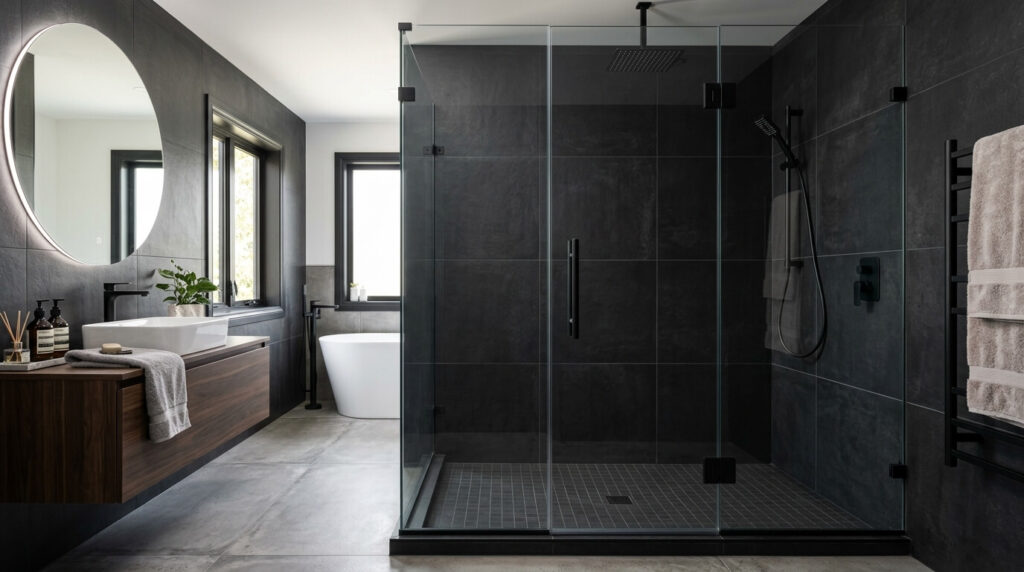
Shower Curtain vs Glass Door: Compare cost, maintenance, durability, style, and resale value to choose the best option for your bathroom. Many homeowners face the same decision when planning a bathroom upgrade: shower curtain or glass door. At first, it seems like a simple design choice. However, the decision affects your budget, maintenance, safety, and home value. It also changes how your bathroom looks and feels every day.
This guide goes further than the typical “pros and cons” list. You’ll get real cost ranges, lifespan data, glass safety standards, mold-prevention science, accessibility considerations, and a decision framework you can use right now — whether you’re renovating a primary bath, updating a rental, or just replacing a worn-out curtain liner.
Quick Answer: Shower Curtain or Glass Door?
If you want the short version, shower curtains are the more affordable option for most homeowners. They usually cost $15–$60 plus a rod and install within minutes. They work well for renters, children’s bathrooms, and unusually shaped tubs. Glass shower doors cost more, typically ranging from $300 to $3,000 or more installed. However, they can last 20–30 years with proper care and maintenance. Glass doors contain water better and create a cleaner, more modern appearance. They may also increase home value and appeal to future buyers. Choose a curtain if affordability, flexibility, and easy replacement matter most. Choose glass if durability, resale value, and long-term performance are your priorities.
Shower Curtain vs Glass Door: At a Glance
| Factor | Shower Curtain | Glass Shower Door |
|---|---|---|
| Average cost | $15–$60 (curtain + liner + rod) | $300–$3,000+ installed |
| Lifespan | 6 months–2 years (liner); curtain 1–3 years | 20–30 years with care |
| Installation | DIY, 10–30 minutes | Professional recommended; 1 day–2 weeks (custom) |
| Water containment | Moderate; depends on technique | High; sealed enclosure |
| Cleaning frequency | Wash/replace liner every 1–6 months | Wipe down weekly; deep clean monthly |
| Mold/mildew risk | Higher (fabric/vinyl liner) | Lower (smooth, non-porous glass) |
| Best for | Renters, tubs, kids’ baths, tight budgets | Walk-in showers, primary baths, resale-focused remodels |
| Resale value impact | Neutral to slightly negative | Positive, especially frameless |
| Design flexibility | Unlimited colors/patterns, swap anytime | Glass texture/tint/hardware finish options |
| Accessibility | Easier for caregivers, no swing clearance | Sliding doors need less clearance than pivot doors |
| Noise/breakage risk | None | Low risk with tempered/laminated safety glass |
What Is a Shower Curtain? Materials, Types, and How It Works
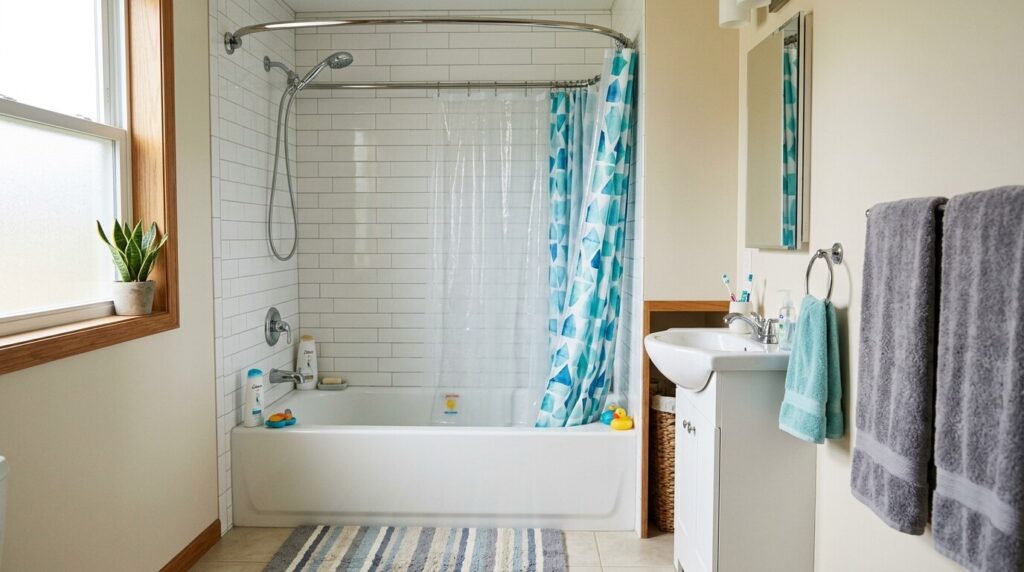
A shower curtain is a sheet of water-resistant fabric or plastic that hangs from rings or hooks on a rod, paired almost always with a separate waterproof liner that sits inside the tub or shower basin.
Curtain and Liner Materials
- Vinyl/PVC: The most affordable and widely available liner material; fully waterproof but can develop a chemical smell when new and is the least eco-friendly option.
- PEVA (polyethylene vinyl acetate): A chlorine-free alternative to vinyl, considered safer and less odorous, though still plastic-based.
- EVA (ethylene vinyl acetate): Slightly more durable and eco-friendly than PEVA, often marketed as a “green” liner option.
- Cotton or polyester fabric: Used for the decorative outer curtain (not the liner); breathable and machine-washable but needs a waterproof backing or separate liner to actually contain water.
- Hookless and magnetic-hem curtains: Newer designs that snap directly onto rod rings or use weighted/magnetic hems to keep the curtain clinging to the tub wall, reducing splash-out.
Rod Types That Affect Performance
- Straight tension rod: Cheapest, no drilling, but provides the least shower space.
- Curved shower rod: Bows outward to add 4–6 inches of elbow room and pulls the curtain away from your body.
- Ceiling-mounted/track rod: Common for clawfoot tubs and oversized showers; supports heavier or double curtains.
- L-shaped or wraparound rod: Used for corner tubs or walk-in showers without a door, mimicking the coverage of a glass enclosure.
What Is a Glass Shower Door? Materials, Types, and How It Works
A glass shower door (or enclosure) is a rigid panel — or set of panels — made from safety glass, mounted with metal or glass-to-glass hardware to fully or partially close off the shower or tub.
Glass Safety Standards You Should Know
Shower glass is never ordinary annealed glass. Building codes (including the IRC and ANSI Z97.1/CPSC 16 CFR 1201 safety glazing standards) require tempered or laminated safety glass in “hazardous locations” like shower and tub enclosures, because it breaks into small, rounded pieces or stays bonded to an interlayer rather than shattering into sharp shards. When shopping, ask any installer or retailer for documentation that the glass meets these standards — reputable companies will have it readily available.
Framing Styles
- Frameless: No metal framing around the glass edges; held with small clips, hinges, and silicone joints. The cleanest, most popular look in modern bathrooms, but typically the most expensive because it requires thicker (3/8″–1/2″) glass for structural rigidity.
- Semi-frameless: Combines some framing (usually on the wall-mounted side) with frameless glass edges elsewhere — a mid-cost compromise.
- Fully framed: Aluminum or metal frames surround every glass edge. The most budget-friendly and often the easiest to retrofit into an existing opening, though it has more surfaces (tracks, corners) that can collect grime.
- Grid-style: A growing trend that pairs clear glass with black metal mullions for a vintage-industrial look that works with farmhouse, transitional, and contemporary designs alike.
Door Configurations
- Pivot/hinged swing door: Swings open like a regular door; needs floor clearance.
- Sliding (bypass) door: Two or more panels slide on a track — ideal for space-constrained bathrooms since nothing swings outward.
- Bi-fold door: Folds in half to open, useful in narrow openings.
- Neo-angle door: Cuts across a corner shower at an angle, maximizing floor space in small bathrooms.
- Fixed shower screen/splash panel: A single stationary pane that blocks the open side of a walk-in shower without forming a full enclosure — a popular middle ground between a curtain and a full door.
Shower Curtain VS Glass Door Complete Guide
Glass Finish Options
- Clear glass: Most popular; makes the bathroom feel larger and shows off tile work. Look for “low-iron” glass if you want to avoid the slight greenish tint standard clear glass can have at the edges.
- Acid-etched/frosted glass: Frosted for privacy while still letting light through.
- Patterned/textured glass: Decorative obscuring options in varying intensities.
- Tinted glass: Gray or bronze tones add privacy and a different aesthetic.
- Cast glass: Heavily textured, dramatic look; harder to keep streak-free due to its ridges.
Cost Comparison: What You’ll Actually Spend
Shower Curtain Costs
| Item | Typical Cost |
|---|---|
| Basic curtain | $10–$30 |
| Designer/heavyweight curtain | $30–$80 |
| Liner (vinyl/PEVA/EVA) | $8–$25 |
| Tension rod | $10–$25 |
| Curved or ceiling-mount rod | $25–$80 |
| Total starter setup | $30–$150 |
| Annual replacement cost (liner) | $10–$30/year |
Glass Shower Door Costs
| Door Type | Installed Cost Range |
|---|---|
| Framed, standard size | $300–$900 |
| Semi-frameless | $700–$1,500 |
| Frameless, standard size | $900–$2,000 |
| Frameless, custom/oversized | $1,500–$3,500+ |
| Fixed splash panel/shower screen | $400–$1,200 |
Add roughly 10–20% more for upgrades like low-iron glass, premium hardware finishes (matte black, brushed gold), permanent water-repellent coatings, or non-standard angles. If your bathroom has an irregular layout, expect custom measurements and fabrication, which adds both cost and lead time.
The Real Cost Comparison: Lifetime Value
A curtain setup costing $30–$150 upfront will typically need a new liner every 6–12 months ($10–$30 each time) and a full curtain refresh every 1–3 years. Over a 20-year period, that adds up to roughly $400–$900 in cumulative spend — plus the ongoing time cost of washing and replacing.
A glass door costing $900–$2,000 installed, with proper care, can last 20–30 years with no replacement needed — making its effective annualized cost often comparable to, or even lower than, a curtain once you factor in two decades of liner replacements. This is the calculation competitor articles routinely skip, and it’s the one that matters most for anyone planning a long-term stay in their home.
Installation: DIY Timeline vs Professional Process
Shower curtain: Most people can hang a rod and curtain in 10–30 minutes with a drill (for permanent rods) or no tools at all (for tension rods). No professional needed.
Glass shower door: Expect this process:
- In-home measurement/consultation — a glazier or installer measures your exact shower opening (custom glass is cut to your space, not the other way around).
- Quote and glass selection — choosing framing style, glass finish, and hardware.
- Fabrication lead time — typically 1–3 weeks for custom glass.
- Installation day — most standard installs take 2–4 hours; complex frameless or neo-angle configurations can take longer.
Prefab/kit doors from big-box retailers can be DIY-installed in a weekend, but they won’t be custom-fitted to your exact opening, which increases the risk of gaps and leaks if your shower isn’t a standard size.
Durability and Lifespan: The Numbers
- Shower curtain liners: 6 months to 2 years before mold, soap scum buildup, or tearing necessitates replacement, even with regular washing.
- Decorative curtains: 1–3 years before fading, fraying, or simply going out of style.
- Framed glass doors: 15–20 years; metal tracks and hinges are the first parts to wear out.
- Frameless glass doors: 20–30+ years with proper maintenance, since there’s less hardware to fail.
- Glass itself: Tempered and laminated safety glass rarely fails structurally; the more common “end of life” trigger for a door is hardware corrosion, hard water etching, or a desire to update the bathroom’s style — not the glass breaking.
Water Containment and Leak Prevention
Glass doors generally win on water containment, but only when properly installed and used. Key factors:
- Curb slope: The shower curb should slope ¼”–½” toward the drain; an improperly sloped curb causes pooling regardless of which enclosure you choose.
- Shower head aim: Aiming a handheld or rain shower head directly at a door seam or curtain gap is the single most common cause of “this enclosure leaks” complaints.
- Curtain technique: A curtain must be pulled fully closed and draped inside the tub wall — both liner and outer curtain — every single time. Half-closed curtains are the #1 cause of bathroom floor flooding.
- Door seals: Vinyl door sweeps and seals degrade over 5–10 years and should be inspected; a worn seal on an otherwise great door will leak.
- Sliding vs. pivot doors: Sliding doors are particularly effective in tight layouts because they never swing outward, but their bottom tracks can trap standing water if not squeegeed.
Best practice for curtains: Pair with a curved rod and a weighted or magnetic-hem liner to dramatically cut down on splash-out — a tip most competitor guides only mention in passing.
Cleaning and Maintenance
Glass Door Maintenance Routine
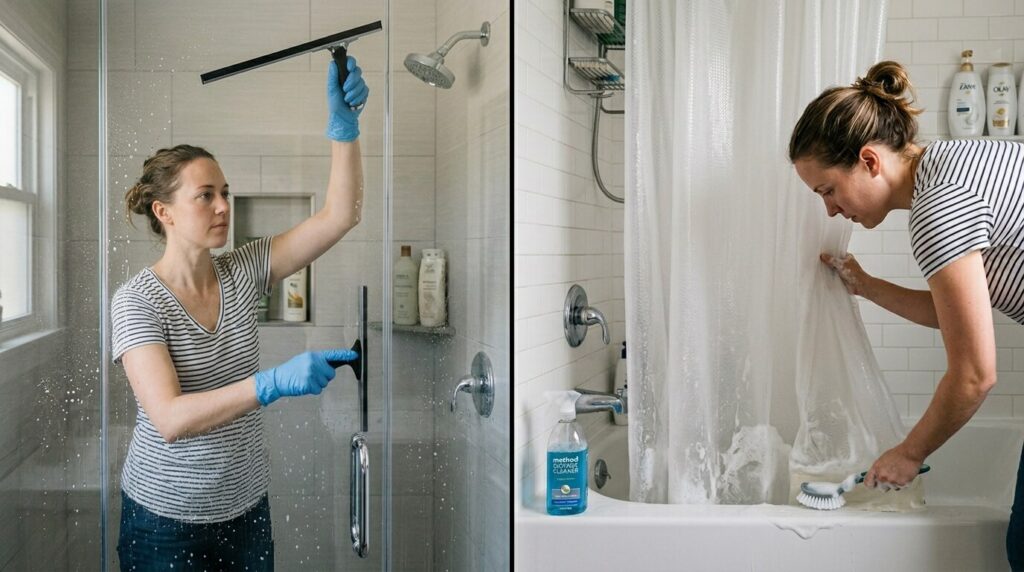
- After every shower: A 10-second squeegee pass prevents 80% of hard water spotting.
- Weekly: Wipe with a non-abrasive glass cleaner or a vinegar-water solution — but not on coated/treated glass (vinegar’s acidity can degrade some protective coatings over time, so check your finish first).
- Monthly: Deep-clean tracks, hinges, and corners where soap scum collects.
- Long-term: Permanently protected or coated glass (a sealant applied at fabrication) sheds water and resists staining far longer than untreated glass, reducing scrubbing time significantly.
Curtain and Liner Maintenance Routine
- Weekly: Spread the curtain/liner fully open after each shower so it can dry; this single habit does more to prevent mold than any cleaning product.
- Monthly: Most fabric curtains and many liners are machine-washable on a gentle cycle with a small amount of detergent and vinegar (check the care label first).
- Every 3–12 months: Replace the liner once staining, discoloration, or a musty smell sets in — cleaning often improves but doesn’t fully reverse liner degradation.
- Ventilation matters most: Running a bathroom exhaust fan for 20–30 minutes after showering reduces ambient humidity and is the single biggest factor in how often you’ll need to clean or replace either a curtain or a door.
Mold, Mildew, and Hygiene
Mold and mildew need moisture, warmth, and a food source (soap residue, skin cells, dust) — both curtains and glass enclosures can develop it if the bathroom is poorly ventilated.
- Curtains are more vulnerable because fabric and vinyl are porous or seam-stitched, giving mold spores more surface area and hiding spots, especially along the bottom hem that stays damp longest.
- Glass and metal can’t be colonized the way fabric can, but silicone caulk joints and metal tracks on a glass door are exactly where mildew tends to take hold if not cleaned — so “glass doesn’t get moldy” is a half-truth; the hardware around it absolutely can.
- A frameless door has fewer tracks, corners, and caulk lines than a framed one, which is part of why it’s considered the easiest enclosure type to keep mold-free.
Aesthetics and Design Trends
Glass doors — particularly frameless and the increasingly popular grid-style (clear glass with black metal mullions) — currently dominate high-end bathroom design because they read as more spacious, modern, and clean. Shower curtains, by contrast, remain unmatched for instant personality: a single curtain swap can shift a bathroom’s entire color story for under $50, something no glass door can do without replacement.
If your priority is matching an evolving design scheme over the years, a neutral-toned glass door paired with a frequently updated curtain on a different shower or tub in the home is a smart hybrid strategy.
Small Bathroom and Space Considerations
- Pivot/hinged glass doors need floor clearance to swing open — usually at least the width of the door itself — which can be a dealbreaker in a cramped bathroom.
- Sliding/bypass doors and neo-angle doors solve this by operating within the shower’s existing footprint.
- Curtains need zero clearance to “open” (you just push them aside), making them the most space-flexible option, but a curtain pushed fully back still occupies visual space and can make a small room feel busier.
- Fixed glass panels/splash screens, which only cover part of the opening, are an underused middle ground for small bathrooms that want the look of glass without a full enclosure’s footprint.

Accessibility, Safety, and Aging in Place
This is one of the most overlooked factors in most comparison articles:
- Caregiving situations (bathing a baby, assisting a toddler, helping an elderly family member): a curtain that pushes fully out of the way gives unobstructed access to the tub, which a hinged or even sliding door can’t always match.
- Walk-in/zero-threshold showers for aging-in-place or mobility-limited households often use a fixed glass panel or splash guard rather than a full door, preserving step-free entry while still containing some water.
- Grab bars and non-slip flooring matter more than enclosure choice for fall prevention, but glass doors should always use safety glazing (tempered/laminated) per code, and curtains should be paired with a properly weighted liner so it can’t be pulled down if someone grabs it for balance.
- ADA-compliant bathrooms typically favor curtains or fixed panels over swinging doors specifically because they don’t obstruct a wheelchair or walker’s turning radius.
Privacy
- Frosted, acid-etched, patterned, or tinted glass can match a curtain’s privacy level while still allowing light through — a good option for shared bathrooms or street-facing windows.
- Clear glass with no coating offers the least privacy of any option discussed here.
- Opaque or dark-colored curtains remain the single most private, lowest-cost option.
Resale Value and ROI
Real estate agents and home appraisers consistently note that updated glass shower enclosures — especially frameless ones — register as a renovation signal to buyers, similar to updated countertops or flooring, because they visually communicate “this bathroom has been modernized.” A worn or dated shower curtain setup, by contrast, rarely hurts a sale on its own but also does nothing to help it. If you’re renovating specifically to sell within the next few years, a glass door in at least the primary bathroom tends to deliver a better perceived-value return than a curtain upgrade.
Renters vs. Homeowners
- Renters almost always default to curtains since installing glass doors usually requires landlord permission and isn’t recoverable when you move.
- Homeowners planning to stay long-term get the most value from glass, since the higher upfront cost amortizes over decades.
- Homeowners planning to sell soon should weigh the cost of a glass door against comparable buyer-facing upgrades in their specific market before committing.
Hybrid and Alternative Options
You don’t have to choose strictly one or the other:
- Splash panel + curtain combo: A short fixed glass panel on the open end of the tub, paired with a curtain or smaller screen on the rest of the opening — common in tub-shower combos where a full door isn’t practical.
- Sliding door over a clawfoot or freestanding tub: A ceiling-track sliding panel that wraps around an otherwise hard-to-enclose tub shape.
- Curtain as a glass-door backup: Some households add a tension-rod curtain just inside a glass door’s swing radius for extra splash protection during high-pressure or rainfall shower heads.
Environmental Considerations
- Vinyl/PVC liners are the least eco-friendly common option due to their production process and disposal; PEVA and EVA liners are marketed as lower-impact alternatives.
- Frequent curtain/liner replacement generates more recurring waste over a 20-year period than a single glass door installation.
- Glass is fully recyclable at end of life, and a well-maintained door rarely needs replacing at all, giving it a smaller long-term environmental footprint despite the higher manufacturing energy cost upfront.
Common Mistakes to Avoid
- Buying a curtain liner without checking the tub’s actual width — an undersized liner won’t tuck into the tub properly, guaranteeing leaks.
- Aiming a rain or handheld shower head directly at a door seam.
- Skipping the exhaust fan — this single habit affects mold risk more than the enclosure type itself.
- Cleaning coated glass with abrasive pads or straight vinegar, which can strip protective treatments.
- Installing a swinging door in a bathroom too small for its clearance radius.
- Assuming all “frameless” doors are equally priced — glass thickness, hardware finish, and custom angles all swing the price significantly.
- Forgetting the curb slope during a remodel, which causes pooling no matter what enclosure sits on top of it.
Expert Tips and Best Practices
- Ask any glass installer for proof their glass meets tempered or laminated safety glazing standards before signing a contract.
- If budget allows only one upgrade in a multi-bathroom home, prioritize glass in the primary bathroom for resale impact and put curtains in secondary or kids’ bathrooms.
- Choose a curved rod over a straight one for any curtain setup — it’s a low-cost change that meaningfully improves both space and water containment.
- For frameless doors, ask about permanently bonded protective coatings; they cost more upfront but cut cleaning time dramatically over the door’s life.
- In humid climates or poorly ventilated bathrooms, lean toward whichever option has fewer seams and crevices (typically frameless glass) to minimize mold maintenance.
How to Decide: A Quick Framework
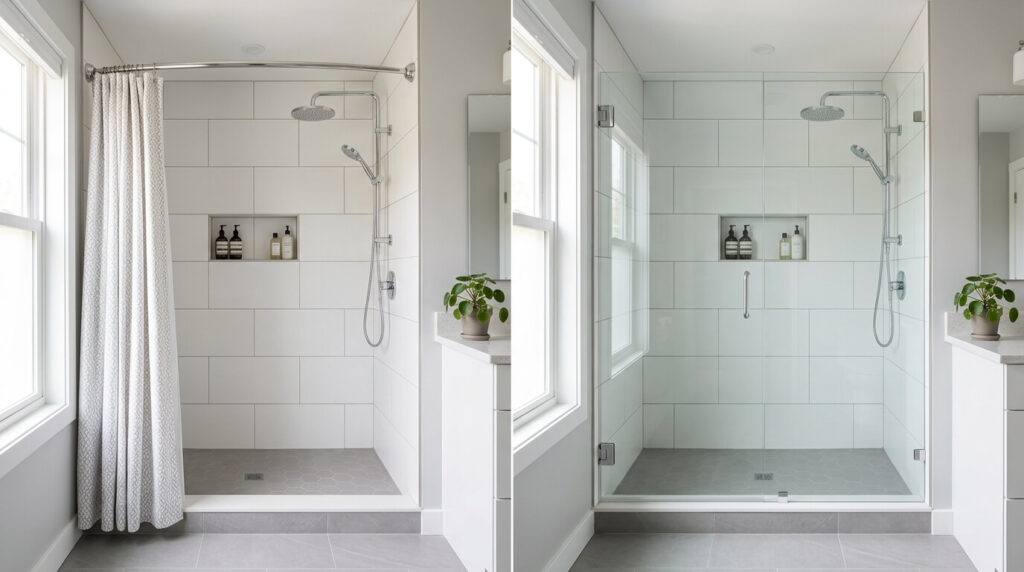
Ask yourself these four questions:
- Am I renting, or could I move within 2–3 years? → Lean curtain.
- Is this a primary bathroom I want to maximize resale value on? → Lean glass.
- Do I need to bathe small children or assist someone with mobility needs? → Lean curtain or fixed splash panel.
- Is my bathroom small or an unusual shape? → Consider a sliding door, neo-angle door, or curtain — avoid a swinging pivot door.
FAQ Shower Curtain VS Glass Door
Which is cheaper, a shower curtain or a glass door?
A shower curtain setup costs $30–$150 upfront versus $300–$3,000+ for an installed glass door, making curtains the clear winner for immediate budget. Over a 20-year span, however, repeated liner and curtain replacements can narrow that gap considerably.
Do glass shower doors increase home value?
Yes — real estate professionals generally treat an updated glass enclosure, especially a frameless one, as a visible sign of a modernized bathroom, which tends to support a stronger resale impression than a curtain.
How often should I replace a shower curtain liner?
Most liners need replacing every 6 to 12 months, sooner if you notice mildew spots, a persistent odor, or visible tearing along the grommets.
Can you put a glass door over a bathtub?
Yes, sliding or pivot glass doors are commonly installed over tub-shower combinations; just confirm the tub’s curb height and width match standard or custom glass dimensions.
Are frameless shower doors worth the extra cost?
For most homeowners planning to stay long-term or sell eventually, yes — frameless doors have fewer mold-prone seams, a longer perceived lifespan, and a more modern look that buyers respond to.
What is the best material for a shower curtain liner?
PEVA and EVA liners are generally preferred over standard vinyl/PVC because they’re chlorine-free and less prone to off-gassing odor, while still being fully waterproof.

Do shower curtains cause more mold than glass doors?
Curtains are statistically more prone to mold because fabric and vinyl are porous and seam-stitched, but glass doors can develop mildew in their caulk lines and tracks if not cleaned regularly — neither option is mold-proof without ventilation.
How do I stop water from leaking past a glass shower door?
Check and replace worn door sweeps/seals every 5–10 years, avoid aiming the shower head directly at seams, and confirm your curb has a proper ¼”–½” slope toward the drain.
Can I install a shower door myself?
Prefab kit doors can be DIY-installed in a weekend, but custom-fitted frameless or semi-frameless doors are best left to a professional glazier to ensure a precise, leak-resistant fit.
What’s the lifespan of a glass shower door vs. a curtain?
A well-maintained frameless glass door can last 20–30 years, while a curtain liner typically lasts under two years and the decorative curtain itself one to three years before needing replacement.
Acid-etched or frosted glass better for privacy?
Both provide similar privacy by obscuring direct visibility while still allowing light through; the choice usually comes down to aesthetic preference rather than functional difference.
Are shower curtains safer for kids and elderly users?
Curtains can be safer in caregiving scenarios because they offer unobstructed tub access and no swinging glass panel, though any glass door installed should always use tempered or laminated safety glazing regardless of household members.
What cleaning products should I avoid on glass shower doors?
Avoid abrasive scouring pads and be cautious with straight vinegar on coated or treated glass, since acidic cleaners can degrade some protective sealants over time — check your door’s specific finish first.
Can I combine a shower curtain with a glass panel?
Yes — a fixed splash panel paired with a curtain on the remaining opening is a popular hybrid for tub-shower combos where a full door isn’t practical or affordable.
Which option is better for small bathrooms?
Sliding glass doors, neo-angle doors, and curtains are all better suited to small bathrooms than swinging pivot doors, since none of them require floor clearance to fully open.