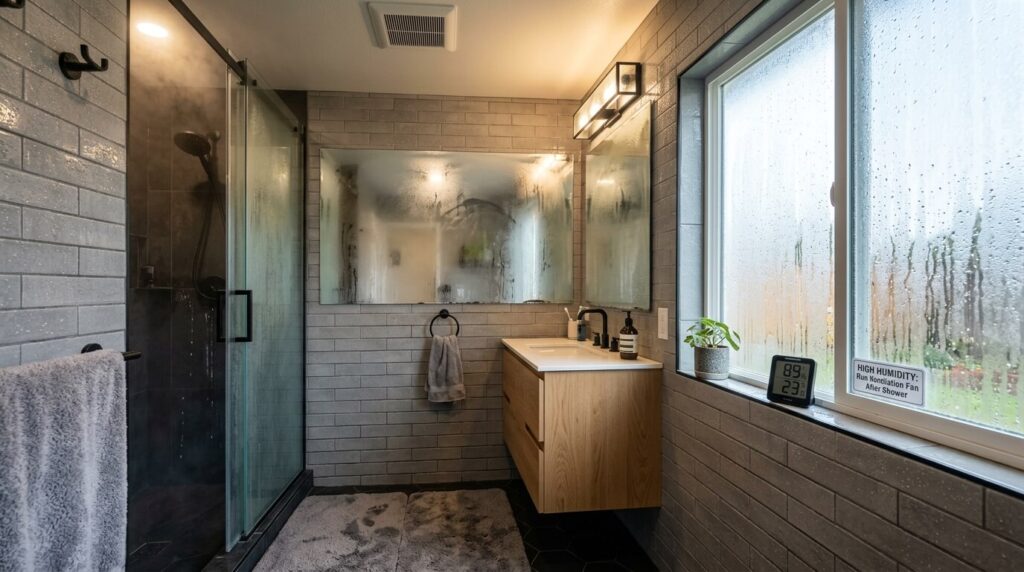
Steam up your mirror every morning? That fog is a warning sign, not just an inconvenience. Once bathroom air sits above 60% relative humidity for more than a day or two, mold has everything it needs to start colonizing your grout, drywall, and ceiling corners.
Quick answer: To dehumidify a bathroom, run a properly sized exhaust fan for at least 20–30 minutes after every shower, add a portable dehumidifier or moisture-absorbing container for humid climates, wipe down wet surfaces immediately, and keep the room’s relative humidity under 60% (ideally 40–50%). A $15 hygrometer lets you check that number instead of guessing.
That’s the short version. Below is the full breakdown — including how to actually size a fan instead of buying one at random, what a dehumidifier’s “pint rating” means for your specific bathroom, and which fixes are worth the money versus which ones are just marketing.
What Counts as “Too Humid” in a Bathroom?
Relative humidity (RH) is the amount of moisture in the air compared to the maximum it could hold at that temperature. The Environmental Protection Agency recommends keeping indoor RH below 60%, with 30–50% as the ideal target range for preventing mold and dust mites. Bathrooms are the exception that spikes temporarily — a hot shower can push a small bathroom to 90%+ RH for several minutes — but the goal is to get it back under 60% within about 20–30 minutes.
That timeline matters because most household mold species begin colonizing damp surfaces once RH stays above 60% for 24–48 hours straight. On surfaces that are already porous or wet from standing water, visible growth can appear even faster. So the real objective isn’t eliminating humidity spikes (impossible), it’s shortening how long the room stays wet after each spike.
Signs Your Bathroom’s Humidity Is a Problem
You don’t need a hygrometer to notice the early warning signs. Watch for:
- Persistent fog on mirrors or windows more than 10 minutes after a shower
- A musty smell that returns even after cleaning
- Peeling paint, bubbling wallpaper, or soft drywall near the tub
- Dark speckling in grout lines or silicone caulk
- Warped wood on vanities, baseboards, or window sills
- Condensation dripping from the ceiling or light fixtures
If you’re seeing more than one of these at once, don’t just add a candle and hope — work through the fixes below, starting with ventilation, since it does more work than any single product.
How to Dehumidify a Bathroom: 9 Methods
1. Size and run an exhaust fan correctly
An exhaust fan is the single most effective fix, but only if it’s sized for the room. The Home Ventilating Institute’s standard formula is 1 CFM (cubic foot per minute) of airflow for every square foot of bathroom floor area, with a 50 CFM minimum for any bathroom regardless of size. For rooms with taller-than-standard 8-foot ceilings, add roughly 10–15% more capacity per extra foot of height.
| Bathroom size | Minimum fan rating | Notes |
|---|---|---|
| Under 50 sq ft | 50 CFM | HVI’s fixed minimum, even for tiny powder rooms |
| 50–100 sq ft | 1 CFM per sq ft | A 7’×10′ bath needs ~70 CFM |
| Over 100 sq ft | 50 CFM per fixture | Tub, shower, and enclosed toilet each count separately |
| Jetted tub or steam shower | +20–30% | These generate significantly more vapor |
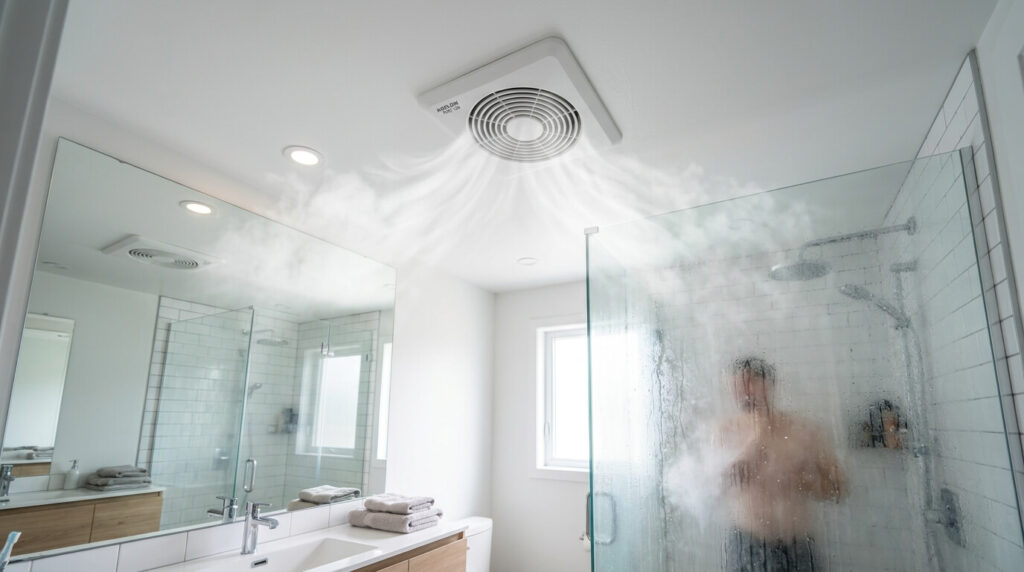
Run the fan during the shower and for a minimum of 20–30 minutes afterward — a built-in timer or a humidity-sensing model (which switches on automatically once RH crosses a set threshold) removes the guesswork. If your current fan sounds like a jet engine, look for a sone rating of 1.0 or lower; anything above 2.0 is loud enough that most people just switch it off early, which defeats the purpose.
2. Add a dehumidifier for chronic humidity
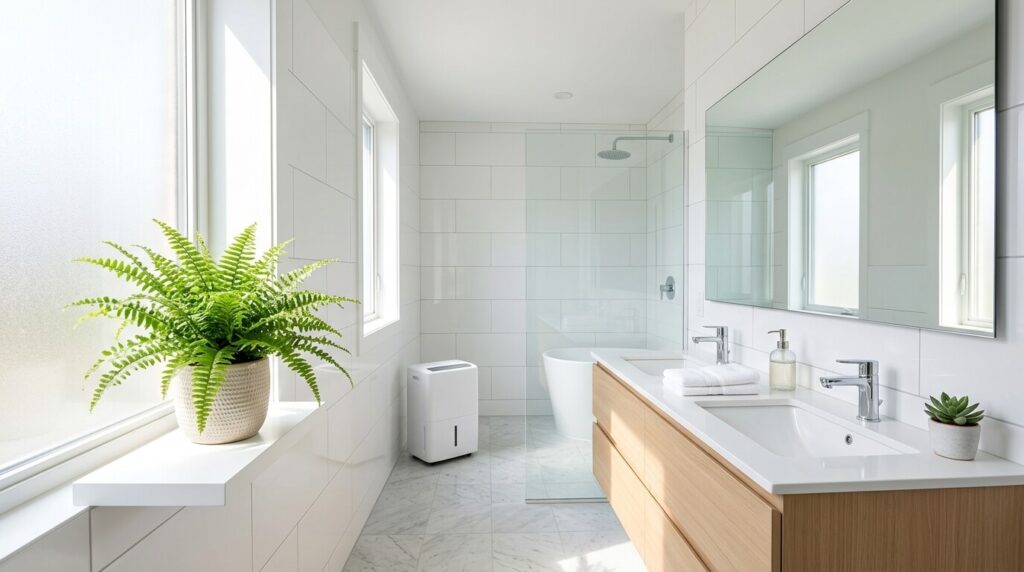
If your climate is naturally humid or the fan alone isn’t keeping the room dry between uses, a standalone dehumidifier picks up the slack. These are rated by “pints per day” — how much water they pull from the air:
- Under 30 pints/day: small or medium bathrooms with mild humidity
- 30–50 pints/day: larger bathrooms, poor ventilation, or humid coastal/southern climates
- Moisture-absorbing tubs (calcium chloride or silica gel): no electricity or noise, but only suited to small enclosed spaces like a linen closet or a powder room, and they need refilling every few weeks
Electric units need an outlet, which many bathrooms lack near a safe, non-wet location — plan the placement before buying.
3. Wipe down wet surfaces immediately
Standing water is the fastest path to mold because it keeps surface humidity at nearly 100% long after the air itself has cleared. A squeegee on glass and tile, plus a quick towel pass on the floor and windowsill, cuts drying time from hours to minutes. This single 60-second habit, done consistently, prevents more mold than almost any product on this list.
4. Crack a window or the door — with a caveat
Opening a window lets humid air escape without running electricity, but it only works if the outdoor air is actually drier than your bathroom air. In summer humidity or freezing winter conditions, this can backfire (either recirculating damp air or losing your heating). Use it as a supplement to a fan, not a replacement for one, and skip it entirely if your climate runs more humid than your bathroom.

5. Take shorter, slightly cooler showers
Water temperature drives how much vapor gets released into the air — a scalding-hot 15-minute shower generates far more moisture than a warm 5-minute one. You don’t have to switch to cold showers; dropping the temperature a few degrees and shaving a couple of minutes off makes a measurable difference in how fast the room clears.
6. Add moisture-absorbing houseplants
Certain plants — Boston fern, peace lily, English ivy, and snake plant among them — draw ambient moisture through their leaves as part of normal transpiration, and thrive in the warm, humid conditions a bathroom provides. They won’t replace mechanical ventilation, but in a well-lit bathroom they’re a low-effort assist. Skip peace lilies if you have pets or small children, since the leaves are mildly toxic if chewed.
7. Swap grout and drywall for water-resistant materials
Traditional tile grout is porous and holds moisture, which is exactly what mold needs. Seamless acrylic or laminate wall panels, non-porous solid-surface materials, and mold-resistant (green or purple) drywall board all remove the grout lines and paper facing that mold typically colonizes first. This is a bigger investment than the fixes above, but it’s the one that solves the problem at the material level instead of managing it day to day.
8. Fix condensation at the source: mirrors and windows
Demisting mirror pads (thin heating elements installed behind the glass) keep the mirror surface just warm enough that vapor never condenses on it in the first place. Anti-fog spray is a cheaper, temporary version of the same idea. If your windows fog heavily on the inside even with the fan running, single-pane glass is likely the culprit — double-glazed replacements reduce that temperature differential.
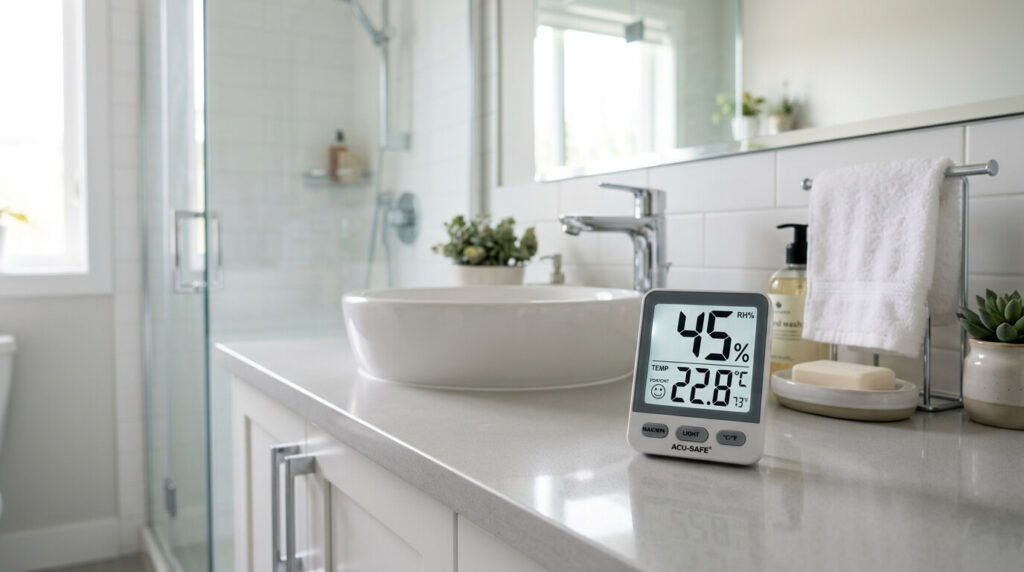
9. Track it with a hygrometer instead of guessing
A basic digital hygrometer costs about the same as a candle and tells you exactly where your bathroom sits, rather than relying on “does it smell musty yet?” Place it away from the direct shower spray, check it a few times over a week to find your baseline, and use that number to decide whether you actually need a dehumidifier or just better fan habits.
Active vs. Passive Methods: Which Should You Prioritize?
–$
| Method | Cost | Effort | Best for |
|---|---|---|---|
| Properly sized exhaust fan | $$ (one-time) | Low, automatic | Every bathroom, non-negotiable |
| Portable dehumidifier | Medium (emptying tank) | Humid climates, poor ventilation | |
| Wiping surfaces after use | Free | Low, daily habit | Every bathroom |
| Open window/door | Free | Low | Dry climates only |
| Houseplants | $ | Low | Supplementary, well-lit bathrooms |
| Water-resistant wall panels | $$$$ | High (renovation) | Chronic mold, remodel projects |
| Hygrometer | $ | Very low | Anyone unsure if they have a problem |
When to Call a Professional
Try the fixes above first. But if you’re already seeing mold covering more than roughly 10 square feet, wood that’s soft or crumbling, or a musty smell that keeps returning after cleaning, it’s time to bring in a contractor or mold remediation specialist. At that point, the moisture has likely gotten into the wall cavity or subfloor, and surface-level fixes won’t reach it.
FAQ
What is the ideal humidity level for a bathroom?
Bathrooms naturally spike above normal household humidity during use, but the goal is to return to under 60% relative humidity within 20–30 minutes and to keep the room’s baseline (when not in use) in the 40–50% range recommended by the EPA.
How long does it take for mold to grow in a humid bathroom?
Most mold species need relative humidity above 60% sustained for 24–48 hours to germinate on a damp surface, and colonies can become established within one to two weeks if the moisture isn’t addressed.
Is a dehumidifier or an exhaust fan better for a bathroom?
An exhaust fan should come first, since it removes moisture at the source during and right after showers. A dehumidifier is a supplement for bathrooms with chronic humidity — humid climates, poor ventilation, or no window — not a replacement for proper ventilation.
Do bathroom plants actually reduce humidity?
Some plants, including Boston fern and peace lily, do absorb measurable moisture from the air through their leaves and thrive in humid bathroom conditions. Their effect is modest compared to a fan or dehumidifier, so treat them as a supplementary step rather than a primary fix.
Why does my bathroom mirror stay foggy long after my shower?
A cold mirror surface causes water vapor to condense on contact, and it stays fogged until the glass warms to room temperature or the moisture is wiped away. Demisting heating pads or anti-fog spray address this directly by keeping the glass surface warm or water-repellent.
What size exhaust fan does my bathroom need?
Use 1 CFM of airflow for every square foot of floor area, with a 50 CFM minimum for any bathroom. A 70-square-foot bathroom needs roughly a 70 CFM fan; bathrooms with a separate enclosed toilet, tub, and shower should size each fixture separately at about 50 CFM apiece.
Can opening a window replace an exhaust fan?
Only in dry climates and mild weather. In humid summers or cold winters, an open window can let in air that’s just as damp as the bathroom or cause unwanted heat loss, so it works best as a supplement to mechanical ventilation rather than a substitute for it.
The Takeaway
A humid bathroom isn’t really a mystery problem — it’s a math problem. Size your fan correctly, run it long enough, dry surfaces before they sit wet, and check your actual RH number instead of guessing. Do those four things consistently and most bathrooms never develop a mold problem in the first place.