Your guest bathroom says more about your home than almost any other room. It’s the one space visitors use privately, judge silently, and remember long after the visit ends. Whether you’re refreshing a small powder room on a budget or undertaking a full guest bathroom remodel, the decisions you make — from tile selection to lighting, vanity style to guest amenities — directly impact how welcome your visitors feel.
This guide covers everything: design styles, layout planning, storage solutions, fixture choices, color palettes, lighting strategies, smart upgrades, and the finishing hospitality touches that competitors consistently overlook. By the end, you’ll have a clear, actionable blueprint to create the most impressive guest bathroom in your home.
What Is a Guest Bathroom? Definition and Purpose
A guest bathroom is a dedicated bathroom intended primarily for visitors rather than daily household use. It may be a full bath (with shower or tub), a three-quarter bath (with shower but no tub), a half bath (toilet and sink only), or a powder room (the same as a half bath, often located near living areas).
Because guests don’t use it constantly, the guest bathroom is the ideal space to take creative design risks — bold tile patterns, dramatic color palettes, statement mirrors, and luxury finishes that you might hesitate to commit to in your primary bathroom.
Types of guest bathrooms at a glance:
| Type | Features | Best For |
|---|---|---|
| Full Bath | Toilet, sink, shower, tub | Overnight guests, multi-day stays |
| Three-Quarter Bath | Toilet, sink, shower (no tub) | Most guest situations |
| Half Bath / Powder Room | Toilet and sink only | Party guests, daily visitors |
| Jack-and-Jill Bath | Shared between two bedrooms | Family guests, multi-room access |
Guest Bathroom Design Styles: Finding Your Aesthetic
Before selecting a single tile or fixture, define the design direction. Every element — color, material, texture, fixture finish — should serve a unified aesthetic.
Modern Guest Bathroom
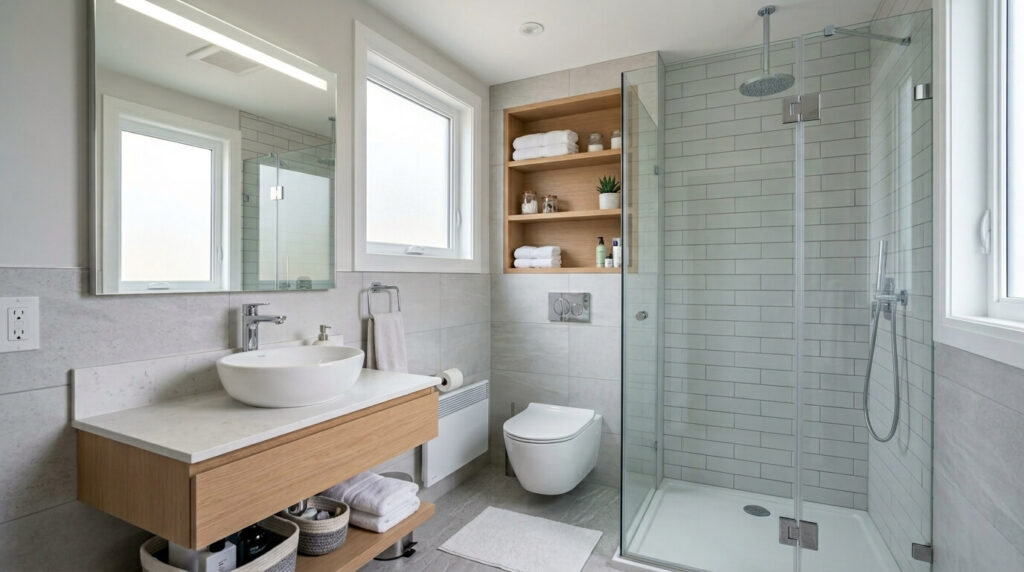
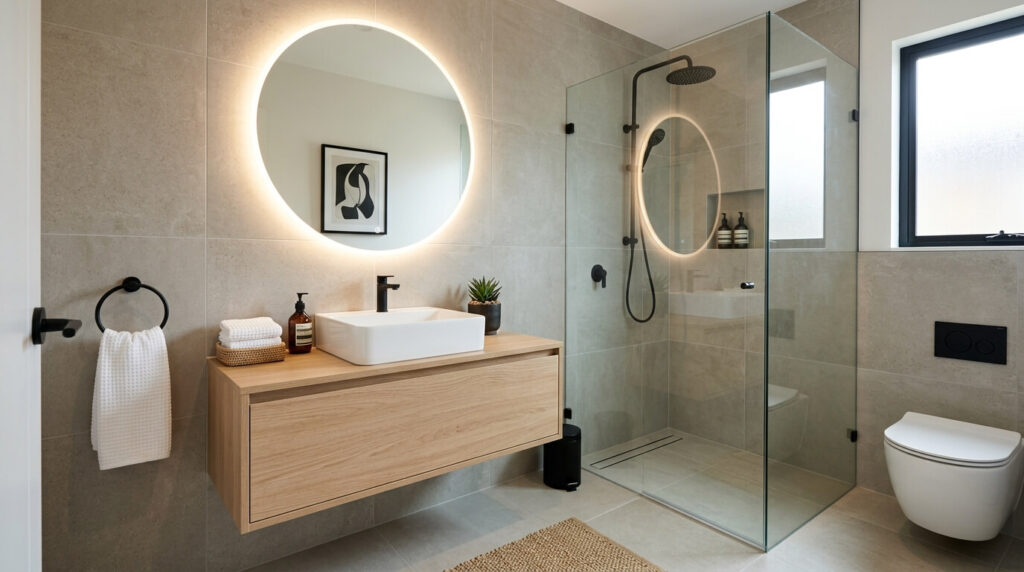
A modern guest bathroom is defined by clean lines, minimal ornamentation, and a restrained palette. Think frameless glass shower enclosures, floating vanities, integrated LED mirrors, and matte black or brushed nickel fixtures. Surfaces favor large-format porcelain tile in neutral tones. Grout lines are thin and uniform.
Key features of a modern bathroom: hidden storage, wall-mounted faucets, comfort height toilets with concealed tanks, and recessed niches instead of protruding shelving.
Best for: Contemporary homes, urban apartments, minimalist sensibilities.
Farmhouse Guest Bathroom
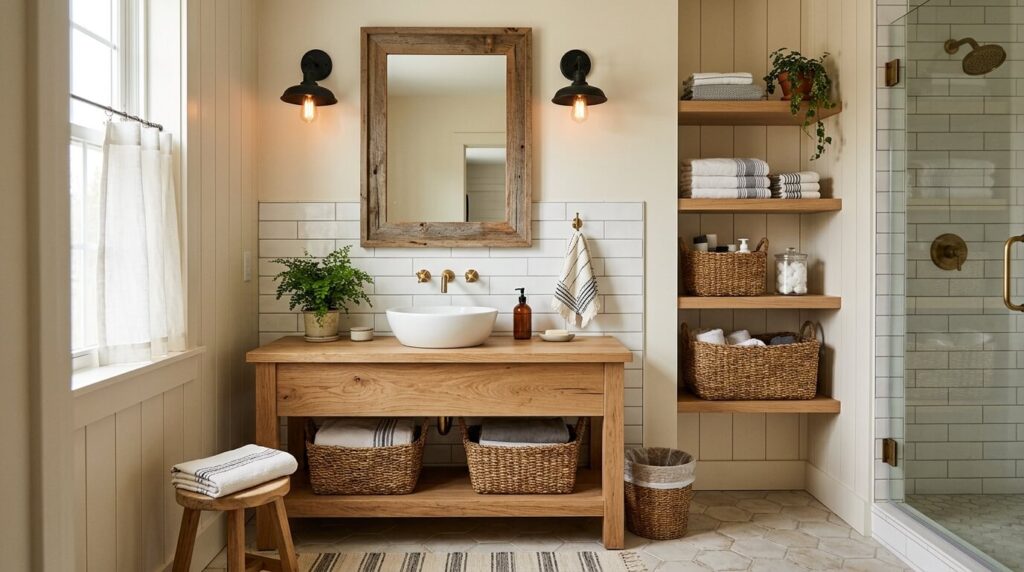
The farmhouse guest bathroom blends rustic warmth with everyday practicality. Shiplap walls, an apron-front sink, an oak vanity or wood-toned vanity, subway tile in a classic brick pattern, and matte black fixtures create an inviting, lived-in character. Open shelving with linen baskets and mason jar accessories complete the look.
Color palette: Soft whites, warm creams, sage greens, and natural wood tones.
Best for: Traditional homes, cottages, country-style interiors.
Minimalist Guest Bathroom
Minimalist design pushes restraint further than modern style. The palette is monochromatic — often all-white, all-gray, or a single earth tone. Every item earns its place. Storage is entirely concealed. Decor is near-absent: perhaps a single indoor plant or one piece of artwork. The vanity countertop is clear except for a soap dispenser.
Minimalist bathrooms rely on material quality to carry the design — marble countertops, honed stone tile, precise grout work.
Best for: Architects, design purists, guests who appreciate calm.
Luxury Guest Bathroom
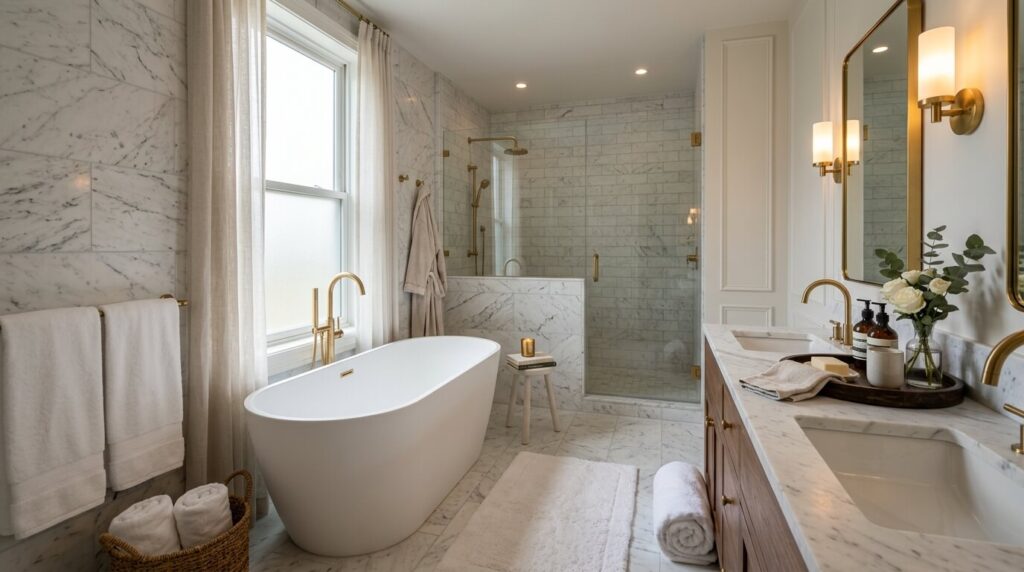
A luxury guest bathroom creates a hotel-style or spa-inspired experience. Expect a freestanding bathtub as the focal point, a walk-in shower with rainfall shower head, heated floors, marble tile or natural stone surfaces, a vessel sink on a custom vanity with quartz countertop, and layered ambient, task, and accent lighting.
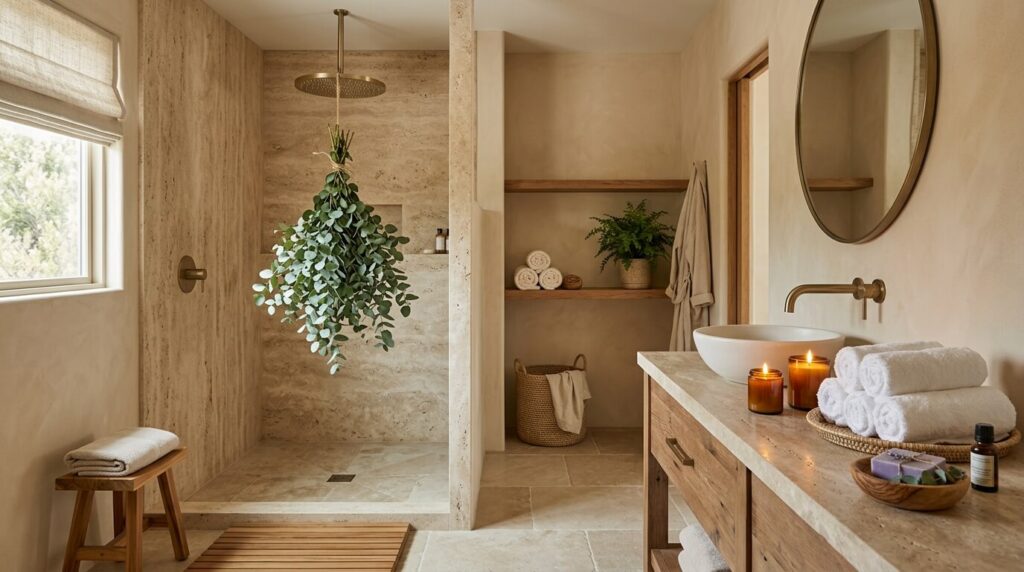
Hotel-inspired details — rolled plush towels in a basket, a decorative tray with curated amenities, a scented candle, fresh eucalyptus — elevate function to hospitality.
Best for: Homes with frequent overnight guests, vacation rentals, high-end renovation budgets.
Spa Guest Bathroom
Closely related to luxury, the spa bathroom prioritizes sensory relaxation: warm neutral color palette, natural stone or wood-look tile, soft ambient lighting with dimmers, an aromatherapy-friendly atmosphere (eucalyptus bathroom decor, candles), a deep soaking tub, and rainfall shower head. Texture plays a major role — woven baskets, linen towels, matte ceramics.
Best for: Wellness-focused homeowners, guests who travel for relaxation.
Contemporary Bathroom
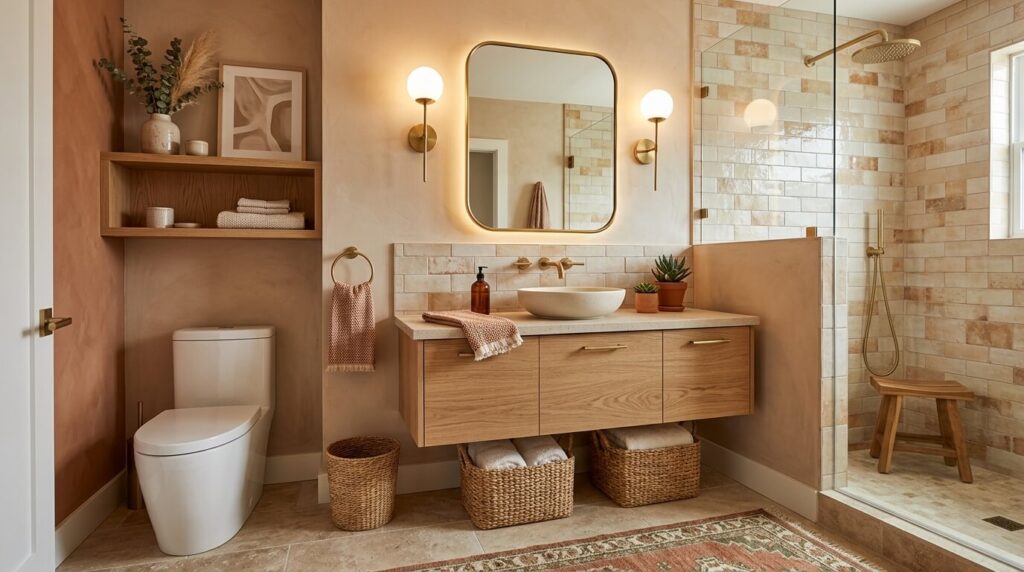
Contemporary design is fluid — it reflects current trends without being rigidly modern or traditional. In 2025, contemporary guest bathrooms blend warm wood tones with cool stone, mix metal finishes (brushed brass + matte black), use arched mirrors and curved vanities, and incorporate earthy, warm neutral palettes. It’s the most adaptable style.
Best for: Most homeowners who want a current, sophisticated look without strict rules.
Hotel-Inspired Guest Bathroom
The hotel bathroom aesthetic focuses on guest experience over personal expression. Crisp white subway tile or large-format stone tile, a simple floating vanity or pedestal sink, a generous mirror with good task lighting, white plush towels in an accessible display, a glass soap dispenser, and a well-stocked amenity tray communicate “we thought of you.” Clutter is eliminated. Every surface is easy-clean.
Guest Bathroom Layout and Floor Plan Planning
Layout decisions affect how a guest bathroom functions permanently. Getting them right before construction or remodel begins saves costly changes later.
Standard Guest Bathroom Dimensions
| Bathroom Type | Minimum Size | Comfortable Size |
|---|---|---|
| Half Bath / Powder Room | 3′ × 6′ (18 sq ft) | 4′ × 5′ (20 sq ft) |
| Three-Quarter Bath | 5′ × 7′ (35 sq ft) | 6′ × 8′ (48 sq ft) |
| Full Bath (tub + shower) | 5′ × 8′ (40 sq ft) | 6′ × 10′ (60 sq ft) |
Layout Principles for Guest Bathrooms
Clearance matters. Leave at least 21 inches of clear floor space in front of the toilet and vanity. Shower entries need a minimum 24-inch clearance. These aren’t suggestions — they’re code requirements in most jurisdictions.
Plumbing placement drives cost. Moving the toilet or shower drain significantly increases remodel costs ($500–$2,000+). If budget is a concern, design around existing rough-in locations.
Natural lighting opportunities. Position the vanity near a bathroom window when possible. Natural lighting is the most flattering light source for guests grooming. Obscure glass windows preserve privacy without sacrificing daylight.
Door swing. In small guest bathrooms, consider a pocket door or barn door to reclaim floor space lost to a swinging door.
Small Guest Bathroom Layout Tips
Small space design requires intentional planning. These strategies maximize a compact guest bathroom:
- Wall-mounted toilet (saves 6–10 inches of floor depth)
- Floating vanity (visually opens the floor plane)
- Corner shower instead of a full-size shower-tub combo
- Single sink vanity (a double vanity in a small space wastes counter surface)
- Recessed medicine cabinet (gains storage without protruding into the room)
- Large-format floor tile (reduces visual grout-line clutter, makes the room feel larger)
- Frameless glass shower enclosure (eliminates a visual barrier)
Bathroom Vanity Ideas for Guest Bathrooms
The vanity is the functional and visual anchor of any bathroom. Choosing the right style, size, material, and configuration defines the character of the space.
Floating Vanity
A floating vanity (wall-mounted, with no legs touching the floor) is one of the most impactful upgrades in a guest bathroom remodel. It creates the illusion of more floor space, simplifies cleaning, and delivers a clean, contemporary look. Heights can be customized between 32–36 inches to suit your guests.
Best pairing: Vessel sink, wall-mounted faucet, large-format floor tile.
Custom Vanity vs. Stock Vanity
| Factor | Custom Vanity | Stock Vanity |
|---|---|---|
| Cost | $800–$5,000+ | $150–$800 |
| Lead Time | 4–12 weeks | 1–3 days |
| Size Options | Any dimension | Standard sizes only |
| Style Flexibility | Unlimited | Limited |
| Best For | Remodel with specific dimensions | Quick refresh |
Vanity Materials: Oak, Wood-Tone, and Painted
Oak vanity (or white oak, natural wood) is trending strongly in 2025. Wood tones add warmth and organic texture that painted vanities lack. Seal the wood properly to withstand bathroom humidity.
Painted vanities in navy, sage green, charcoal, or classic white are timeless and easier to clean.
Countertop Choices
Quartz countertop: Non-porous, stain-resistant, extremely durable, available in marble-look patterns. Best choice for guest bathrooms that see heavy use.
Marble countertop: Stunning but requires regular sealing and is vulnerable to etching from acidic products. Best reserved for light-use guest bathrooms where appearance trumps durability.
Solid surface (e.g., Corian): Seamless, easy-clean, modest price point. Good choice for a hotel-inspired or minimalist look.
Sink Types
Undermount sink: Installed below the countertop for a seamless look. Easy to wipe countertop clean. Most popular choice for guest bathrooms.
Vessel sink: Sits above the countertop like a bowl. Makes a design statement. Requires a taller vanity or lower counter height to work ergonomically.
Pedestal sink: Freestanding, space-saving. Classic aesthetic but minimal storage. Best in powder rooms or small half baths.
Wall-mounted sink: Space-saving. Works well in minimalist or contemporary designs.
Bathroom Tile Ideas: Walls, Floors, and Showers
Tile is the single most impactful design choice in a guest bathroom renovation. It sets color, texture, pattern, and style for the entire room.
Floor Tile Options
Porcelain tile: Dense, low-absorption, frost-resistant. The most practical and durable choice for bathroom floors. Available in virtually every aesthetic — natural stone looks, concrete looks, wood-look planks.
Ceramic tile: Slightly softer than porcelain, easier to cut, lower cost. Excellent for guest bathroom walls and lower-traffic floors.
Marble tile: Luxurious and timeless. Requires sealing; cold underfoot without radiant heat. Ideal for luxury guest bathrooms.
Mosaic tile: Small-format tiles (typically on a mesh sheet) used for shower floors (the texture provides natural slip resistance), feature walls, or niches. Creates intricate patterns.
Luxury vinyl flooring (LVP): Waterproof, warm underfoot, easy DIY installation. Not suitable for wet shower floors but excellent for the main bathroom floor in a guest bath. Best budget-friendly option.
Natural stone: Travertine, slate, limestone — each brings unique texture and warmth. Requires sealing and specific cleaning products.
Wall Tile Strategies
Subway tile remains the most versatile and timeless wall tile choice. Classic 3×6-inch white subway tile in a brick pattern suits farmhouse, modern, and transitional aesthetics equally. For an elevated look, try a herringbone layout or a colored grout.
Large-format wall tile (24×48 inches or larger) minimizes grout lines and makes a small bathroom feel taller and larger. Best for modern and contemporary designs.
Marble tile on walls — particularly in a feature wall behind the vanity or in the shower — creates an instantly luxurious impression.
Mosaic tile accent wall: Use a mosaic pattern as a single feature wall in the shower or behind the vanity. It’s a contained, high-impact statement.
Shower Tile Design
The shower is the most intensive tile area in a full guest bathroom. Consider these elements:
Shower niche: A recessed shelf built into the shower wall. Essential for storing shampoo, conditioner, and body wash without cluttering the floor. Plan tile layout so the niche is centered within a tile row.
Shower floor: Use a small-format tile (2×2-inch mosaic is most common) for the required slip resistance. Alternatively, a pebble mosaic creates a natural spa-like texture.
Grout color: Light grout reads clean and open. Dark grout (charcoal, black) conceals staining and creates bold contrast with light tile.
Bathroom Lighting Ideas: Layered Lighting Strategy
Lighting is one of the most underdiscussed elements in guest bathroom design. A single overhead light is never sufficient. A thoughtful layered lighting plan makes the bathroom look better, feel larger, and be more functional.
The Three Layers of Bathroom Lighting
1. Ambient lighting provides overall illumination. Recessed ceiling lights, a central flush-mount fixture, or a decorative pendant lighting piece serves this function. Use dimmable bulbs to allow guests to adjust intensity.
2. Task lighting directly illuminates the vanity mirror for grooming. Vanity lighting flanking both sides of the mirror (wall sconces at eye level, approximately 60–65 inches from the floor) delivers the most shadow-free, flattering light. An LED mirror with built-in lighting is an excellent alternative in a small space.
3. Accent lighting highlights architectural features or decor — under-cabinet LED strips, a backlit niche in the shower, or a chandelier in a larger guest bath.
Mirror and Lighting Combinations
| Mirror Type | Best Lighting Pairing |
|---|---|
| Large rectangular mirror | Side-mounted wall sconces |
| Round mirror | Pendant lighting above or integrated LED halo |
| Arched mirror | Single overhead bar light + ambient |
| LED mirror | Self-contained (no additional task lighting needed) |
| Framed mirror | Side sconces to complement the frame |
Natural Lighting
A bathroom window — particularly a frosted or obscure-glass casement — dramatically improves the atmosphere of a guest bathroom. North-facing windows provide consistent, cool daylight. South-facing windows bring warmer afternoon light. Skylights are the highest-impact natural light option for interior bathrooms.
If a window isn’t possible, a sun tunnel (tubular skylight) can route daylight into windowless interior bathrooms.
Shower and Bath Options for Guest Bathrooms
Frameless Shower vs. Framed Shower
| Feature | Frameless Shower | Framed Shower |
|---|---|---|
| Appearance | Clean, modern, open | More traditional |
| Cost | $800–$2,500+ | $200–$600 |
| Cleaning | Easier (no metal frame to scrub) | More grout/frame to clean |
| Best For | Modern, contemporary, luxury | Budget renovations |
Walk-In Shower
A walk-in shower with a low or zero-threshold entry is the most versatile shower design. It works for guests of all ages and mobility levels. A curbless entry also makes the space feel larger and is a key feature in spa bathroom and accessible design.
Rainfall Shower Head
A rainfall shower head — ceiling-mounted or extended on an arm — is the signature fixture of a luxury and spa guest bathroom. It creates a full-body drenching experience distinctly different from a standard wall-mounted head. Pair it with a handheld shower head for flexibility.
Freestanding Bathtub
If the guest bathroom has the square footage, a freestanding bathtub becomes the room’s focal point and a signature luxury feature. Position it under a window, centered on a tile feature wall, or as a room divider. Slipper tubs, oval soaking tubs, and clawfoot tubs each carry a different aesthetic.
Soaking tub vs. jetted tub for guests: A soaking tub is lower-maintenance (no jet mechanism to clean) and equally relaxing. Jetted tubs require regular internal cleaning to prevent biofilm buildup — a legitimate concern in a guest context.
Guest Bathroom Storage Solutions
Adequate storage is the difference between a guest bathroom that feels welcoming and one that feels cluttered or underprepared.
Built-In Storage Options
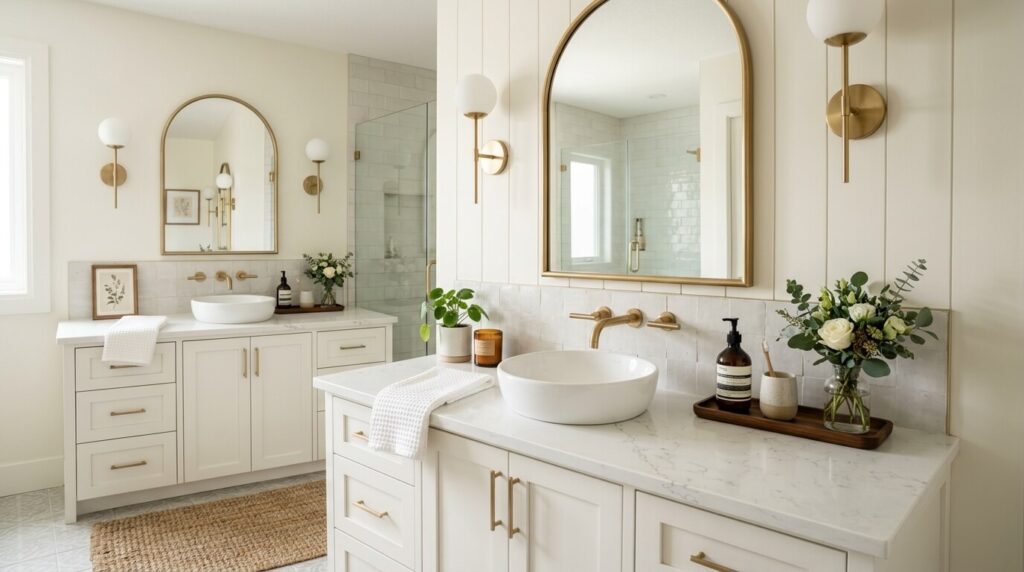
Recessed niche: Built into the wall cavity between studs. Zero floor or counter footprint. Ideal in showers (for toiletries) and above the toilet (for extra supplies).
Medicine cabinet: A recessed medicine cabinet behind the mirror is the most space-efficient storage solution in a small guest bathroom. Modern medicine cabinets have built-in lighting and full-length mirrored doors.
Linen cabinet: A floor-to-ceiling linen cabinet stores extra towels, toilet paper, and supplies. If space allows, a built-in linen cabinet flanking the vanity creates a custom, furniture-like appearance.
Built-in shelving: Open shelves on either side of the vanity or above the toilet provide both storage and display space.
Freestanding Storage
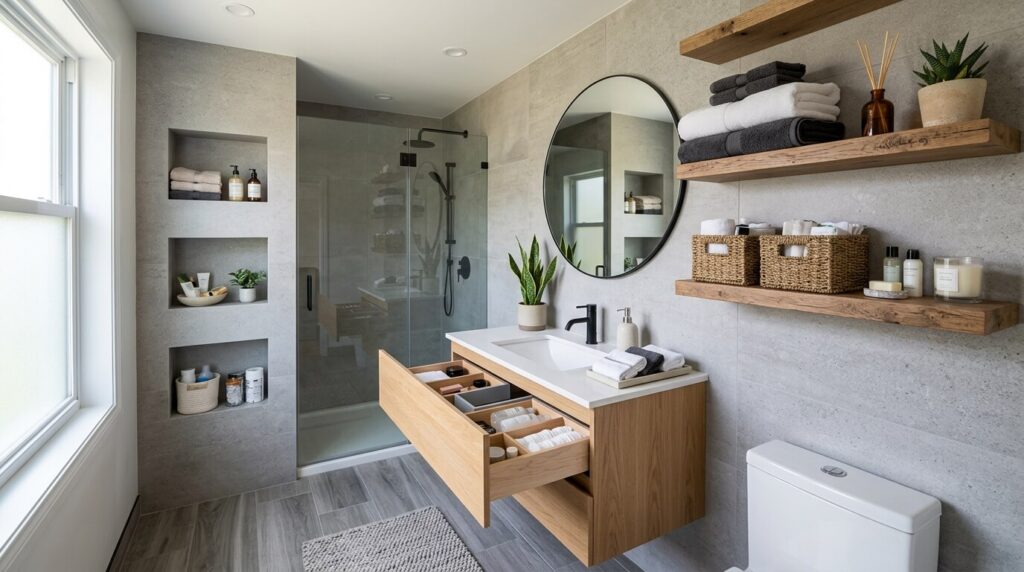
Floating shelves: Wall-mounted wood or metal shelves are simple, inexpensive, and adaptable. Use them above the toilet or beside the vanity for decorative items and essentials.
Storage baskets: Woven seagrass or rattan storage baskets on open shelves give a guest bathroom a relaxed, organic texture while concealing toilet paper rolls, washcloths, and travel amenities.
Towel storage: Options include towel bars (traditional, hidden mounting), towel rings, ladder-style towel racks (freestanding, adds farmhouse or contemporary character), and heated towel bars (a luxury upgrade that also improves towel drying).
Over-toilet etagere: A freestanding unit that straddles the toilet and adds 2–3 shelves of storage. Easy to add without any wall work — ideal for renters or budget makeovers.
Linen Storage Strategy for Guests
A common oversight in guest bathrooms: guests don’t know where to find extra towels. Solve this with visible linen storage — a basket on the counter with a rolled hand towel, a small shelf with folded towels, or a labeled basket on the floor. Make accessibility obvious and intuitive.
Bathroom Color Schemes and Paint Colors
Color defines mood more quickly than any other design element. Guest bathrooms respond especially well to intentional color decisions because the space is small enough that one bold choice transforms the entire room.
Neutral Color Palette
The safe, timeless choice. White bathroom walls with warm wood accents, gray tile with chrome fixtures, or a beige bathroom with brass hardware — neutral palettes photograph well, appeal to a wide range of guests, and pair with any towel color.
Best neutral combinations:
- Warm white walls + oak vanity + unlacquered brass fixtures
- Light gray large-format tile + white subway tile + chrome fixtures
- Soft greige walls + dark charcoal grout + matte black fixtures
White Bathroom
An all-white guest bathroom reads as clean, crisp, and hotel-like. To prevent it feeling sterile, layer texture: white subway tile, white beadboard, white marble countertop, white oak vanity — each white is a slightly different shade, and the contrast between textures adds depth.
Gray Bathroom
A gray bathroom is the most popular choice for contemporary guest bathrooms. Warm gray (with brown undertones) feels more inviting than cool gray (blue or green undertones). Charcoal gray as an accent wall paired with white fixtures creates high contrast drama.
Earth Tone Bathroom
In 2024–2025, earth tone bathrooms — terracotta, warm caramel, clay, sand, and mushroom — have become the dominant design trend. These warm, organic palettes feel grounded and spa-like simultaneously. Pair with brass or unlacquered brass fixtures and natural stone tile.
Bold Accent Colors
The guest bathroom is the ideal room for a bold color experiment. Deep navy, forest green, dusty rose, or matte black — a guest bathroom’s smaller footprint makes a bold color feel rich rather than overwhelming. Use bold color on all walls or as a single feature wall.
Fixtures and Hardware: Finish Guide
Fixture finishes set the metal tone for the entire guest bathroom. Consistency across faucet, towel bar, toilet paper holder, shower head, and mirror frame creates a polished, intentional look.
Popular Fixture Finishes
| Finish | Aesthetic | Maintenance |
|---|---|---|
| Matte black fixtures | Bold, modern, contemporary | Low — doesn’t show water spots |
| Brushed brass / gold fixtures | Warm, luxurious, current | Medium — avoid harsh cleaners |
| Polished chrome fixtures | Classic, bright, clean | High — shows every water spot |
| Brushed nickel | Versatile, understated | Low to medium |
| Oil-rubbed bronze | Rustic, traditional | Low |
| Unlacquered brass | Living finish, antique look | Develops patina over time |
Mixing Metal Finishes
Mixing two metal finishes (e.g., matte black fixtures + brushed brass mirror frame) is accepted and even encouraged in contemporary design. The rule: use one finish for functional hardware (faucet, towel bars, toilet paper holder) and a second for decorative elements (mirror, light fixture). Avoid three or more finishes — it reads chaotic.
Comfort Height Toilet
Standard toilet height is 15–17 inches. A comfort height toilet sits at 17–19 inches — closer to a standard chair height. It’s significantly more comfortable for adults and guests with mobility limitations. In a guest bathroom used by people of varying ages, comfort height is the more hospitable choice.
Wall-Mounted Faucet
A wall-mounted faucet above a vessel sink or floating counter creates a striking, high-end look while keeping the countertop completely clear. Requires rough-in plumbing in the wall rather than the counter — plan this during a remodel phase rather than a cosmetic refresh.
Mirrors for Guest Bathrooms
The mirror is both functional and decorative — one of the most visible elements in the guest bathroom.
Mirror Types and Their Best Contexts
Statement mirror: An oversized mirror — edge-to-edge above a double vanity, or dramatically large above a single sink — amplifies light, makes the room feel larger, and functions as art.
Round mirror: Soft, friendly, and versatile. Works in farmhouse, contemporary, boho, and minimalist aesthetics. Pairs naturally with a single-sink vanity.
Arched mirror: One of the strongest 2024–2025 design trends. The curved top adds architectural interest. Works in virtually every design style.
Framed mirror: A frame adds definition and can reinforce the room’s style (black frame for modern, wood frame for farmhouse, gold frame for glam or vintage).
LED mirror: Combines mirror and task lighting in a single slim fixture. Particularly valuable in small guest bathrooms where there’s no room for side sconces.
Guest Bathroom Decor and Styling
Once the bones of the bathroom are in place, decor and styling transform a functional space into a memorable experience.
Bathroom Artwork and Wall Decor
Art in the guest bathroom is both unexpected and impactful. Use moisture-resistant frames (acrylic frames or sealed wood) and mount artwork away from direct water spray. Botanical prints, abstract color studies, architectural photography, and simple line art all work well. A single oversized piece creates more impact than a gallery wall in a small bathroom.
Indoor Plants and Greenery
Indoor plants in guest bathrooms add life, color, and humidity-filtering benefits. Best plant choices for bathroom conditions (high humidity, variable light):
- Pothos — tolerant of low light, trailing habit works on shelves
- Snake plant (Sansevieria) — nearly indestructible, thrives in low light
- Peace lily — elegant white blooms, loves humidity
- Air plants (Tillandsia) — no soil required, can be displayed in glass globes or on driftwood
- Ferns — lush and tropical-looking, need consistent moisture
Eucalyptus bathroom decor (a bundle of fresh or dried eucalyptus hung from the shower head) releases a pleasant natural fragrance when steam activates the essential oils. It’s one of the most cost-effective luxury touches for a guest bathroom.
Candles and Scent
A scented candle on the vanity counter (in a fire-safe location, away from towels and curtains) adds warmth and fragrance. Choose a subtle, universally appealing scent — white tea, linen, eucalyptus, or light citrus. Avoid heavily perfumed scents that may conflict with guests’ sensitivities.
Decorative Tray
A decorative tray (marble, brass, wood, or ceramic) on the vanity countertop corrals guest amenities — a soap dispenser, lotion, a small candle — and prevents them from looking randomly scattered. It’s a small organizational tool that has an outsized visual effect.
Soap Dispenser and Bathroom Accessories
Replace plastic pump dispensers with ceramic, glass, or stone soap dispensers. The upgrade costs $10–$30 and immediately elevates the bathroom’s aesthetic. Match the dispenser material or color to other accessories (toothbrush holder, cotton ball jar, small tray) for a coordinated look.
Guest Bathroom Essentials Checklist
This is the section that separates a comfortable guest bathroom from an exceptional one — the hospitality layer. Competitors consistently underdeliver on this aspect.
Non-Negotiable Basics
- Toilet paper (minimum 2–3 spare rolls visible or accessible)
- Hand soap (liquid or bar)
- Hand towels (minimum 2, freshly laundered)
- Bath towels (if a shower is present — 1 per expected guest)
- Washcloths
- Waste bin with liner
- Functional mirror with adequate lighting
Elevated Guest Amenities (Hotel-Style)
- Travel-sized toiletries: shampoo, conditioner, body wash
- Facial soap or gentle cleanser
- Toothpaste (travel size)
- Disposable toothbrush (individually wrapped)
- Cotton swabs (Q-tips) in a small jar or box
- Cotton balls
- Makeup remover wipes or remover pads
- Feminine hygiene products (discreetly stored)
- Hair dryer (mounted to wall or stored in a basket)
- Small mirror for magnified makeup application
- Lotion (unscented or lightly scented)
- Nail file
Thoughtful Details That Make an Impression
- A note welcoming guests to the bathroom (particularly for vacation rentals or multi-day guests)
- Fresh flowers or a small plant
- A scented candle (with matches)
- Eucalyptus bundle in the shower
- Rolled plush towels in a basket on the counter or floor
- Nightlight (for middle-of-the-night use)
- A small Bluetooth speaker (for longer-stay guests)
Bathroom Ventilation: The Most Overlooked Guest Bathroom Feature
Every competitor article we analyzed missed this entirely. Bathroom ventilation is not decorative — but it’s functionally critical.
An exhaust fan in the guest bathroom serves three purposes: it removes humidity (preventing mold and mildew on tile grout and walls), eliminates odors, and protects paint and cabinetry from moisture damage.
What to look for in a bathroom exhaust fan:
- CFM rating: The fan should move at least 1 CFM per square foot of bathroom area. A 50-square-foot bathroom needs a minimum 50 CFM fan.
- Sone rating: Quieter fans (under 1.0 sones) are strongly preferred for guest use. Nobody wants to announce their bathroom visit with a loud fan.
- Humidity sensor: A fan with a built-in humidity sensor automatically activates when moisture levels rise — ensuring the bathroom ventilates even if a guest forgets to turn it on manually.
- Combined light/fan units: In a small guest bathroom, a combined light-exhaust fixture simplifies the ceiling and reduces electrical work.
ASHRAE standard 62.2 recommends guest bathrooms ventilate at a rate of 50 CFM intermittently or 20 CFM continuously.
Easy-Clean Surfaces and Low-Maintenance Design
Guest bathrooms see irregular use — sometimes daily, sometimes weeks without use. Easy-to-maintain surfaces reduce upkeep without sacrificing style.
Best easy-clean surface choices:
- Large-format porcelain tile (fewer grout lines = less grout to clean)
- Quartz countertop (non-porous, no sealing required)
- Solid surface (Corian-style) sink/countertop (seamless, no crevices)
- Matte or satin paint finish (more washable than flat; less glare than gloss)
- Frameless glass shower (no metal frame to scrub; squeegee after each use)
- Wall-mounted toilet (floor-to-wall clearance makes mopping easy)
- Touchless faucet (reduces fingerprints and mineral buildup on handles)
Grout sealing: Seal tile grout at installation and annually thereafter. Sealed grout resists staining and reduces the effort of cleaning dramatically.
Guest Bathroom Remodel: Planning, Timeline, and Budget
Remodel Scope Categories
Cosmetic refresh ($500–$2,000): Paint, new hardware, new mirror, new light fixture, new towel bars, re-caulk tub/shower, new accessories. No construction required. Can be completed in a weekend.
Mid-level renovation ($3,000–$10,000): New vanity and countertop, new toilet, new tile (in a contained area), new shower fixtures, new lighting. May require a plumber and electrician for 1–2 days each.
Full remodel ($10,000–$25,000+): Gut to studs, new layout, all new tile, custom vanity, frameless shower enclosure, new plumbing, new electrical. Typical timeline: 4–8 weeks.
Guest Bathroom Renovation Timeline
| Phase | Duration |
|---|---|
| Design and planning | 2–4 weeks |
| Permit (if required) | 1–4 weeks |
| Demolition | 1–2 days |
| Rough-in plumbing/electrical | 2–3 days |
| Tile installation | 3–5 days |
| Vanity and fixture installation | 1–2 days |
| Painting and finishing | 1–2 days |
| Punch-list and cleanup | 1 day |
| Total (full remodel) | 4–8 weeks |
Budget Guest Bathroom Makeover Tips
A guest bathroom makeover doesn’t require demolition. These high-impact, low-cost upgrades transform a dated space:
- Paint the walls — $30–$80 for a gallon of quality paint. The single highest ROI upgrade.
- Replace the vanity light fixture — $50–$200 for a dramatically updated look.
- Swap hardware and accessories — New towel bars, toilet paper holder, and drawer pulls ($50–$150 total) modernize a dated bathroom immediately.
- Install a new mirror — An arched or round statement mirror ($80–$300) transforms the vanity area.
- Re-caulk the tub and shower — $10–$20 in materials; makes an older bathroom look dramatically cleaner.
- Add a peel-and-stick tile backsplash — Renter-friendly, no-adhesive option for a quick pattern update.
- Refinish the bathtub — If the tub is in good structural condition but the surface is stained or dated, professional refinishing costs $300–$600 vs. $1,000+ for replacement.
Bathroom Trends for Guest Bathrooms
Understanding current bathroom design trends prevents a renovation that feels dated within two years.
Top guest bathroom trends:
- Warm, earthy palettes replacing cool grays — Terracotta, warm sand, clay, and caramel are replacing the gray-dominated aesthetic of the 2010s.
- Arched and curved forms — Arched mirrors, curved vanities, rounded shower niches.
- Unlacquered and warm brass fixtures — Moving away from polished chrome and even matte black toward the warmth of aged or brushed brass.
- Mixed material vanities — Combining stone countertops with wood or fluted wood fronts.
- Fluted tile and fluted cabinetry — Vertical reeded texture adds dimension without pattern.
- Large-format stone-look porcelain — 24×48-inch and 36×36-inch tiles minimizing grout lines.
- Statement ceilings — Paint, wallpaper, or tile extended to the ceiling as a fifth design surface.
- Built-in niches beyond the shower — Recessed display niches in bathroom walls for art and plants.
- Integrated LED mirrors replacing separate lighting — Cleaner, more functional.
- Biophilic elements — Natural stone, real wood, live plants, and organic shapes.
Timeless bathroom design elements (invest here for long-term value): subway tile, marble or marble-look surfaces, white or neutral color palette, frameless shower, quality chrome or brass fixtures.
Comparison: Guest Bathroom vs. Primary Bathroom Design Priorities
| Factor | Guest Bathroom | Primary Bathroom |
|---|---|---|
| Design risk | Higher — great place to experiment | More conservative (daily use) |
| Storage | Focus on guest-accessible items | Deep personal storage |
| Maintenance | Easy-clean surfaces critical | Personal preference |
| Lighting | Generous task lighting for guests | Personal preference |
| Amenities | Hotel-style stocking | Personal products only |
| Budget allocation | Can achieve impact with less | Worth investing more |
FAQ: Guest Bathroom Ideas
1. What should I include in a guest bathroom?
At minimum: toilet paper (plus extras), hand soap, hand towels, a waste bin, and adequate lighting. For overnight guests, add bath towels, shampoo, conditioner, body wash, and a small tray of extra amenities like cotton swabs, cotton balls, and a disposable toothbrush.
2. How do I make a small guest bathroom feel larger?
Use large-format tile (fewer grout lines), a floating vanity (opens floor space), a frameless glass shower, a large or full-width mirror, and light wall colors. Eliminate clutter completely — a small space reads as cramped only when it’s overcrowded.
3. What is the best tile for a guest bathroom?
Porcelain tile is the best all-around choice for durability, water resistance, and aesthetic range. Subway tile for walls is the most versatile. Large-format porcelain for floors minimizes grout cleaning. Marble tile is most luxurious but requires maintenance.
4. What color should I paint a guest bathroom?
Neutral colors (soft white, warm gray, light beige) are the safest and most universally appealing. If you want drama, deep navy, forest green, or terracotta work beautifully in small spaces. The guest bathroom is the ideal room to use a bold color you’d hesitate to commit to elsewhere.
5. How much does a guest bathroom remodel cost?
A cosmetic refresh costs $500–$2,000. A mid-level renovation (new vanity, tile, toilet, fixtures) runs $3,000–$10,000. A full gut remodel costs $10,000–$25,000+. Costs vary significantly by region and material selection.
6. Should a guest bathroom have a tub or shower?
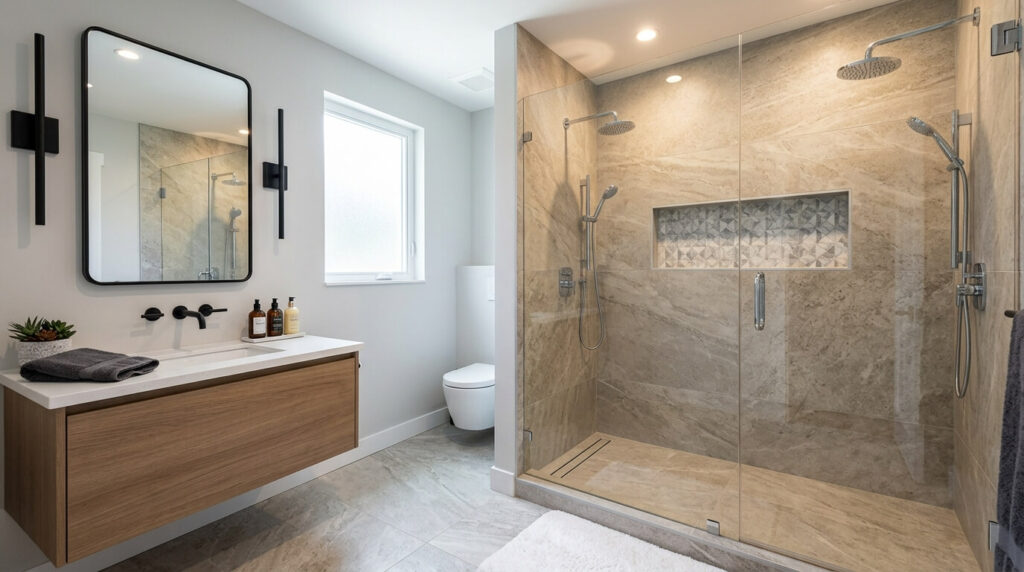
A walk-in shower is more practical for most guest situations and takes less space. A freestanding soaking tub adds luxury and a design focal point if the room has adequate square footage (at least 60 sq ft for a tub + separate shower). If space allows only one, choose a well-designed shower over a tub.
7. What type of lighting is best for a guest bathroom vanity?
Side-mounted wall sconces at eye level (60–65 inches from the floor) on either side of the mirror provide the most shadow-free, flattering task lighting. An LED mirror with built-in lighting is an excellent alternative in a compact space.
8. What is a powder room vs. a guest bathroom?
A powder room (also called a half bath) contains only a toilet and sink — no shower or tub. A guest bathroom typically refers to a full or three-quarter bath with a shower. Both serve guests; the distinction is whether bathing facilities are included.
9. How do I make a guest bathroom feel like a hotel?
Focus on clean surfaces, well-placed task lighting, rolled or neatly folded white or neutral towels, a curated amenity tray with travel-size toiletries, a soap dispenser, and a fresh scent (candle or eucalyptus). Remove all personal items. The hotel aesthetic is defined by prepared cleanliness and thoughtful stocking.
10. What exhaust fan is best for a guest bathroom?
Choose a fan rated for at least 1 CFM per square foot (50 CFM minimum for most guest baths), with a noise rating under 1.0 sones. A humidity-sensing exhaust fan is the best investment — it runs automatically when moisture is detected and shuts off when the air clears, protecting the space even when guests are unfamiliar with the fan switch.
11. What is the best vanity for a small guest bathroom?
A floating (wall-mounted) vanity with a single sink and an undermount or vessel sink is ideal for small guest bathrooms. It maximizes visual floor space, allows for easy cleaning, and can be installed at a custom height. Pair with a recessed medicine cabinet to maximize storage without adding depth.
12. How do I add storage to a guest bathroom without remodeling?
Add floating shelves above the toilet, a freestanding over-toilet etagere, woven storage baskets on any available surface, a ladder towel rack (freestanding), and hooks on the back of the door. All of these require no plumbing or construction.
13. Should I use real plants or artificial plants in a guest bathroom?
Real plants (pothos, snake plants, air plants) add authenticity and air-purifying benefits. If the bathroom lacks natural light or you prefer zero maintenance, high-quality artificial plants are a perfectly respectable alternative. The goal is visual warmth — either achieves it.
14. What are the best low-maintenance surfaces for a guest bathroom?
Quartz countertops, large-format porcelain tile, and sealed grout require the least maintenance. Avoid polished marble in a high-traffic guest bathroom (etches and stains easily) and unsealed natural stone.
15. How do I improve bathroom ventilation in a guest bathroom?
Replace an aging or undersized exhaust fan with a new unit rated for the room’s square footage. Choose a fan with a built-in humidity sensor for automatic operation. Ensure the fan exhausts to the exterior (not into an attic or wall cavity, which is a code violation). If your guest bathroom has a window, keep it operational for supplemental ventilation.